
Detailed Guide on Top 15 Maintenance Management Certifications in the US (2026)
The best maintenance certifications in the US for 2026 include CMRP for maintenance managers, CRE for reliability engineers, PMP for shutdown leaders, ISO 55001 for asset governance, and CMRT for technicians. The right certification depends on responsibility level and industry exposure.
Walk through enough industrial plants and you start to notice a pattern.
The difference between stable operations and constant firefighting rarely comes down to effort. Most maintenance teams work hard. The difference is structure – how work is planned, how assets are prioritized, how data is interpreted, and how leadership thinks about reliability.
Maintenance leadership today is no longer measured by how quickly a breakdown is repaired. It is measured by how rarely breakdowns occur, how predictable operations become, and how effectively assets protect revenue.
Unplanned downtime is not just an operational inconvenience – it is a financial liability. Siemens’ True Cost of Downtime 2024 report estimates that the world’s 500 largest companies lose nearly $1.4 trillion annually to unplanned downtime, roughly 11% of revenue. For large industrial facilities, losses can average hundreds of millions of dollars per year.
Maintenance roles are also expanding as industries invest in reliability and automation. According to the U.S. Bureau of Labor Statistics, employment for industrial maintenance professionals continues to grow as manufacturers modernize operations and asset reliability programs.
In that environment, maintenance management becomes strategic. And certifications are not résumé ornaments – they are structured signals that you understand reliability frameworks, work management discipline, and asset governance.
This guide breaks down the top 15 maintenance management certifications in the United States, covering:
- Leadership and reliability credentials
- Asset management frameworks
- Technical and compliance programs
- Digital and analytics certifications shaping modern maintenance
It is deliberately broader than facilities-only certifications. Whether you are a plant maintenance manager, reliability engineer, multi-site director, or operations leader, this roadmap is designed to help you choose credentials that align with real-world responsibility – not just titles.
What Are Maintenance Certifications?
Maintenance certifications are professional credentials that validate structured knowledge in equipment reliability, preventive maintenance, asset lifecycle management, safety compliance, and maintenance leadership.
In the United States, these certifications are issued by professional bodies such as:
- Society for Maintenance & Reliability Professionals (SMRP)
- American Society for Quality (ASQ)
- Project Management Institute (PMI)
- Association of Asset Management Professionals (AMP)
They serve as formal recognition that a professional understands standardized maintenance frameworks aligned with industry best practices.
Why Maintenance Certifications Matter in 2026
The maintenance profession has evolved in five critical ways:
- From reactive to predictive
- From manual logs to CMMS-driven execution
- From cost center to revenue protector
- From siloed sites to multi-location portfolios
- From mechanical skill to data-informed leadership
Certifications matter because they:
- Standardize terminology and frameworks
- Improve cross-functional credibility
- Align professionals with industry-recognized best practices
- Accelerate leadership mobility
However, not all certifications carry equal weight. Some validate technician competency. Others validate enterprise reliability thinking.
Below, we break down each major certification with:
- Who it is for
- What it covers
- Approximate cost
- Renewal requirements
- Strategic career value
Track 1: Maintenance Leadership & Reliability Certifications
These are the certifications that show up most often when maintenance shifts from reactive firefighting to structured performance management.
In my experience across CMMS implementations, the difference between chaotic and disciplined operations is rarely effort. It’s structure. And the leaders who pursue certifications in this track usually care about structure.
1. Certified Maintenance & Reliability Professional (CMRP)
Issuing Organization: SMRP
Official Program: https://smrp.org/Certification/CMRP-Certification
Cost: $300–$470
Renewal: Every 3 years
CMRP is the closest thing the maintenance industry has to a baseline leadership credential.
It doesn’t test how well you replace bearings. It tests whether you understand:
- Work management discipline
- Preventive strategy design
- Inventory governance
- KPI interpretation
- Reliability integration
In plants where I’ve seen backlog under control and preventive schedules respected, the maintenance leader often thinks in CMRP-aligned frameworks – whether certified or not.
CMRP works best for:
- Maintenance managers
- Reliability engineers
- Supervisors preparing for leadership
- Multi-site coordinators
Contrarian reality:
If you’re early in your career and haven’t yet struggled through real planning failures or reactive overload, CMRP may feel conceptual. Its value compounds when you’ve lived through operational friction.
For director-level aspirations, it often becomes a credibility anchor.
Applied Example: When Structure Replaced Chaos
In one regional manufacturing group I worked with, the maintenance department wasn’t underperforming because of lack of effort – it was drowning in reactivity. Preventive tasks were scheduled, but planners were constantly interrupting technicians for breakdowns. Backlog hovered above 2,500 work orders. Inventory accuracy was inconsistent. PM compliance reports looked acceptable on paper but hid a growing reactive culture.
The turning point wasn’t a new tool. It was leadership alignment around structured work management principles – the same ones embedded in the CMRP Body of Knowledge.
The maintenance manager began separating planning from execution, defined weekly scheduling discipline, introduced backlog aging metrics, and tied KPIs to accountability.
Within a year:
- Reactive work dropped below 35%
- Backlog aging stabilized
- PM compliance improved with clearer job plans
- Inventory discrepancies reduced significantly
The certification didn’t magically fix performance. But the structured thinking behind it created consistency.
That’s often the real value of leadership-level certifications – they give leaders a framework to organize effort that was already happening.
2. Certified Maintenance Manager (CMM)
Issuing Organization: AFE
Official Program: https://www.afe.org/certifications/cmm-certified-maintenance-manager
Cost: $400–$600
CMM is practical. It leans into plant-level leadership rather than deep reliability theory.
It focuses on:
- Budget control
- Workforce supervision
- Preventive scheduling
- Documentation and compliance
- Cost management
Where CMM shines is in environments transitioning from informal supervision to structured management.
In smaller manufacturing facilities or institutional settings, I’ve seen CMM-aligned thinking bring clarity to cost reporting and scheduling consistency.
It’s less technical than CMRP and less analytical than CRE. But for someone stepping into formal management for the first time, it can stabilize leadership fundamentals.
3. Certified Reliability Leader (CRL)
Issuing Organization: AMP
Official Program: https://assetmanagementprofessionals.org/certified-reliability-leader-overview/
Cost: $495–$795
CRL is about mindset.
It doesn’t dive deeply into statistical modeling or planning mechanics. Instead, it pushes leaders to think in terms of reliability culture and organizational alignment.
In several organizations I’ve worked with, reliability initiatives stalled not because of lack of tools – but because leadership treated maintenance as a cost center rather than a performance driver.
CRL resonates most with:
- Maintenance directors
- Plant managers
- Enterprise asset leaders
It’s less about “how to calculate MTBF” and more about “how to embed reliability into how decisions are made.”
4. Certified Maintenance & Reliability Technician (CMRT)
Issuing Organization: SMRP
Official Program: https://smrp.org/Certification/CMRT-Certification
Cost: $250–$400
CMRT focuses on execution discipline.
It covers:
- Preventive task execution
- Troubleshooting structure
- Documentation rigor
- Corrective workflow consistency
In plants where technicians document inconsistently or skip procedural steps under pressure, reliability suffers quietly.
When organizations invest in technician-level certification and training, something subtle happens: work orders become clearer, failure histories become usable, and preventive compliance improves.
CMRT is particularly useful for:
- Front-line technicians
- Teams formalizing structured maintenance
- Technicians aiming for supervisory roles
It’s not glamorous – but execution quality is where reliability begins.
Track 2: Reliability Engineering & Asset Strategy Certifications
This track leans more technical and strategic. It’s where maintenance moves from fixing equipment to designing failure prevention systems.
Across many implementations, I’ve noticed a common gap: teams collect data but don’t deeply analyze it. Reliability certifications help close that gap.
5. Certified Reliability Engineer (CRE)
Issuing Organization: ASQ
Official Program: https://asq.org/cert/reliability-engineer
Cost: $398–$498
Renewal: Required
CRE is mathematically rigorous. It dives into probability, statistical modeling, failure analysis, and risk quantification.
It’s suited for environments where:
- Asset failure modeling matters
- Safety exposure is high
- Downtime risk is expensive
- Predictive strategies are being designed
CRE adds depth in areas such as:
- Reliability testing
- Weibull analysis
- Risk assessment
- Data-driven maintenance optimization
But here’s the nuance: CRE only makes sense if your role involves analytical decision-making. In highly execution-focused environments, its depth may go unused.
For aerospace, energy, advanced manufacturing, and complex production systems, however, it carries real weight.
6. ISO 55001 Asset Management Certification
Issuing Standard: ISO
Official Standard: https://www.iso.org/standard/55089.html
Training Cost: ~$1,000–$3,000
ISO 55001 shifts maintenance from equipment care to asset governance.
It introduces structured thinking around:
- Asset lifecycle planning
- Risk-based prioritization
- Capital allocation alignment
- Organizational objective integration
In multi-site utilities and infrastructure organizations, ISO-aligned thinking changes executive conversations. Maintenance becomes part of long-term strategic planning rather than annual budgeting exercises.
In smaller single-site operations, the framework may feel heavier than necessary.
This certification is most valuable when:
- Asset portfolios are large
- Regulatory oversight is strong
- Capital planning is formalized
- Executive reporting requires structure
It’s less about wrench-turning and more about enterprise alignment.
7. Reliability-Centered Maintenance (RCM)
Reference Standard: SAE JA1011
Official Reference: https://www.sae.org/standards/ja1011_199908
Cost: $2,000–$3,500
RCM forces disciplined questioning.
Instead of blindly increasing preventive tasks, RCM asks:
- What is the functional failure?
- What causes it?
- What are the consequences?
- What intervention makes economic sense?
In one plant I worked with, preventive schedules had grown over the years without review. After an RCM-based reassessment, unnecessary tasks were removed, critical assets received deeper focus, and technician labor hours were redistributed more effectively.
RCM is highly practical when organizations need to rationalize preventive strategies rather than simply expand them.
It works best for:
- Reliability engineers
- Maintenance planners
- Teams optimizing PM programs
Track 3: Compliance & Technical Certifications
These credentials are less about strategy and more about responsibility. In regulated or hazardous environments, technical literacy protects both people and operations.
8. OSHA 30-Hour General Industry Certification
Issuing Authority: OSHA
Official Program: https://www.osha.gov/training/outreach
Cost: $150–$300
OSHA training builds foundational safety awareness.
For maintenance managers overseeing hazardous equipment, it strengthens understanding of:
- Workplace hazard identification
- Compliance obligations
- Incident prevention
- Regulatory accountability
It may not directly improve uptime – but it reduces exposure risk.
In heavily industrial environments, safety credibility strengthens leadership authority.
9. NFPA 70E Electrical Safety Certification
Issuing Authority: NFPA
Official Program: https://www.nfpa.org/70E
Cost: $500–$1,200
Electrical hazards are among the highest-risk exposures in maintenance.
NFPA 70E certification reinforces:
- Arc flash risk assessment
- Safe work practices
- Personal protective equipment standards
- Electrical safety program compliance
For maintenance leaders overseeing electrical systems, this certification builds critical literacy and risk awareness.
10. HVAC Excellence or Industry-Specific Trade Certifications
Example Program: https://www.hvacexcellence.org
Cost: $150–$400
Trade certifications may appear technician-focused, but for supervisors managing specialized environments – such as hospitals, commercial facilities, or food production – they build credibility.
Understanding technical depth within specific systems strengthens oversight and troubleshooting quality.
These certifications are particularly useful for:
- Maintenance supervisors overseeing specialized trades
- Leaders in facilities-heavy environments
- Technicians transitioning into supervisory roles
Track 4: Leadership & Operational Excellence Certifications
As maintenance moves closer to capital planning, shutdown execution, and cross-functional coordination, technical skill alone stops being enough. Some of the most expensive failures I’ve seen weren’t caused by poor wrench work – they were caused by poor planning.
This track isn’t about reliability theory. It’s about execution discipline.
11. Project Management Professional (PMP)
Issuing Organization: PMI
Official Program: https://www.pmi.org/certifications/project-management-pmp
Cost: $405 (members) / $555 (non-members)
Renewal: Every 3 years
If you’ve ever been through a plant shutdown that ran two days late, you already understand why PMP matters.
Maintenance leaders often manage work that behaves like a project – even if nobody formally calls it one. Major overhauls, capital installations, automation upgrades, CMMS rollouts – these are structured initiatives with budgets, timelines, and risk exposure.
PMP strengthens your ability to:
- Define scope clearly before execution
- Map task dependencies
- Anticipate bottlenecks
- Control contractor coordination
- Quantify risk before it becomes maintenance downtime
This certification does not make you a better mechanic. It makes you better at controlling complexity.
It’s especially valuable for:
- Maintenance managers running annual shutdowns
- Leaders overseeing equipment replacements
- Directors coordinating multi-site initiatives
Where it adds real value is in environments where maintenance intersects heavily with engineering, procurement, and finance.
12. Lean Six Sigma Green Belt
Issuing Organization: ASQ
Official Program: https://asq.org/cert/six-sigma-green-belt
Cost: $338–$438 (exam only)
Maintenance problems often masquerade as equipment issues. In reality, they’re workflow issues.
Lean Six Sigma gives structure to fixing that.
Instead of saying, “We have too much reactive work,” Green Belt training pushes you to ask:
- Where exactly is the delay occurring?
- Is it planning?
- Is it parts availability?
- Is it job scoping?
- Is it repeat failure?
The DMAIC framework forces discipline into troubleshooting processes – not just machines.
In maintenance operations, that usually translates into:
- Stabilizing backlog age
- Reducing rework
- Improving PM completion rates
- Cleaning up chaotic work order pipelines
But here’s the important part: Lean certifications only work when tied to real metrics. Without KPI ownership, it becomes theoretical.
13. Certified Energy Manager (CEM)
Issuing Organization: AEE
Official Program: https://www.aeecenter.org/certified-energy-manager
Cost: $500–$800 (exam) plus training
Energy quietly eats margin.
In many plants, maintenance is responsible for equipment efficiency – but energy performance is treated as someone else’s problem. CEM closes that gap.
It builds competency in:
- Energy audits
- Load management
- HVAC and boiler efficiency
- Utility analysis
- Financial justification of efficiency upgrades
For energy-intensive facilities, this shifts maintenance conversations from “repair cost” to “lifecycle cost.”
That financial framing changes how executives view maintenance investment.
Real-World Case Example: When Planning Discipline Changed the Outcome
In one mid-sized manufacturing facility I worked with, shutdowns routinely ran over schedule. The maintenance team was technically strong, but planning was informal. Contractor coordination happened on spreadsheets. Scope changes were common. Risk mapping was minimal.
After structured project discipline was introduced – not even full PMP certification yet, just PMP-aligned methodology – the next major shutdown finished within the planned window. Labor overruns dropped. Production loss from delays decreased significantly.
The technical team hadn’t changed.
The structure had.
That’s the kind of shift certifications like PMP and Lean Six Sigma are meant to reinforce. They don’t replace technical skill. They organize it.
Track 5: Digital & Data Certifications for Modern Maintenance
14. Certified Analytics Professional (CAP)
Issuing Organization: INFORMS
Official Program: https://www.certifiedanalytics.org
Approximate Cost: $495–$695 (exam only)
Renewal: Every 3 years with continuing education
CAP is not a maintenance-specific certification – and that’s exactly why it matters.
As maintenance shifts toward predictive and condition-based strategies, the bottleneck is rarely sensor data collection. It’s interpretation. Plants generate thousands of data points daily through CMMS platforms, vibration systems, thermal imaging tools, and IoT devices. The challenge is converting that data into structured, defensible decisions.
CAP validates competency across:
- Data framing and problem definition
- Statistical modeling
- Predictive techniques
- Data lifecycle governance
- Model validation and communication
In practical terms, this certification strengthens your ability to answer questions such as:
- Which assets should move from preventive to predictive?
- Which failure patterns justify capital replacement?
- How reliable is our current MTBF calculation?
- Are we optimizing inventory based on real failure probability – or habit?
In several CMMS implementations, I’ve seen maintenance teams collect performance data for years without extracting actionable insights. The gap wasn’t tools. It was analytical discipline.
CAP is best suited for:
- Reliability engineers working with failure data
- Maintenance managers overseeing KPI governance
- Leaders transitioning into predictive maintenance programs
- Professionals collaborating closely with data science teams
Contrarian insight:
If your environment does not yet collect structured data – or if your role is still heavily execution-focused – CAP may be premature. It becomes most valuable when maintenance decisions are increasingly data-driven.
As Industry 4.0 expands, maintenance leaders who can interpret data – not just collect it – will hold a strategic advantage.
15. Certified Automation Professional (ISA CAP)
Issuing Organization: International Society of Automation (ISA)
Official Program: https://www.isa.org/certification/cap
Approximate Cost: $395–$595 (exam only)
Renewal: Required periodically
Industrial environments are becoming increasingly automated. PLC systems, SCADA platforms, robotics, and process control systems now influence maintenance strategy as much as mechanical equipment does.
ISA’s Certified Automation Professional (CAP) credential validates expertise in:
- Control systems design and integration
- Automation architecture
- Process optimization
- Instrumentation and control theory
- System lifecycle management
For maintenance leaders in automated facilities – such as pharmaceuticals, advanced manufacturing, energy, and process industries – automation literacy changes how reliability is managed.
Instead of reacting to mechanical failure alone, automation-aware leaders can:
- Diagnose control logic issues
- Understand instrumentation drift
- Interpret alarm patterns
- Align maintenance tasks with control system behavior
In automated plants, I’ve seen breakdown investigations stall because maintenance and automation teams operated in silos. Leaders who understand both reliability and automation bridge that gap more effectively.
ISA CAP is best suited for:
- Reliability engineers in highly automated environments
- Maintenance managers overseeing process-heavy operations
- Professionals responsible for integrating CMMS with control systems
- Leaders supporting digital transformation initiatives
Subtle but important point:
Automation expertise does not replace reliability fundamentals – it complements them. The strongest industrial leaders understand both mechanical failure modes and system-level control architecture.
As manufacturing and utilities become more digitally integrated, automation literacy increasingly influences maintenance strategy at the enterprise level.
Quick Comparison of the Best Maintenance Certifications in the US
| Certification | Best For | Cost | Renewal | Difficulty | Strategic Value |
|---|---|---|---|---|---|
CMRP | Managers | $300–$470 | 3 yrs | Moderate | High |
CMM | Supervisors | $400–$600 | Varies | Moderate | Medium |
CRL | Directors | $495–$795 | Yes | Moderate | High |
CRE | Reliability Engineers | $398–$498 | Yes | High | High |
PMP | Project Leaders | $405–$555 | 3 yrs | High | High |
RCM | Planners | $2,000+ | No | Moderate | Medium |
ISO 55001 | Asset Leaders | $1,000+ | Varies | Moderate | Very High |
Best Maintenance Certification in the US by Role
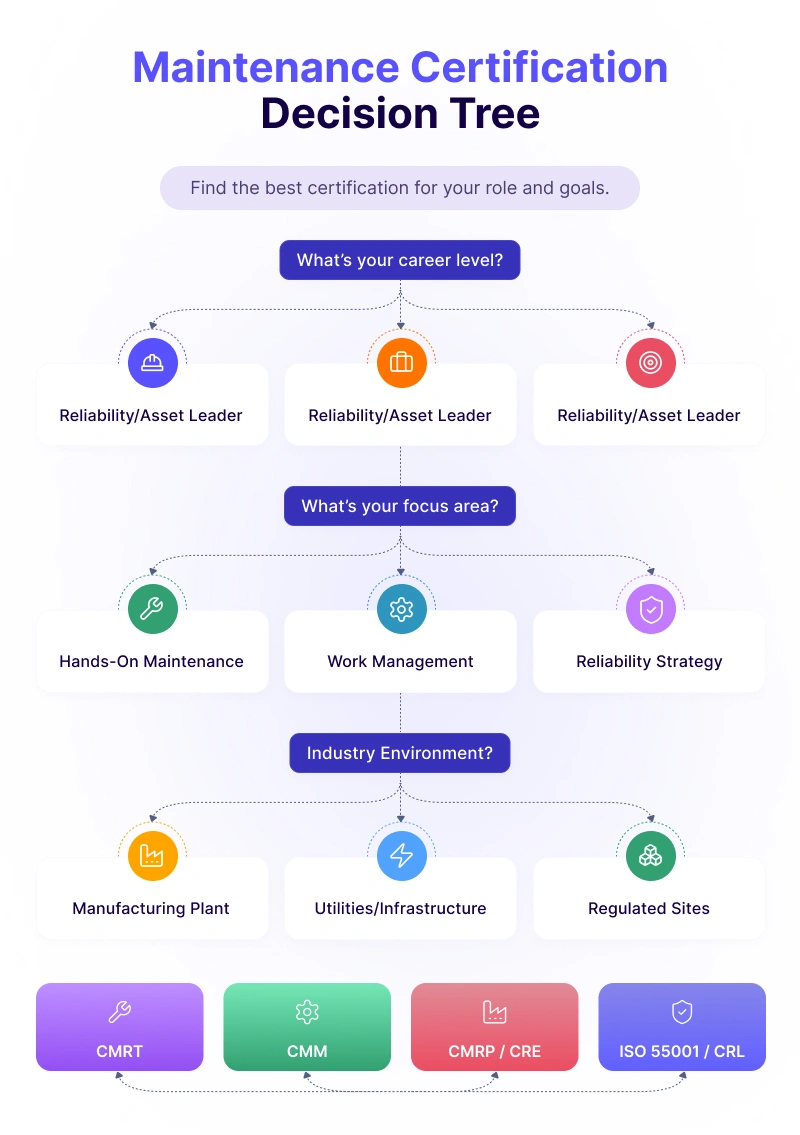
One of the biggest mistakes I see professionals make is choosing certifications based on reputation instead of responsibility. A credential that makes perfect sense for a reliability engineer may offer limited value to a front-line supervisor. The right certification depends on what you are accountable for today – and where you want your career to move over the next five to ten years.
Maintenance roles evolve in layers. Execution comes first. Then coordination. Then, performance ownership. Eventually, governance and enterprise alignment.
The certifications below align more realistically with how careers tend to progress inside maintenance organizations.
- Best for Technicians: CMRT
If you’re focused on preventive maintenance execution, troubleshooting discipline, and documentation quality, CMRT strengthens structured execution fundamentals and builds credibility for future supervisory roles.
- Best for Supervisors: CMM
For professionals managing teams, budgets, and preventive schedules, CMM reinforces plant-level leadership and operational control.
- Best for Maintenance Managers: CMRP
CMRP is often the most balanced credential for managers responsible for KPIs, planning processes, reliability programs, and cost governance.
- Best for Reliability Engineers: CRE
If your work involves statistical modeling, failure analysis, and predictive strategy, CRE offers deeper analytical validation than general management certifications.
- Best for Directors: CRL or ISO 55001
Leaders overseeing enterprise reliability or asset portfolios benefit from CRL’s cultural reliability focus or ISO 55001’s structured asset governance framework.
- Best for Multi-Site Operations Leaders: CMRP + ISO 55001
Multi-location complexity demands both operational reliability discipline and enterprise-level asset alignment. This combination supports both.
Ultimately, certifications should mirror responsibility. The most valuable credential is the one that strengthens the type of decisions you are expected to make – not just the title you hold today.
When Should You Pursue a Maintenance Certification?
One of the most common questions I hear is not which certification to pursue – it’s when.
Timing matters more than people realize. The same certification can feel transformational at the right stage of your career and abstract at the wrong one.
Here’s a practical way to think about it.
Early Career (0–5 Years Experience)
If you’re still focused on execution – learning equipment behavior, understanding preventive schedules, and building troubleshooting confidence – technician-level certifications make the most sense.
CMRT or trade-specific certifications build structure around daily work. At this stage, jumping into CMRP or CRE often feels theoretical because you haven’t yet experienced maintenance backlog chaos, budget pressure, or cross-functional conflict.
Build execution strength first.
Developing Leaders (5–10 Years Experience)
This is when certification begins to create real leverage.
If you’re:
- Supervising technicians
- Managing small teams
- Owning preventive schedules
- Contributing to reliability improvements
Certifications like CMM or CMRP start to pay off.
You’ve likely experienced operational friction by now – reactive overload, poor planning discipline, inventory gaps. Structured frameworks suddenly make sense because you can connect them to lived problems.
This is often the ideal window for CMRP.
Established Managers & Reliability Engineers (8–15 Years)
If you’re accountable for KPIs, budgeting, shutdowns, or predictive strategy, more advanced certifications become valuable.
CRE makes sense when you’re actually analyzing failure data.
PMP becomes useful when capital projects or shutdowns fall under your responsibility.
At this stage, certifications should sharpen influence – not just add credentials.
Senior Leaders & Multi-Site Directors (10+ Years)
When you’re operating at enterprise level – overseeing multiple plants, aligning maintenance with capital planning, presenting to executive leadership – certifications like CRL or ISO 55001 add governance depth.
They shift the conversation from equipment repair to asset stewardship.
But here’s the honest truth:
By this stage, experience carries more weight than credentials. Certification supports credibility – it does not replace track record.
A Simple Rule of Thumb
If a certification helps you solve problems you are already facing, it’s probably well timed.
If it feels disconnected from your daily responsibilities, it may be premature.
Certifications should amplify responsibility – not precede it.
Common Mistakes When Choosing a Maintenance Certification
Over the years, I’ve seen professionals invest serious time and money into certifications that didn’t actually move their careers forward. Not because the credential lacked value – but because it didn’t align with their role, environment, or long-term direction.
Certifications work best when they solve a real gap in your day-to-day responsibilities. When chosen purely for prestige or trend value, they often sit unused.
Here are the most common mistakes I’ve seen maintenance professionals make:
- Choosing CRE without working in analytical reliability roles.
CRE is mathematically rigorous and built for professionals modeling failure probabilities and risk. If your role is primarily execution-focused or supervisory, the statistical depth may not translate into daily value.
- Pursuing ISO 55001 in small operations where asset governance is minimal.
ISO-aligned asset management frameworks are powerful in utilities, infrastructure, and multi-site enterprises. In smaller single-site operations without formal asset governance structures, it may feel disconnected from reality.
- Taking PMP without exposure to structured project environments.
PMP strengthens project control and stakeholder alignment – but if you’re not managing shutdowns, capital installations, or structured improvement initiatives, it may not be immediately applicable.
- Ignoring renewal requirements and continuing education costs.
Many certifications require renewal fees and continuing education credits. Professionals sometimes underestimate the ongoing commitment required to maintain credentials.
- Choosing based on popularity rather than career direction.
Just because a certification is well-known does not mean it is right for your path. The best certification is the one aligned with the responsibilities you want to grow into – not the one that appears most frequently on LinkedIn profiles.
Ultimately, certifications should be intentional investments. Before enrolling, ask yourself:
Will this help me perform better in my current role? Or is it preparing me for the role I genuinely want next?
When chosen strategically, certifications accelerate growth. When chosen impulsively, they become expensive line items on a résumé.
How Employers View These Maintenance Certifications
When you look at certifications through an employer’s lens, the question is rarely “Is this credential impressive?” The real question is: Does this person understand how maintenance performance is actually measured – and can they translate that into better uptime?
Across CMMS implementations, I’ve seen certifications help in two very practical ways:
-
they create confidence that the person speaks the language of reliability and structured maintenance, and
-
they reduce the “training burden” because the candidate already understands core frameworks like planning, work management, and reliability thinking.
That said, different employers value different certifications depending on their operating context:
- CMRP tends to carry the strongest recognition in industrial environments because it signals balanced understanding of work management, reliability, and leadership. In many manufacturing-heavy organizations, it’s often the credential that gets immediate respect in interviews and internal promotions.
- CRE is respected in engineering-heavy sectors – especially where reliability is treated as an analytical function. Employers hiring for reliability engineering roles typically view CRE as a signal that you can handle statistical thinking, failure modeling, and structured risk analysis, not just operational supervision.
- PMP is valued when maintenance touches capital projects, shutdowns, or site expansions. In plants where maintenance leaders regularly manage contractors, scope creep, timelines, and commissioning, project discipline matters. PMP signals that you can run work like a project – not like a series of urgent tasks.
- ISO 55001 knowledge matters more in utilities, infrastructure, and asset-intensive multi-site organizations because those environments care deeply about asset lifecycle governance, risk-based planning, and long-term capital alignment. In smaller single-site plants, ISO training may still be valuable – but it won’t always be recognized as “must-have.”
Here’s the part that often surprises people: most hiring managers still care more about outcomes than credentials.
In interviews and performance reviews, the questions that matter usually sound like this:
-
Did you reduce reactive work, or did it stay the same?
-
Did PM compliance improve in a measurable way?
-
Did backlog age come down and stay down?
-
Did spare parts availability improve without inflating inventory spend?
-
Did uptime improve in the areas you owned?
So yes – certifications can open doors, help you get shortlisted, and strengthen promotion narratives.
But results keep those doors open. The strongest candidates are usually the ones who pair a credible certification with clear operational wins, even if the wins are small and local to one site or one asset class.
Salary Impact of Maintenance Certifications in the US
Certifications alone do not determine compensation. Experience, industry, plant or facility size, and geographic region all matter. That said, credentials often influence promotion velocity and earning ceilings – especially in larger or more structured organizations.
According to the U.S. Bureau of Labor Statistics and aggregated salary data from industrial recruiting benchmarks:
| Role | Typical US Salary Range |
|---|---|
Maintenance Supervisor | $65,000 – $95,000 |
Maintenance Manager | $85,000 – $125,000 |
Reliability Engineer | $90,000 – $130,000 |
Maintenance Director | $120,000 – $170,000+ |
Industries such as oil & gas, pharmaceuticals, aerospace, advanced manufacturing, and utilities often sit toward the higher end of these ranges.
Here’s where certifications come into play.
Where Certifications Influence Salary
Certifications rarely increase salary overnight. What they often do instead:
- Strengthen eligibility for leadership roles
- Differentiate candidates in competitive hiring pools
- Justify promotion to multi-site or enterprise roles
- Improve credibility in capital planning discussions
In several organizations I’ve worked alongside, CMRP or PMP credentials were not explicitly required – but they influenced who was trusted with broader responsibility.
And broader responsibility typically drives compensation growth.
A Realistic View
If you are early in your career, certification may not dramatically change compensation immediately.
If you are already performing at manager or director level, certification can remove friction during promotion decisions.
The strongest salary growth typically occurs when:
Certification + Measurable Operational Results + Expanded Responsibility all align.
That combination is what moves compensation tiers.
Frequently Asked Questions
What is the best maintenance certification in the US?
The answer depends on career stage and professional goals, but Certified Maintenance & Reliability Professional (CMRP) is widely regarded as the most recognized maintenance management certification in the United States. What makes CMRP stand out is its broad coverage of maintenance and reliability domains.
Unlike narrowly focused credentials, CMRP evaluates whether a professional understands maintenance as a strategic business function rather than just a technical activity. For mid-level and senior maintenance managers, CMRP often serves as a benchmark certification. But then “best” ultimately depends on your role. A technician, reliability engineer, and asset manager may each benefit from different certifications aligned to their responsibilities.
Which certification is best for reliability engineers?
For reliability engineers, two certifications are commonly considered: Certified Reliability Engineer (CRE) and CMRP. The right choice depends on the depth of analytical focus required in the role.
The CRE emphasizes reliability modeling, probability distributions, failure analysis, risk assessment, life data analysis, and design reliability. If you are working in product design, aerospace, defense, automotive engineering, or advanced manufacturing environments, you are likely to benefit most from CRE because it validates strong quantitative and analytical expertise.
CMRP, on the other hand, is broader and more operational. It focuses on maintenance systems, reliability strategy, planning and scheduling, and organizational effectiveness. So, if you are deeply involved in plant-level asset performance, maintenance planning, and cross-functional leadership, you will find CMRP more aligned with their day-to-day responsibilities.
Do maintenance certifications increase salary?
Yes, maintenance certifications can increase salary, but typically in an indirect and long-term way. They improve credibility, qualify professionals for higher-level roles, and strengthen promotion prospects. Certified individuals are always considered first for supervisory, reliability, or management positions, which carry higher pay. While a certification alone may not trigger an immediate raise, it significantly improves earning potential over time.
How Much Do Maintenance Certifications Cost in the US?
Maintenance certification costs vary depending on the credential level, exam structure, training requirements, and renewal policies. Below is a general breakdown of typical cost ranges:
| Certification Level | Typical Cost Range |
|---|---|
Technician-level | $150 – $400 |
Supervisor-level | $400 – $800 |
Manager-level | $400 – $600 (exam only) |
Advanced Reliability | $1,000 – $3,500 |
Enterprise Asset Programs | $1,000 – $3,000 |
Final Perspective
Maintenance is no longer defined by mechanical skill alone.
It is defined by structured planning, reliability thinking, risk awareness, data interpretation, and the ability to align asset performance with business outcomes.
Certifications do not replace experience. They do not automatically reduce downtime. They do not fix chaotic planning.
What they do – when pursued at the right time – is provide structure. They sharpen language. They create alignment. They help maintenance leaders move from reactive coordination to deliberate strategy.
The strongest professionals I’ve seen combine:
- Reliability frameworks (CMRP, RCM, CRE)
- Execution discipline (PMP, Lean)
- Asset governance awareness (ISO 55001, CRL)
- Digital literacy (analytics and automation)
As predictive technologies expand and multi-site visibility becomes the norm, maintenance leadership will increasingly require both operational depth and analytical fluency.
Certifications accelerate credibility. Systems drive results. Discipline sustains them.
If your goal in 2026 and beyond is to move from fixing problems to preventing them – and from managing assets to governing them – the right certification, pursued at the right time, becomes a strategic investment in your long-term career.