


Asset-intensive industries across the United States are under mounting pressure to improve uptime, control costs, and meet stricter compliance requirements. Maintenance is no longer viewed as a reactive support function. Organizations are prioritizing reliability-driven strategies that align asset performance with broader business goals and operational stability.
As expectations rise, companies seek leaders who understand budgeting, risk management, lifecycle planning, and performance metrics – not just equipment repair. The Certified Maintenance & Reliability Professional (CMRP) credential distinguishes professionals who can manage maintenance strategically and drive measurable results in competitive, performance-focused environments. Below, I take you through the ins and outs of CMRP and its relevance for maintenance professionals in this comprehensive CMRP certification guide.
Key Takeaways:
- CMRP is an ANSI-accredited certification validating leadership capability across maintenance, reliability, and asset strategy.
- The exam consists of 110 multiple-choice questions completed in 2.5 hours.
- There is no strict degree requirement, but 3–5 years of practical experience is strongly recommended.
- Member exam fee (2026): $300; Non-member: $470.
- The certification focuses on five pillars: Business Management, Equipment Reliability, Process Reliability, Leadership, and Work Management.
- Many professionals pursue CMRP when preparing for maintenance manager, reliability lead, or asset leadership roles.
- Long-term value includes stronger promotion eligibility and measurable salary growth in asset-intensive industries.
What is CMRP Certification?
CMRP stands for Certified Maintenance & Reliability Professional. It is a globally recognized credential issued by SMRP (Society for Maintenance & Reliability Professionals) to validate comprehensive knowledge in maintenance and reliability management.
It is one of the most recognized SMRP certifications, designed to validate leadership competence across asset performance, budgeting, and structured maintenance systems. Unlike narrow technical credentials, it functions as a comprehensive maintenance management certification with cross-industry recognition.
The certification is based on the SMRP Body of Knowledge, which defines standardized competencies required to manage reliability systems effectively. These competencies extend beyond technical maintenance execution and include business planning, cost control, compliance, leadership, and structured work management.
Unlike certifications tied to a particular methodology or software system, CMRP is vendor-neutral. It reflects industry-wide best practices rather than proprietary frameworks. That neutrality makes it applicable across manufacturing, oil and gas, utilities, mining, pharmaceuticals, and food processing sectors.
ANSI accreditation further strengthens its credibility. Accreditation confirms that the certification process meets rigorous standards for fairness, consistency, and defensibility.
For many professionals, CMRP serves as a benchmark credential demonstrating readiness for senior maintenance and reliability leadership roles.
Who Should Pursue CMRP?
CMRP is designed for professionals who influence asset performance, cost control, and operational reliability. These professionals are:
- Maintenance managers
Maintenance managers responsible for budgets, workforce supervision, compliance, and KPI performance benefit from CMRP by strengthening strategic planning, financial oversight, and structured reliability implementation skills.
- Reliability engineers
Reliability engineers working with failure analysis, predictive technologies, and reliability modeling gain broader business, financial, and leadership exposure that supports advancement into senior reliability or asset leadership roles.
- Asset management professionals
Professionals overseeing asset lifecycle planning, capital investment decisions, and risk-based prioritization can use CMRP to reinforce operational reliability knowledge aligned with long-term financial performance objectives.
- Maintenance planners and schedulers
Planners and schedulers managing backlog control, shutdown coordination, and CMMS systems benefit from CMRP by gaining strategic reliability perspective beyond daily work execution responsibilities.
- Operations managers handling asset-intensive environments
Operations leaders responsible for production performance in equipment-heavy facilities gain stronger understanding of reliability metrics, downtime analysis, and maintenance-budget alignment through CMRP preparation.
- Professionals transitioning from technical roles to leadership roles
Technicians and senior engineers moving into supervisory roles benefit from structured exposure to budgeting, KPI analysis, workforce planning, and change management concepts covered in CMRP.
CMRP Eligibility Requirements
CMRP is structured as a competency-based certification rather than an academic qualification. The focus is on practical knowledge, applied understanding, and professional experience in maintenance and reliability environments.
There is no mandatory degree requirement to sit for the exam. Candidates are not required to hold an engineering, management, or technical diploma, making the certification accessible to experienced professionals from diverse educational backgrounds.
There is also no strict minimum experience threshold enforced by SMRP. However, practical exposure to maintenance systems, reliability tools, and performance metrics is strongly recommended to successfully interpret scenario-based exam questions.
While not formally required, many successful candidates typically have three to five years of industry experience in maintenance, reliability engineering, asset management, or operations leadership roles.
Before applying, candidates should be comfortable with preventive and predictive maintenance concepts, reliability metrics such as MTBF and MTTR, budgeting basics, CMMS usage, and structured problem-solving approaches like root cause analysis.
The ideal time to apply is when you begin influencing maintenance strategy, managing budgets, supervising teams, or preparing for a leadership promotion—rather than during early technical or entry-level stages of your career.
CMRP Exam Overview
The CMRP exam evaluates both conceptual clarity and applied understanding across maintenance, reliability, and leadership functions. It is designed to test how well candidates can interpret real-world scenarios rather than simply recall definitions.
CMRP Exam Format
- Computer-based exam
- 110 multiple-choice questions
- 2.5-hour duration
-
Passing score methodology (scaled scoring system)
Exam Domains (SMRP Body of Knowledge)
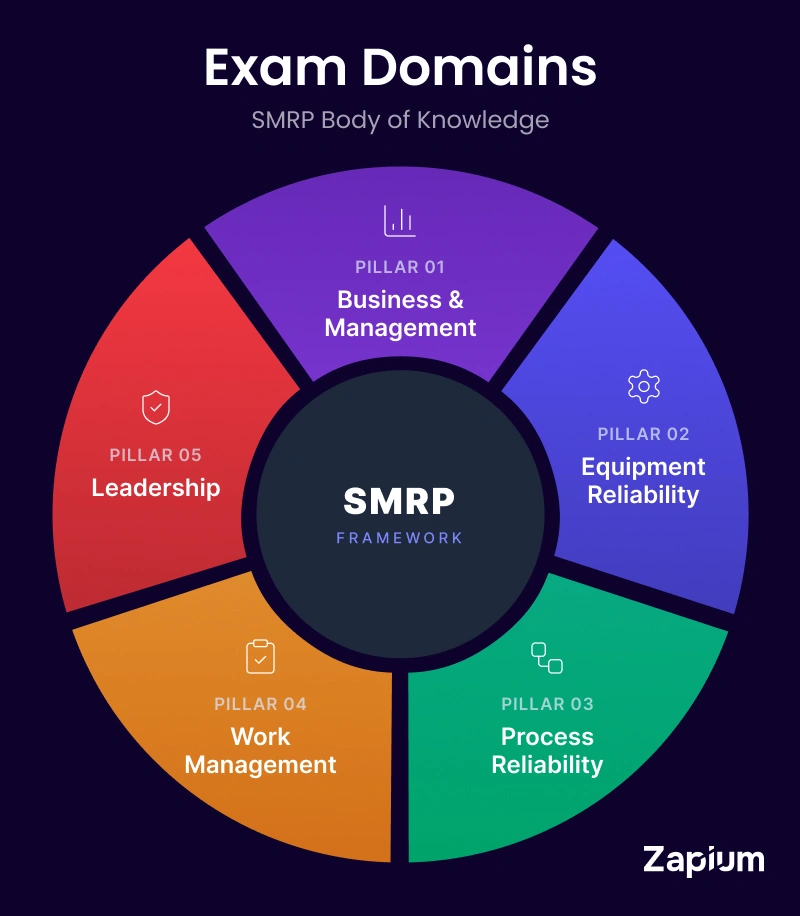
The exam is structured around five pillars defined by the SMRP Body of Knowledge. Each pillar represents a core competency area in maintenance and reliability leadership. Here is a breakdown of the five pillars and the areas they focus on:
1. Business & Management- Cost control and budgeting
- KPIs and performance metrics
- Risk management
- Regulatory compliance
-
Strategic planning
- Root cause analysis
- Process mapping
- Continuous improvement
-
Bottleneck identification
- Preventive and predictive maintenance
- Failure modes and effects analysis (FMEA)
- Reliability-centered maintenance (RCM)
- Asset lifecycle management
- Workforce planning
- Training and skills development
- Change management
-
Communication strategies
- Planning and scheduling
- CMMS utilization
- Maintenance backlog control
-
Shutdown and turnaround planning
CMRP Exam Registration Process
Registering for the CMRP exam requires completing a few structured steps through SMRP’s certification portal. Follow the sequence below to successfully secure your exam date.
- Create your SMRP account:
Register on the SMRP website, set up your login credentials, and enter your professional details to access the certification dashboard.
- Complete and submit the application:
Fill out the certification form, verify your work information, and submit the application for processing before moving to payment.
- Review and pay the exam fee:
Confirm whether you qualify for member pricing or will register as a non-member, then complete the payment through the online system.
- Select your testing option:
Choose between an authorized testing center or online proctoring, depending on your location and scheduling preference.
- Schedule your exam date:
Pick an available exam slot through the testing provider and confirm your booking. If needed, reschedule within the allowed window to avoid additional fees.
CMRP Certification Cost (2026 Update)
Understanding CMRP certification cost helps you budget for certification and decide if SMRP membership makes financial sense before exam registration. Below are the key cost components based on the latest SMRP published pricing.
- SMRP member fee:
SMRP members pay $300 (USD) for the CMRP exam, which is significantly lower than the non-member rate and reflects a membership discount.
- Non-member fee:
Non-members are charged $470 (USD), which is the standard fee for candidates without active SMRP membership.
- Retake fee:
If you need to retake the exam after an unsuccessful attempt, you must pay the full exam fee again (member or non-member rate applies) when registering for a new exam session.
- Membership benefits vs exam cost comparison:
SMRP members not only receive a lower exam fee but also access study resources, discounts on practice tests, training offerings, and networking opportunities—making membership worthwhile for many candidates.
- Refund and cancellation policies:
Exam fees are generally non-refundable once paid. If you cancel or fail to take the exam within the eligibility window after application, the fee may be forfeited. Appeals can be submitted to SMRP but refunds are not guaranteed.
How to Prepare for CMRP
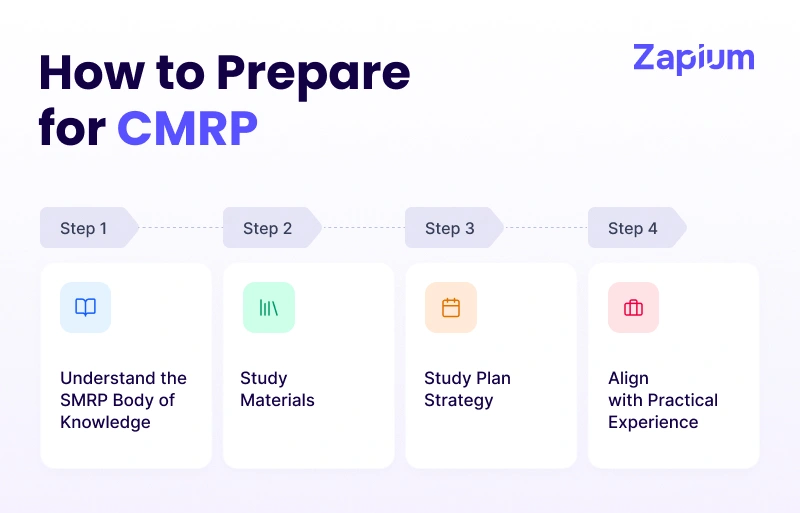
The CMRP exam requires a structured approach that combines clear planning, focused study, and practical application. The key preparation priorities are outlined below.
Understand the SMRP Body of Knowledge
- Weightage of each domain
Review the exam domain weight distribution to allocate study time proportionally, giving appropriate attention to Business & Management, Equipment Reliability, and other heavily weighted sections.
- Identifying weak areas
Conduct an honest self-assessment or take a diagnostic test to identify gaps in financial knowledge, KPI interpretation, or reliability tools before building your study schedule.
Study Materials
- SMRP Body of Knowledge guide
Use the official guide as your primary reference since exam questions are directly aligned with its terminology, concepts, and defined competency expectations.
- Practice exams
CMRP exam preparation strategy massively rests on the practice tests. It will help you to understand question patterns, improve speed, and identify areas where conceptual clarity or applied decision-making needs improvement.
- Reliability engineering textbooks
Refer to practical reliability-focused books to deepen understanding of FMEA, RCM, preventive strategies, and asset lifecycle principles beyond surface-level definitions.
- Maintenance management case studies
Study real-world scenarios involving maintenance budgeting, shutdown planning, backlog control, and KPI tracking to strengthen applied knowledge for scenario-based questions.
Study Plan Strategy
- 8–12 week preparation roadmap
Create a realistic preparation timeline spanning two to three months, allowing enough time for concept mastery, practice testing, and structured revision cycles.
- Domain-based study scheduling
Dedicate focused study blocks to each exam pillar instead of random reading, building structured understanding before integrating topics across domains.
- Weekly mock test strategy
Schedule at least one full-length or partial mock test per week to build exam stamina, refine pacing, and monitor improvement over time.
- Review and reinforcement cycle
After each practice session, analyze incorrect answers, clarify misunderstandings, and maintain summary notes for efficient final-week revision.
Practical Experience Alignment
- Applying concepts to current job
Relate exam topics such as preventive maintenance optimization or risk assessment directly to your workplace systems to strengthen applied understanding.
- Reviewing internal KPIs and maintenance data
Examine actual facility metrics like MTBF, MTTR, and backlog trends to connect theoretical exam content with real performance indicators.
- Using real-world scenarios for retention
Mentally simulate workplace-based decision-making scenarios to reinforce concepts, improving recall speed and confidence during the actual exam.
Common Challenges in CMRP Preparation
Many candidates approach the CMRP exam with strong technical confidence but underestimate the broader management and analytical expectations. The roadblocks are:
- Underestimating business management section
Technical professionals focus heavily on equipment reliability while neglecting budgeting, compliance, KPIs, and strategic planning topics that carry meaningful exam weight.
- Weak financial analysis knowledge
Candidates without budgeting or cost-control experience may struggle with questions involving lifecycle costing, ROI evaluation, and maintenance expense justification scenarios.
- Lack of familiarity with reliability metrics
Limited exposure to metrics like MTBF, MTTR, OEE, and schedule compliance can create confusion when interpreting data-driven, scenario-based exam questions.
- Over-reliance on theoretical knowledge
Memorizing definitions without understanding real-world application can make it difficult to answer situational questions that test decision-making rather than recall.
- Time management during exam
With 110 questions in 2.5 hours, slow pacing or overanalyzing complex questions can leave insufficient time to complete the exam confidently.
CMRP vs Other Maintenance Certifications
Maintenance and reliability professionals should compare CMRP with other certifications before making a decision. While each credential has its value, differences in scope, recognition, and career positioning can influence which option aligns best with your goals.
CMRP vs CRL
Comparison Area CMRP CRL Issuing Organization
Offered by the Society for Maintenance & Reliability Professionals (SMRP).
Offered by the Association of Asset Management Professionals (AMP).
Primary Focus
Broad maintenance and reliability leadership across five competency pillars.
Advanced reliability engineering and reliability leadership specialization.
Scope Coverage
Covers business management, equipment reliability, process reliability, leadership, and work management.
Concentrates more heavily on reliability engineering tools, system reliability modeling, and asset strategy.
Strategic vs Technical Depth
Balanced between strategic planning and operational execution.
Deeper technical and analytical reliability emphasis.
Target Audience
Maintenance managers, reliability engineers, planners, asset managers, and operations leaders.
Senior reliability engineers, asset reliability leaders, and technical specialists.
ANSI Accreditation
ANSI-accredited certification.
ANSI-accredited certification.
Industry Recognition
Widely recognized across multiple industries globally.
Strong recognition within reliability engineering communities.
Career Positioning
Supports transition into plant leadership, reliability director, or asset management roles.
Suited for advanced reliability leadership and technical authority roles.
Exam Structure
110 multiple-choice questions covering five pillars.
Fewer but more technically intensive questions focused on reliability domains.
CMRP vs CPMM
Comparison Area CMRP CPMM Issuing Organization
Offered by SMRP.
Offered by the Association for Facilities Engineering (AFE).
Primary Focus
Strategic maintenance and reliability management.
Maintenance management and facility supervision.
Scope Coverage
Integrates reliability engineering, business management, and structured work systems.
Focuses more on maintenance operations and supervisory practices.
Industry Recognition
Recognized internationally across asset-intensive industries.
More regionally recognized within facility and maintenance management circles.
ANSI Accreditation
ANSI-accredited.
Not ANSI-accredited.
Target Audience
Mid-to-senior-level maintenance and reliability professionals.
Maintenance supervisors and facility managers.
Strategic Emphasis
Strong strategic and KPI-driven performance orientation.
More operational and facility management oriented.
Career Mobility
Supports advancement into reliability director and asset leadership roles.
Suitable for plant-level or facility management progression.
Global Applicability
Vendor-neutral and globally applicable.
Primarily U.S.-focused recognition.
When CMRP is the Better Choice
When comparing options such as reliability engineer certification pathways or broader asset management certification programs, CMRP stands out for balancing strategic leadership capability with operational reliability depth.
CMRP becomes the stronger choice when your career goal involves strategic reliability leadership, cross-industry mobility, or executive-level maintenance management roles. Its ANSI accreditation, vendor-neutral structure, and balanced coverage of financial, operational, and leadership competencies make it particularly suitable for professionals aiming to move beyond plant-level supervision into broader asset management or corporate reliability positions.
Recertification Requirements
Earning the credential marks only the beginning of professional accountability. Recertification confirms continued competence, alignment with evolving industry practices, and sustained contribution to maintenance and reliability excellence.
- Certification Validity Period
The certification remains valid for three years from the date of approval. Professionals must complete renewal requirements before expiration to avoid lapses and the need to retake the full examination.
- Continuing Education Credits
Renewal requires documented continuing education activities such as technical training, workshops, conferences, or coursework. These credits demonstrate ongoing learning and updated knowledge in maintenance and reliability practices.
- Professional Development Points
SMRP assigns professional development points for approved activities, including industry presentations, publications, leadership roles, and technical participation. Accumulating sufficient points during the three-year cycle is mandatory for renewal eligibility.
- Renewal Fees
A renewal fee must be submitted along with the recertification application. The amount varies based on membership status, with discounted rates typically available for active SMRP members.
- Maintaining Compliance with SMRP Standards
Certification holders are expected to uphold SMRP’s code of ethics and professional conduct standards. Any violation or failure to maintain compliance may impact recertification approval or credential standing.
Career Benefits of CMRP
Professional growth in maintenance and reliability depends on more than experience alone. A recognized credential strengthens positioning, sharpens strategic capability, and signals readiness for broader responsibility across asset-intensive environments.
Salary Impact
- Increased Earning Potential
CMRP holders command higher compensation due to validated cross-functional competence in business management, reliability strategy, and operational performance. Employers associate certification with measurable value creation and reduced operational risk.
- Leadership Eligibility
Many organizations view CMRP as a qualification benchmark for maintenance managers, reliability leads, and asset management roles. Certification strengthens eligibility for supervisory and strategic leadership positions within maintenance hierarchies.
Professional Credibility
- Industry recognition
ANSI-accredited recognition and alignment with globally accepted reliability standards elevate professional standing. Certification demonstrates mastery across the five pillars of maintenance and reliability rather than narrow technical specialization.
- Promotion leverage
During performance evaluations or advancement discussions, CMRP provides objective validation of expertise. Decision-makers rely on recognized credentials to differentiate candidates competing for higher-responsibility roles.
Organizational Impact
- Improved Asset Reliability Performance
Certified professionals apply structured reliability frameworks, failure analysis methods, and lifecycle thinking that directly improve equipment uptime, reduce recurring failures, and strengthen preventive maintenance programs.
- Better Maintenance ROI
Financial literacy embedded in the certification supports cost justification, lifecycle cost analysis, and optimized maintenance strategies. Organizations benefit through controlled expenditures and improved return on maintenance investments.
- Data-Driven Decision-Making Influence
CMRP preparation emphasizes performance metrics, reliability KPIs, and analytical interpretation. Certified professionals influence strategic decisions using data rather than assumptions, shaping maintenance planning with measurable operational insights.
Industries Where CMRP Adds Maximum Value
CMRP proves invaluable across industries where asset reliability, cost control, and operational discipline directly influence profitability and risk exposure, as we see below.
- Manufacturing
Supports production stability by aligning maintenance strategy with throughput targets, equipment reliability, and overall operational efficiency.
- Oil & Gas
Strengthens asset integrity, risk-based maintenance planning, and lifecycle cost control in safety-critical and capital-intensive operations.
- Utilities and Power Generation
Improves outage management, regulatory compliance alignment, and long-term infrastructure reliability performance.
- Pharmaceuticals
Reinforces compliant maintenance systems that support validation standards, audit readiness, and controlled engineering processes.
- Mining
Optimizes heavy equipment reliability and lifecycle planning in remote, high-capital, and harsh operating environments.
- Food & Beverage
Balances preventive maintenance execution with hygiene regulations and continuous high-speed production demands.
Is CMRP Worth It?
It is obvious for any maintenance professional to question whether the investment of time and effort in CMRP truly pays off. From a practical standpoint, CMRP delivers measurable ROI through stronger earning potential, leadership eligibility, and more credible positioning in a competitive job market.
Long-term advantages extend beyond immediate salary impact. The credential supports structured career growth, builds cross-industry credibility, and offers global mobility advantages in organizations that value standardized reliability and maintenance leadership expertise.
Final Thoughts
For professionals evaluating a recognized maintenance and reliability certification with strong leadership positioning and cross-industry mobility, CMRP remains one of the most strategically aligned credentials available today. It aligns closely with modern asset management strategies by integrating financial awareness, structured work management, and data-backed reliability practices into a unified professional standard.
Professionals ready to advance should review eligibility criteria, map study plans to the five pillars, and commit to disciplined preparation. Structured effort, consistent practice, and strategic focus can turn certification into a long-term career accelerator.
What Are the Most Frequently Asked Questions About CMRP?
Is the CMRP Exam Difficult?
The CMRP exam is widely regarded as challenging because it tests knowledge across multiple domains, including business and management, equipment reliability, work management, and people management. Candidates must demonstrate both theoretical understanding and practical application of reliability principles. Those with several years of hands-on maintenance or reliability experience typically find it manageable with structured preparation, while professionals newer to the field may require a more disciplined and extended study approach.
What Is the CMRP Pass Rate?
The official pass rate is not publicly disclosed by the Society for Maintenance & Reliability Professionals. However, industry estimates commonly suggest that first-time pass rates fall somewhere between 50 and 70 percent. Actual results vary depending on a candidate’s professional background, preparation quality, familiarity with the Body of Knowledge, and comfort with multiple-choice exam formats.
How Long Should You Study for CMRP?
Study duration depends largely on professional experience and prior exposure to reliability concepts. Experienced maintenance and reliability professionals often prepare within eight to twelve weeks by dedicating consistent weekly study hours. Candidates with limited exposure to reliability frameworks may require twelve to sixteen weeks or more.
Can Technicians Apply for CMRP?
Yes, technicians can apply for CMRP as long as they meet the eligibility criteria established by SMRP. Qualification typically depends on a combination of education and relevant work experience. Candidates with a high school diploma can qualify with sufficient industry experience, while those holding college degrees may require fewer years of professional practice. The certification is not restricted to engineers and is open to qualified maintenance professionals across roles.
How Many Times Can You Retake the CMRP Exam?
Candidates who do not pass the exam on their first attempt are permitted to retake it after a mandatory waiting period, typically around 30 days. Multiple retakes are generally allowed, although policies may require additional preparation or documentation after repeated unsuccessful attempts.
Is CMRP Certification Worth It?
For professionals committed to long-term careers in maintenance, reliability, and asset management, CMRP certification is often considered a worthwhile investment. It validates competency against recognized industry standards and strengthens professional credibility. Many certified professionals report improved promotion prospects, expanded leadership opportunities, and stronger positioning within reliability-driven organizations.
Related Posts
- Certification Validity Period