

CMRP vs CMM: Which Maintenance Certification Should You Choose?
Maintenance and reliability functions sit at the heart of modern industrial operations. Organizations increasingly prefer professionals who possess specialized knowledge in asset reliability, maintenance planning, and equipment performance management. Professional maintenance and reliability certifications have therefore gained considerable attention among engineers, supervisors, and maintenance leaders.
Two certifications frequently discussed in this field are the Certified Maintenance and Reliability Professional (CMRP) and the Certified Maintenance Manager (CMM). Each credential focuses on different aspects of maintenance practice. One emphasizes reliability engineering and maintenance optimization, while the other concentrates on maintenance leadership and management responsibilities. Choosing between them depends on professional goals, technical orientation, and career stage. Below, I offer you a detailed maintenance certification comparison, discussing their scope, structure, and professional relevance.
Why Are Maintenance Certifications Important for Career Growth?
Industrial maintenance has evolved significantly over the past few decades. Earlier maintenance practices relied heavily on reactive repairs and routine servicing schedules. Modern operations demand a more strategic approach centered on predictive analytics, reliability engineering, asset performance monitoring, and optimized maintenance planning.
How Do Certifications Improve Maintenance and Reliability Skills?
Maintenance certifications typically follow a structured body of knowledge that reflects widely accepted industry practices. Preparing for certification requires professionals to review frameworks, methodologies, and analytical approaches used in modern maintenance environments.
One major benefit lies in structured learning. Many professionals acquire maintenance knowledge through practical experience on the shop floor. Certification programs complement that experience by introducing theoretical models such as reliability engineering concepts, root cause analysis techniques, failure modes and effects analysis, and predictive maintenance strategies.
Candidates also gain exposure to asset lifecycle thinking. Instead of focusing solely on repair activities, certification programs introduce broader concepts such as reliability planning during equipment design, preventive maintenance optimization, spare parts management, and asset performance monitoring.
Why Do Employers Value Certified Maintenance Professionals?
Organizations increasingly recognize maintenance as a strategic business function rather than a support activity. Equipment failures can disrupt production schedules, increase safety risks, and lead to significant financial losses. As a result, employers look for professionals who understand systematic maintenance practices and reliability management principles.
Certified professionals demonstrate knowledge of standardized methodologies used in asset-intensive industries. Employers often view certifications as proof that an individual understands structured maintenance frameworks and can apply them within operational environments.
Another factor relates to operational consistency. Certified professionals typically follow established maintenance strategies rather than relying solely on reactive repairs. Such practices improve equipment uptime, reduce unplanned downtime, and contribute to better asset utilization.
From an organizational perspective, certified professionals also contribute to long-term reliability planning. They participate in maintenance strategy development, equipment performance analysis, and continuous improvement initiatives. Their ability to apply structured reliability methods supports operational efficiency and risk reduction.
For these reasons, many organizations encourage maintenance teams to pursue professional certifications as part of workforce development initiatives.
What Is CMRP Certification?
The Certified Maintenance and Reliability Professional certification is one of the most widely recognized credentials in the maintenance and reliability discipline. It focuses on validating technical knowledge related to reliability engineering, maintenance management, and asset performance improvement.
The certification emphasizes the integration of maintenance strategies with operational objectives. Professionals who earn the credential demonstrate an understanding of reliability-centered maintenance concepts, preventive and predictive maintenance techniques, and maintenance work management systems.
What Is the Society for Maintenance & Reliability Professionals (SMRP)?
The Society for Maintenance & Reliability Professionals is an international organization dedicated to advancing maintenance and reliability practices. It provides education resources, research publications, industry standards, and professional certification programs for maintenance professionals.
Founded in the United States, the organization has grown into a global community of reliability engineers, maintenance leaders, consultants, and asset management specialists. Members participate in conferences, training programs, and professional development initiatives aimed at improving maintenance practices across industries.
What Does the CMRP Certification Validate?
CMRP certification validates a professional’s ability to apply reliability and maintenance principles within industrial environments. The certification framework assesses knowledge across several domains related to equipment reliability, maintenance processes, and organizational leadership.
Professionals holding the certification demonstrate familiarity with reliability engineering concepts such as failure analysis, preventive maintenance optimization, and predictive maintenance technologies. Knowledge of asset performance monitoring and maintenance planning strategies also forms a key component of the certification.
Who Should Pursue the CMRP Certification?
There are CMRP certification benefits that compel various professionals to pursue the CMRP certification. These roles include:
- Reliability Engineers: Focus on analyzing equipment failures and improving reliability strategies across production systems.
- Maintenance Engineers: Manage maintenance programs and benefit from deeper knowledge of reliability engineering principles.
- Maintenance Planners: Coordinate maintenance schedules and gain stronger insight into work management and equipment reliability planning.
- Maintenance Supervisors: Oversee maintenance teams and apply structured maintenance strategies to improve operational performance.
- Asset Management Professionals: Handle asset lifecycle planning and use reliability concepts to improve equipment performance.
- Operations Engineers: Work closely with production systems and benefit from understanding how maintenance reliability affects process stability.
- Maintenance Consultants: Advise organizations on maintenance optimization and require validated knowledge of reliability practices.
- Technical Specialists in Predictive Maintenance: Use condition monitoring technologies and benefit from structured reliability frameworks.
What Topics Are Covered in the CMRP Body of Knowledge?
The CMRP Body of Knowledge outlines the core areas maintenance and reliability professionals must understand to manage equipment performance, maintenance operations, and organizational coordination within asset-intensive environments. Each domain reflects practical responsibilities found in modern maintenance roles.
Business and Management
Maintenance functions operate within broader business objectives. Professionals study budgeting, performance measurement, maintenance strategy alignment with organizational goals, cost control practices, and decision-making processes that link maintenance activities with operational performance.
Equipment Reliability in CMRP
Equipment reliability focuses on understanding failure patterns, reliability analysis, and maintenance strategies that reduce equipment breakdowns. Topics include root cause analysis, reliability modeling, condition monitoring technologies, and predictive maintenance approaches used in industrial environments.
Manufacturing Process Reliability
Production systems depend on stable equipment performance. This domain examines how maintenance strategies influence manufacturing continuity, product quality, process efficiency, and operational stability across interconnected equipment within complex industrial processes.
Organization and Leadership Play
Maintenance operations require coordination among maintenance technicians, engineers, planners, and operations teams. Leadership topics address workforce management, communication practices, team coordination, and organizational structures that support effective maintenance execution.
Work Management in Maintenance Reliability
Work management focuses on organizing maintenance activities through structured planning and scheduling. Topics include work order systems, maintenance backlog control, resource allocation, spare parts coordination, and computerized maintenance management system (CMMS) utilization.
What Is the Structure of the CMRP Exam?
The CMRP exam is designed to evaluate a candidate’s understanding of maintenance and reliability principles across multiple domains defined in the CMRP Body of Knowledge. The examination measures both conceptual knowledge and the ability to apply maintenance practices in real operational scenarios. Key elements of the CMRP exam structure include:
- Total Number of Questions
The exam consists of 110 multiple-choice questions, with each question designed to test knowledge related to maintenance management, reliability engineering, and asset performance practices.
- Exam Duration
Candidates are given 2.5 hours (150 minutes) to complete the exam, requiring careful time management while analyzing scenario-based and conceptual questions.
- Exam Format
Questions follow a multiple-choice format with four answer options, focusing on practical maintenance situations, reliability analysis, and decision-making scenarios commonly encountered in industrial operations.
- Domains Covered in the Exam
Questions are distributed across the five domains of the CMRP Body of Knowledge, including Business and Management, Equipment Reliability, Manufacturing Process Reliability, Organization and Leadership, and Work Management.
- Passing Score
The exam uses a scaled scoring system, and candidates must achieve a minimum passing score determined by the certification body to demonstrate sufficient competency in maintenance and reliability practices.
- Exam Delivery Method
Candidates can take the exam online through authorized testing platforms or at designated testing centers, depending on the exam registration method and available testing options.
What Are the Eligibility Requirements for CMRP?
The CMRP certification does not have strict eligibility criteria related to education or job title. Any professional working in maintenance, reliability, or asset management roles can apply for the exam and attempt the certification.
Is Work Experience Required for CMRP?
Work experience is not mandatory to register for the CMRP exam. However, practical experience in maintenance or reliability roles is strongly recommended because the exam includes scenario-based questions drawn from real industrial environments.
How Does CMRP Recertification Work?
CMRP certification is not permanent and must be renewed periodically to maintain its validity. Recertification allows professionals to demonstrate continued involvement in maintenance and reliability practices through professional development activities, training programs, and industry participation.
How Many CEUs Are Required for Renewal?
CMRP certification holders must earn 30 continuing education units (CEUs) during the renewal period. These CEUs can come from activities such as attending reliability conferences, completing training programs, publishing technical articles, or participating in industry workshops.
What Is the Recertification Cycle?
The CMRP recertification cycle is three years. During this period, professionals must accumulate the required CEUs and submit documentation before the renewal deadline to maintain their certification status.
What Is CMM Certification?
CMM certification is a professional credential designed for individuals responsible for managing maintenance operations within organizations. It focuses on leadership, maintenance strategy, budgeting, and operational planning required to oversee maintenance departments effectively.
What Is the Association for Maintenance Professionals (AMP)?
The Association for Maintenance Professionals (AMP) is a professional organization that supports maintenance leaders through education, certification programs, and industry resources. It promotes structured maintenance management practices and professional development for maintenance supervisors and managers.
What Does the Certified Maintenance Manager (CMM) Credential Represent?
The Certified Maintenance Manager credential represents a professional’s ability to lead maintenance teams, manage maintenance operations, and align maintenance strategies with organizational goals. It validates expertise in maintenance leadership, planning, financial oversight, and regulatory compliance.
Who Should Consider the CMM Certification?
CMM certification is most suitable for professionals responsible for managing maintenance teams and operations.
- Maintenance Managers: Oversee maintenance departments and require structured knowledge of maintenance strategy, budgeting, and team coordination.
- Plant Maintenance Supervisors: Manage daily maintenance operations and benefit from formal training in leadership and maintenance planning.
- Facility Managers: Handle infrastructure maintenance and require strong understanding of asset lifecycle and operational planning.
- Operations Managers: Coordinate production and maintenance activities and benefit from structured maintenance management knowledge.
- Senior Maintenance Engineers: Transitioning into leadership roles and seeking to strengthen their management and strategic planning capabilities.
What Skills and Competencies Does the CMM Certification Cover?
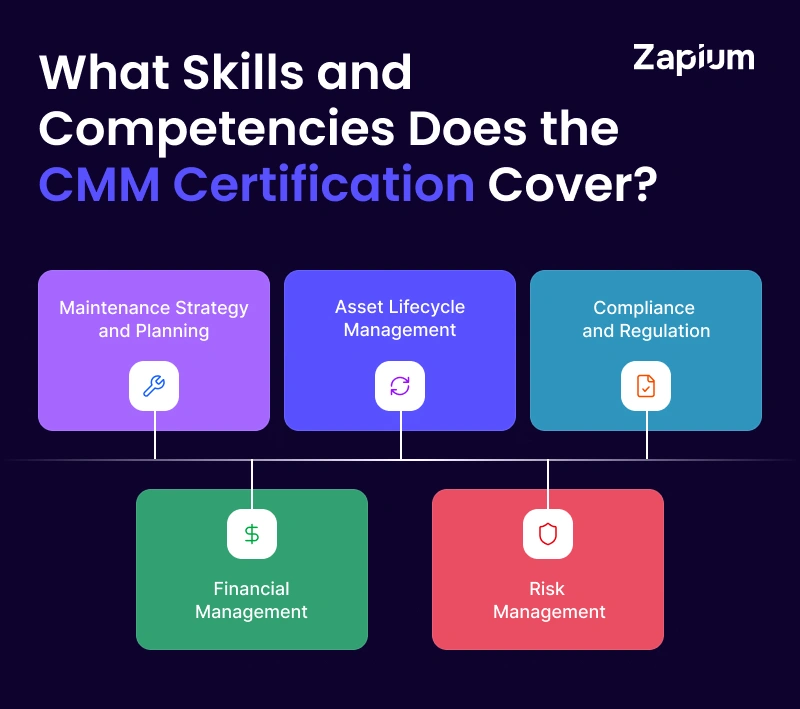
The CMM certification focuses on the managerial and strategic aspects of maintenance operations. It evaluates a professional’s ability to plan maintenance activities, manage budgets, address operational risks, and maintain regulatory compliance while overseeing asset performance.
Maintenance Strategy and Planning
Maintenance managers develop structured strategies that guide preventive maintenance programs, workforce allocation, and long-term maintenance scheduling to maintain equipment performance and reduce operational disruptions.
Financial Management
Maintenance leaders manage departmental budgets, track maintenance expenses, analyze repair costs, and evaluate investment decisions related to equipment maintenance, upgrades, and replacement planning.
Risk Management
Maintenance management requires identifying operational risks related to equipment failure, workplace safety, and production interruptions while implementing measures that reduce potential operational and safety hazards.
Asset Lifecycle Management
Managers oversee throughout their assets lifecycle management, from procurement and installation to maintenance, performance monitoring, and eventual replacement planning based on lifecycle cost analysis.
Compliance and Regulation
Maintenance departments must follow safety standards, environmental regulations, and industry compliance requirements, requiring managers to maintain operational practices that meet regulatory expectations and documentation standards.
What Is the CMM Assessment and Certification Process?
The certified maintenance manager certification evaluates a candidate’s ability to manage maintenance operations through a combination of professional review and examination. The process verifies both practical management experience and knowledge of maintenance leadership practices.
- Application Submission
Candidates begin by submitting an application that includes personal details, professional background, and relevant maintenance management experience.
- Professional Experience Review
The certification body reviews the candidate’s maintenance leadership experience to confirm that their professional responsibilities align with maintenance management roles.
- Documentation Verification
Applicants may be required to provide supporting documentation such as employment records, role descriptions, and professional references to validate their management experience. - Certification Examination
After approval, candidates complete an exam designed to assess knowledge related to maintenance planning, financial management, risk assessment, asset lifecycle management, and regulatory compliance.
- Certification Approval
Candidates who successfully complete the evaluation process and pass the examination receive the Certified Maintenance Manager credential.
What Are the Eligibility Requirements for CMM?
CMM certification is designed for professionals who already hold responsibilities in maintenance leadership or supervisory roles. Candidates are generally expected to demonstrate practical experience in managing maintenance teams, coordinating maintenance activities, and overseeing equipment or facility maintenance operations. Educational background may vary, but professional maintenance management experience remains the primary eligibility factor. Through the following questions, I help you understand more about CMM certification requirements.
How Much Management Experience Is Required?
Candidates pursuing the CMM certification are typically expected to have several years of experience in maintenance management or supervisory positions. This experience may include managing maintenance staff, planning maintenance schedules, controlling maintenance budgets, or coordinating asset management programs within industrial or facility environments.
What Professional Documentation Must Be Submitted?
Applicants usually submit documentation that verifies their professional experience in maintenance management. Common documents include employment records, job descriptions, proof of supervisory responsibilities, professional references, and educational credentials that support their eligibility for the certification.
How Does CMM Recertification Work?
The Certified Maintenance Manager (CMM) certification requires periodic renewal to maintain its active status. Recertification confirms that maintenance managers continue to stay engaged with industry practices and professional development activities.
The CMM recertification cycle typically occurs every three years. During this period, certification holders must participate in professional development activities related to maintenance management, asset management, or facility operations.
To renew the certification, professionals usually need to accumulate continuing education units (CEUs) or professional development credits. These credits can be earned through activities such as attending maintenance conferences, completing professional training programs, participating in workshops, publishing technical articles, or contributing to industry organizations.
At the end of the three-year cycle, certification holders submit documentation showing the required CEUs along with a recertification application and renewal fee. Once the certification body reviews and approves the submission, the CMM credential remains valid for the next recertification period.
What Are the Key Differences Between CMRP and CMM?
| Factor | CMRP (Certified Maintenance & Reliability Professional) | CMM (Certified Maintenance Manager) |
|---|---|---|
Primary Focus | Focuses on maintenance reliability practices and technical aspects of asset performance. | Focuses on leadership and management responsibilities within maintenance departments. |
Certification Body | Offered by the Society for Maintenance & Reliability Professionals (SMRP). | Offered by the Association for Maintenance Professionals (AMP). |
Target Audience | Designed for reliability engineers, maintenance engineers, planners, and asset reliability professionals. | Designed for maintenance managers, supervisors, and facility management professionals. |
Core Knowledge Areas | Covers reliability engineering, equipment performance analysis, maintenance planning, and work management systems. | Covers maintenance strategy, budgeting, risk management, asset lifecycle planning, and regulatory compliance. |
Professional Orientation | More technical and engineering-focused. | More managerial and leadership-focused. |
Industry Recognition | Widely recognized across global manufacturing, energy, and industrial sectors. | Commonly recognized in organizations focusing on maintenance leadership and facility operations. |
Typical Career Path | Supports roles in reliability engineering, asset management, and maintenance optimization. | Supports roles in maintenance leadership, plant maintenance management, and facility management. |
Exam Emphasis | Tests knowledge of reliability methodologies and maintenance processes. | Tests knowledge of maintenance management, leadership practices, and operational planning. |
How Do CMRP and CMM Compare Side by Side?
CMRP and CMM certifications differ mainly in their focus areas. CMRP emphasizes maintenance reliability and technical practices, while CMM concentrates on maintenance leadership, management responsibilities, and strategic planning within maintenance operations.
Which Certification Has Greater Global Recognition?
CMRP generally has broader global recognition because it is offered by an internationally known professional organization and is widely adopted across manufacturing, energy, and asset-intensive industries.
Which Credential Focuses More on Reliability Engineering?
CMRP focuses more heavily on reliability engineering concepts such as failure analysis, predictive maintenance, equipment reliability improvement, and maintenance optimization strategies.
Which Certification Is Better for Maintenance Managers?
CMM is typically more suitable for maintenance managers since it focuses on leadership responsibilities, budgeting, maintenance strategy development, and management of maintenance teams and operations.
How Do CMRP and CMM Impact Salary and Career Growth?
Both CMRP and CMM certifications support career advancement, but they influence different career paths within maintenance.
- CMRP Impact
CMRP strengthens technical credibility and often helps professionals move into roles such as Reliability Engineer, Maintenance Engineer, or Asset Manager. These positions typically offer higher salaries due to their specialized reliability expertise.
- CMM Impact
CMM supports career growth into leadership roles such as Maintenance Manager, Plant Maintenance Head, or Facility Manager. These positions involve strategic planning and team management and usually offer higher management-level compensation.
Which Certification Should You Choose: CMRP or CMM?
Choosing between CMRP and CMM depends on your career direction. CMRP suits professionals focused on technical reliability and maintenance practices, while CMM fits professionals responsible for managing maintenance operations and teams.
Should Engineers Choose CMRP for Technical Expertise?
Yes. Engineers working with equipment reliability, failure analysis, and maintenance optimization benefit from CMRP because it focuses on reliability engineering concepts and technical maintenance practices.
Should Maintenance Managers Choose CMM for Leadership Roles?
Yes. Maintenance managers responsible for planning maintenance strategies, managing teams, and controlling budgets typically benefit more from the CMM certification.
How Does Career Stage Influence Certification Choice?
Early-career professionals often choose CMRP to strengthen technical expertise, while mid-career professionals moving into supervisory or management roles may find CMM more relevant.
Can Professionals Pursue Both CMRP and CMM Certifications?
Yes, professionals can pursue both CMRP and CMM certifications if their career path includes both technical reliability work and maintenance leadership responsibilities. Many professionals first obtain CMRP to build strong reliability and maintenance expertise and later pursue CMM when they move into maintenance management or leadership roles. Having both credentials demonstrates balanced knowledge of technical reliability practices and maintenance management strategy.
Which Industries Prefer CMRP or CMM Certifications?
Organizations in asset-intensive sectors often prefer maintenance professionals with recognized certifications because these roles require structured reliability practices, asset management knowledge, and maintenance leadership capabilities. Industries that commonly prefer CMRP or CMM certifications are:
- Manufacturing
- Oil and Gas
- Power Generation
- Mining and Metals
- Transportation and Logistics
- Utilities and Infrastructure
- Pharmaceutical Industry
- Chemical Processing
- Food and Beverage Processing
- Pulp and Paper Industry
- Automotive Manufacturing
- Aerospace and Defense
How Should You Prepare for CMRP and CMM Certification?
When you are preparing for CMRP or CMM certification, you need to follow a structured approach that combines studying the official knowledge areas with practical maintenance experience.
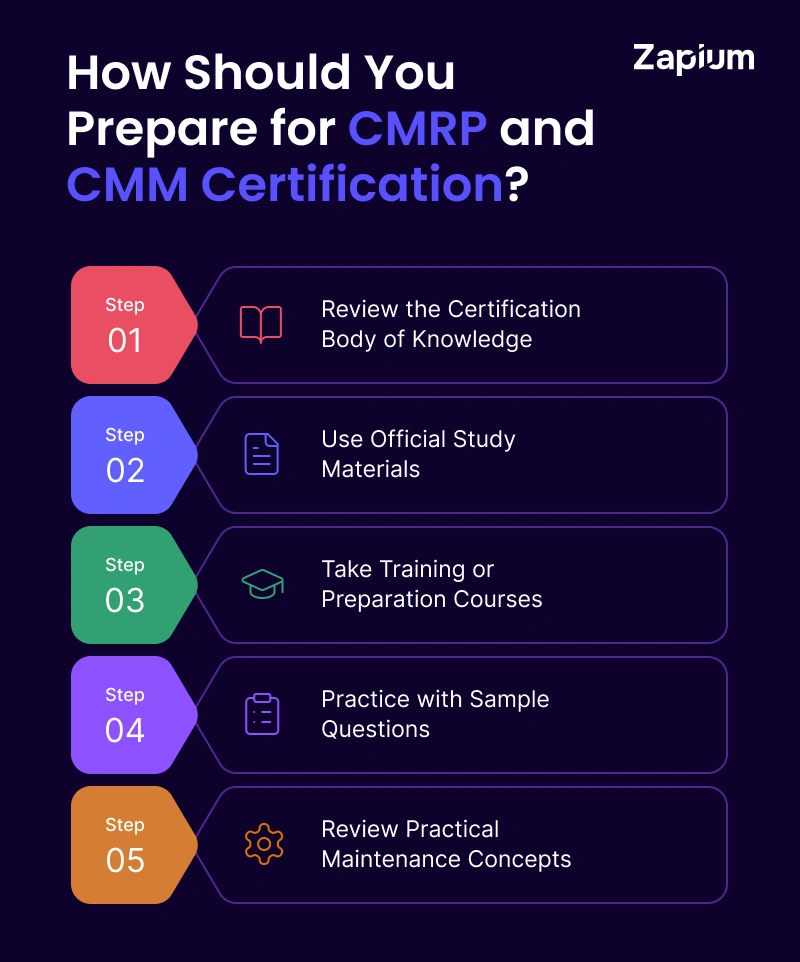
- Step 1: Review the Certification Body of Knowledge
Start by studying the official exam domains for CMRP or CMM to understand the topics and competencies covered in the certification.
- Step 2: Use Official Study Materials
Refer to recommended textbooks, industry guides, and training resources that focus on maintenance reliability, maintenance management, and asset management practices.
- Step 3: Take Training or Preparation Courses
Professional training programs and certification preparation courses help candidates understand exam topics and review real maintenance scenarios.
- Step 4: Practice with Sample Questions
Practice exams and sample questions help candidates become familiar with the exam format and improve their ability to analyze maintenance-related situations.
- Step 5: Review Practical Maintenance Concepts
Revisit concepts related to reliability engineering, maintenance planning, asset lifecycle management, budgeting, and maintenance leadership before attempting the exam.
What Common Mistakes Do Candidates Make When Choosing or Preparing for These Certifications?
Many candidates approach maintenance certifications without fully understanding their focus, requirements, or preparation expectations and become susceptible to:
- Choosing a certification without aligning it with career goals
- Not understanding the difference between technical and management focus
- Attempting the exam without reviewing the official body of knowledge
- Underestimating the level of preparation required
- Relying only on practical experience without studying exam topics
- Ignoring practice exams and sample questions
- Not gaining sufficient maintenance or management experience before applying
- Failing to review reliability and maintenance management concepts in detail
- Registering for the exam without a structured study plan
- Overlooking recertification requirements and continuing education obligations