
CMRP vs CRE: Which Reliability Certification Should You Choose?

Industrial organizations increasingly depend on professionals who understand equipment reliability, maintenance planning, and asset performance management. Certification programs help professionals demonstrate structured knowledge in these areas and support career development within reliability and maintenance functions.
Two certifications discussed in the maintenance and reliability field are the Certified Maintenance and Reliability Professional and the Certified Reliability Engineer. Each credential reflects a different perspective on reliability practice. One focuses more on maintenance operations and asset reliability within industrial environments, while the other emphasizes reliability engineering analysis and statistical modeling. In this guide, I explain how these certifications differ and how professionals typically choose between them.
What Is CMRP Certification?
The Certified Maintenance & Reliability Professional (CMRP) is a top-tier global certification for maintenance and reliability experts. Managed by the Society for Maintenance & Reliability Professionals (SMRP), it verifies that you have the skills to keep equipment running efficiently and align maintenance with business goals. It is uniquely ANAB/ISO accredited, making it a universally respected benchmark for leadership and asset management.
What Is the Society for Maintenance & Reliability Professionals?
The Society for Maintenance & Reliability Professionals (SMRP) is an international professional organization dedicated to improving maintenance and reliability practices across industries. The organization develops professional standards, educational resources, and certification programs designed to support maintenance professionals worldwide.
What Does the CMRP Certification Validate?
CMRP certification validates a professional’s ability to apply maintenance and reliability principles within operational environments. The certification framework evaluates knowledge across multiple domains related to equipment performance, maintenance processes, and organizational coordination.
Professionals holding the credential demonstrate familiarity with maintenance strategy development, reliability improvement methods, and structured maintenance planning. Knowledge of predictive maintenance technologies, failure analysis techniques, and work management systems also forms an important part of the certification.
Another aspect validated by CMRP certification relates to asset lifecycle thinking. Instead of focusing only on equipment repair, professionals learn to manage reliability across the entire asset lifecycle—from installation and commissioning to long-term maintenance planning and eventual replacement decisions.
Because of this broader perspective, the certification supports both technical and managerial roles within maintenance departments.
Who Should Pursue the CMRP Certification?
Several professionals working in maintenance and reliability functions benefit from pursuing CMRP certification. These roles typically involve managing equipment performance, maintenance planning, or asset lifecycle decisions.
- Reliability Engineers Analyze equipment failures and develop strategies that improve reliability across industrial systems.
- Maintenance Engineers Design maintenance programs that support equipment performance and operational continuity.
- Maintenance Planners Coordinate maintenance schedules, work orders, spare parts planning, and workforce allocation.
- Maintenance Supervisors Oversee maintenance teams and implement structured maintenance strategies within industrial facilities.
- Asset Management Professionals Manage equipment performance throughout the asset lifecycle and coordinate long-term maintenance planning.
- Operations Engineers Work closely with production processes and benefit from understanding how maintenance reliability affects operational stability.
What Topics Are Covered in the CMRP Body of Knowledge?
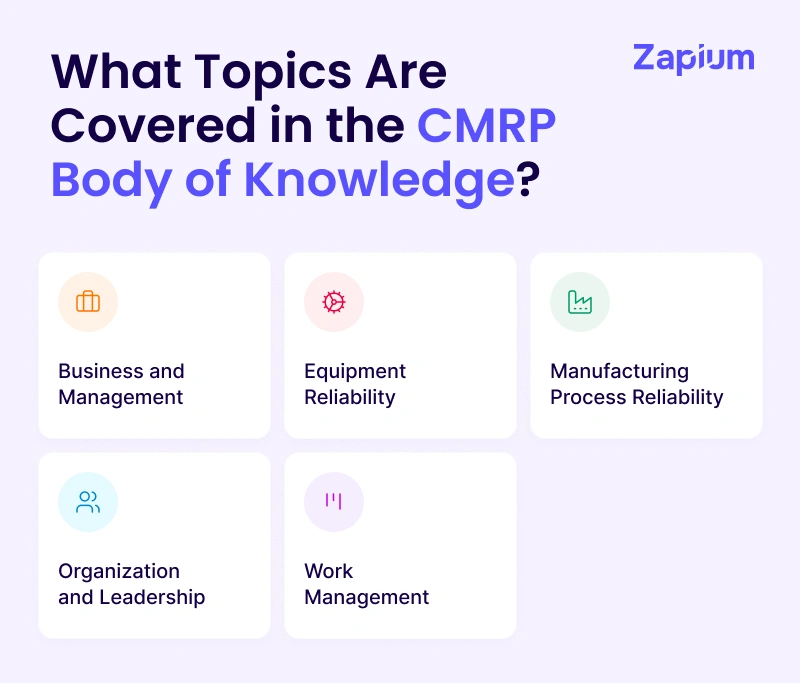
The CMRP Body of Knowledge outlines the primary competency areas maintenance and reliability professionals must understand to manage equipment performance and maintenance operations effectively. Each domain reflects responsibilities commonly found in modern maintenance departments.
Business and Management
Maintenance activities operate within larger business objectives. Professionals study financial planning, cost control, and maintenance performance metrics used to evaluate maintenance effectiveness.
Topics include budgeting for maintenance operations, analyzing maintenance costs, and aligning maintenance strategies with production goals. Professionals also learn how maintenance decisions affect operational profitability, equipment availability, and long-term asset investment strategies.
Equipment Reliability
Equipment reliability focuses on identifying failure patterns and improving equipment performance through structured reliability strategies. Maintenance professionals study reliability engineering principles that help reduce equipment failures and improve operational uptime.
Key topics include root cause analysis, condition monitoring technologies, reliability improvement techniques, and preventive maintenance optimization. Understanding how to detect early signs of equipment degradation also plays an important role in this domain.
Manufacturing Process Reliability
Production systems rely on stable equipment performance. Maintenance professionals study how equipment reliability influences production continuity, product quality, and operational efficiency.
This domain examines interactions between equipment reliability and manufacturing performance. Professionals learn how maintenance strategies support process stability, reduce production disruptions, and improve system throughput within complex manufacturing environments.
Organization and Leadership
Maintenance departments require coordination between technicians, engineers, planners, and operations teams. Organizational leadership therefore plays an important role in effective maintenance management.
Topics include workforce coordination, communication between departments, leadership practices within maintenance teams, and development of maintenance organizational structures that support reliability improvement initiatives.
Work Management
Work management focuses on organizing maintenance tasks through structured planning and scheduling processes. Efficient work management helps maintenance teams complete maintenance activities in a timely and organized manner.
Professionals study work order management systems, maintenance backlog control, spare parts coordination, maintenance scheduling, and the use of computerized maintenance management systems (CMMS). Effective work management improves resource utilization and reduces maintenance delays.
What Is the Structure of the CMRP Exam?
The CMRP examination evaluates a candidate’s understanding of maintenance reliability principles across multiple domains. The exam measures both conceptual knowledge and the ability to apply maintenance practices in practical industrial situations.
The exam format includes multiple-choice questions that address real maintenance scenarios, reliability challenges, and operational decision-making situations commonly encountered in industrial facilities. I offer CRE exam details by offering answers to some common questions.
How Many Questions Are on the CMRP Exam?
The CMRP exam consists of 110 multiple-choice questions designed to evaluate knowledge across all domains of the CMRP Body of Knowledge. Questions may include both conceptual topics and scenario-based reliability situations.
How Long Is the CMRP Exam?
Candidates are given 2.5 hours (150 minutes) to complete the exam. Effective time management is therefore important when reviewing questions related to reliability analysis, maintenance planning, and operational decision-making.
What Is the Passing Score for CMRP?
The exam uses a scaled scoring system established by SMRP. Candidates must achieve the minimum passing score determined by the certification body to demonstrate competency in maintenance reliability practices. The scoring system accounts for variations in exam difficulty across different exam versions.
What Are the Eligibility Requirements for CMRP?
The CMRP certification is designed to be accessible to professionals working in maintenance and reliability roles across different industries. Unlike some engineering credentials, the certification does not impose strict academic prerequisites.
Professionals from technical, operational, and engineering backgrounds can apply for the certification if they work in roles related to maintenance management, equipment reliability, or asset performance.
Is an Engineering Degree Required for CMRP?
An engineering degree is not mandatory for CMRP certification. Many professionals working in maintenance supervision, technical operations, and equipment management pursue the certification without formal engineering degrees.
However, individuals with engineering backgrounds may find some reliability concepts easier to understand due to their familiarity with technical systems and equipment design.
How Much Work Experience Is Needed for CMRP?
Although the certification does not impose mandatory experience requirements, most candidates possess several years of practical maintenance or reliability experience before attempting the exam.
Practical experience helps candidates understand maintenance planning challenges, reliability improvement strategies, and asset performance issues commonly addressed in the exam.
How Does CMRP Recertification Work?
CMRP certification is not permanent. Professionals must renew the certification periodically to demonstrate continued involvement in maintenance and reliability practices.
Recertification encourages professionals to stay updated with new maintenance technologies, reliability improvement strategies, and industry best practices.
How Many Continuing Education Units Are Required?
Certification holders must earn 30 Continuing Education Units (CEUs) during the recertification period. These CEUs can be earned through professional training programs, conferences, workshops, technical publications, or industry participation.
What Is the CMRP Recertification Cycle?
The CMRP recertification cycle lasts three years. During this time, professionals accumulate the required CEUs and submit documentation before the renewal deadline.
Participation in professional development activities helps maintenance professionals stay informed about emerging reliability technologies and maintenance strategies. In many cases, I see professionals using conferences and technical training programs as their primary source of CEUs.
What Is CRE Certification?
The Certified Reliability Engineer certification is a professional credential focused on reliability engineering principles used in product design, manufacturing systems, and quality engineering environments. The certification validates a professional’s ability to analyze reliability challenges using engineering methods, statistical analysis, and structured reliability modeling techniques.
Unlike maintenance-focused certifications, CRE places stronger emphasis on analytical and engineering aspects of reliability. Professionals pursuing the credential work with reliability testing, product lifecycle evaluation, system reliability modeling, and statistical failure analysis.
What Is the American Society for Quality?
The American Society for Quality (ASQ) is an international professional association dedicated to advancing quality engineering, reliability management, and process improvement practices. The organization provides professional education, technical resources, research publications, and globally recognized certification programs.
What Does the Certified Reliability Engineer Credential Validate?
The CRE credential validates a professional’s ability to apply engineering and statistical methods to reliability analysis and system performance evaluation. Professionals holding the certification demonstrate knowledge of reliability modeling techniques, reliability testing methods, and failure analysis strategies used in engineering environments.
The certification also reflects a professional’s ability to integrate reliability considerations into product design and manufacturing processes. Engineers learn to evaluate reliability risks during early design stages and develop strategies that minimize potential system failures.
Because of its strong analytical focus, CRE certification is particularly valuable for professionals involved in product reliability engineering, reliability testing, and system design.
Who Should Pursue CRE Certification?
CRE certification is most relevant for professionals working in engineering roles that focus on system reliability, product durability, and statistical reliability analysis. These roles require strong analytical skills and knowledge of engineering reliability models.
- Reliability Engineers Evaluate system reliability and analyze product failure data to improve reliability performance.
- Quality Engineers Assess manufacturing processes and identify reliability risks that may affect product quality.
- Design Engineers Integrate reliability principles into product design to reduce the likelihood of future failures.
- Systems Engineers Evaluate reliability performance across complex systems and coordinate reliability analysis during system development.
- Test Engineers Design reliability testing programs and interpret reliability data gathered during product testing.
What Topics Are Covered in the CRE Body of Knowledge?
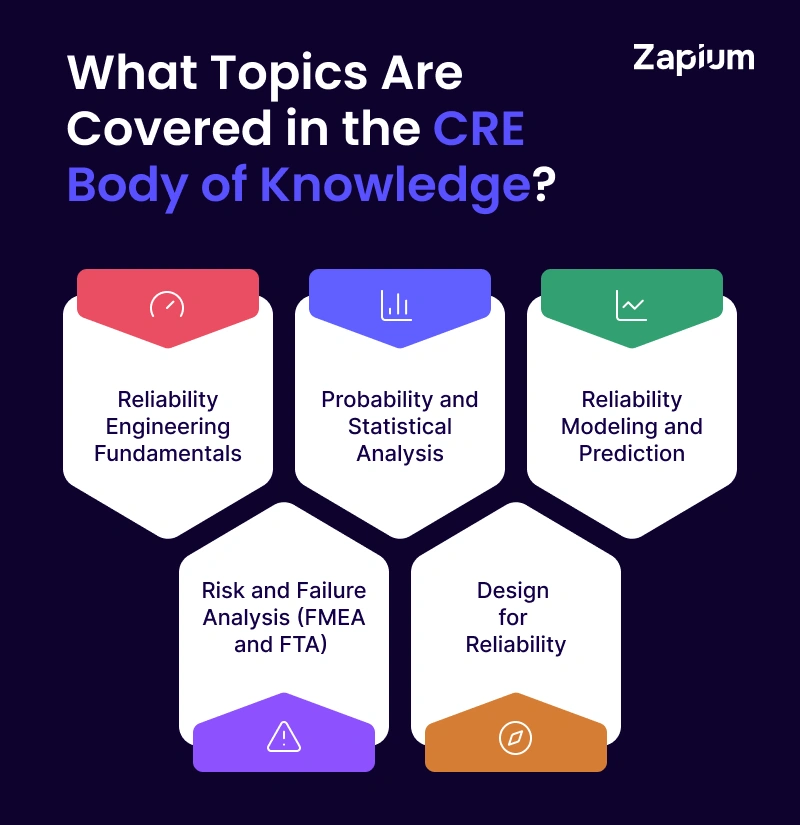
The CRE Body of Knowledge focuses on reliability engineering principles and analytical techniques used to evaluate and improve system reliability. The certification emphasizes both theoretical understanding and practical application of reliability analysis methods.
Reliability Engineering Fundamentals
Reliability engineering fundamentals introduce the core concepts used to measure and manage system reliability. Professionals learn about reliability metrics, reliability life cycles, reliability program planning, and reliability performance evaluation.
This domain also addresses the role of reliability engineering within product development and manufacturing systems. Engineers learn how reliability programs support long-term product performance and reduce operational risks associated with system failures.
Probability and Statistical Analysis
Statistical analysis plays a critical role in reliability engineering. Engineers study probability distributions, statistical inference methods, and reliability data interpretation techniques.
Professionals learn how statistical tools help estimate failure probabilities, evaluate reliability trends, and analyze reliability data gathered during testing or operational monitoring. Understanding statistical reliability models allows engineers to make informed decisions about product design improvements and system performance.
Reliability Modeling and Prediction
Reliability modeling helps engineers estimate system reliability under different operating conditions. Engineers study modeling techniques such as reliability block diagrams, fault tree analysis structures, and life data analysis.
These tools allow reliability professionals to predict system behavior, evaluate potential failure scenarios, and identify components that present higher reliability risks. Reliability prediction models are widely used in industries that design complex systems such as aerospace equipment, industrial machinery, and electronic products.
Risk and Failure Analysis (FMEA and FTA)
Failure analysis techniques help engineers identify potential system failures before they occur. The CRE Body of Knowledge includes structured failure analysis methods such as Failure Modes and Effects Analysis (FMEA) and Fault Tree Analysis (FTA).
These analytical tools help engineers understand how system components may fail and how those failures could affect overall system performance. Engineers use these methods to prioritize reliability improvements and reduce operational risks.
Design for Reliability
Design for reliability focuses on integrating reliability considerations during product design stages. Engineers learn how design decisions influence system reliability and long-term product performance.
Topics include reliability growth testing, redundancy planning, reliability testing strategies, and design verification processes. By incorporating reliability principles during design stages, engineers reduce the probability of product failures after deployment.
What Is the Structure of the CRE Exam?
The CRE exam evaluates both engineering knowledge and statistical reasoning. The exam contains questions that test reliability engineering theory, statistical analysis methods, and practical reliability engineering applications.
Questions require candidates to interpret reliability data, evaluate failure scenarios, and apply analytical techniques to reliability problems.
How Many Questions Are on the CRE Exam?
The CRE exam typically contains 165 multiple-choice questions, including both scored and unscored items. These questions evaluate knowledge across the entire CRE Body of Knowledge.
How Long Is the CRE Exam?
Candidates are given 5 hours and 18 minutes to complete the exam. Because of the exam length and analytical complexity, candidates must manage their time carefully when reviewing statistical and engineering problems.
What Statistical Knowledge Is Required for CRE?
Statistical knowledge plays a significant role in the CRE exam. Candidates must understand probability distributions, reliability estimation techniques, hypothesis testing, and statistical reliability modeling methods.
Engineers also need to interpret reliability data, evaluate failure probability trends, and apply statistical methods to reliability testing results. For many candidates, the statistical portion of the exam represents one of the more challenging aspects of the certification process.
What Are the Eligibility Requirements for CRE?
CRE certification has more defined eligibility criteria compared to some other reliability certifications. Because the certification focuses on engineering reliability analysis, candidates must demonstrate professional experience in engineering or reliability-related roles.
Is an Engineering Degree Required for CRE?
An engineering degree is not strictly required for CRE certification. However, candidates with engineering or technical degrees meet CRE exam requirements more easily because of their familiarity with engineering systems and analytical methods. Professionals with degrees in engineering, statistics, mathematics, or applied sciences commonly pursue the certification.
How Much Work Experience Is Required for CRE?
Candidates usually need several years of professional experience in reliability engineering, quality engineering, or related technical roles. Engineers working with reliability testing, product design evaluation, or statistical analysis meet the experience requirements more easily.
How Does CRE Recertification Work?
Like many professional certifications, CRE must be renewed periodically to maintain active certification status. Recertification ensures that professionals continue participating in professional development activities related to reliability engineering.
What Are Recertification Units (RUs)?
Recertification Units (RUs) represent professional development activities that contribute to ongoing learning. These activities may include attending professional conferences, completing training programs, publishing technical articles, or participating in reliability engineering workshops.
How Often Must CRE Be Renewed?
CRE certification must be renewed every three years. During this period, certification holders accumulate the required Recertification Units and submit documentation to maintain their certification status.
Participation in industry events, professional training programs, and technical publications helps engineers accumulate the required credits. Over the years, I have noticed many reliability engineers using industry conferences and technical workshops as their primary method of maintaining certification requirements.
What Are the Key Differences Between CMRP and CRE?
Although both certifications address reliability, they focus on different professional functions within industrial environments. One credential centers on maintenance and asset reliability management, while the other emphasizes engineering analysis and reliability modeling.
Certification Focus: Maintenance Management vs Reliability Engineering
The Certified Maintenance and Reliability Professional certification primarily focuses on maintenance strategy, asset reliability management, and operational performance improvement within industrial facilities.
Professionals holding this certification typically work in plant operations, maintenance planning, and reliability programs designed to improve equipment performance and reduce operational downtime.
The Certified Reliability Engineer certification, in contrast, concentrates on engineering reliability analysis and product reliability evaluation. Engineers applying this certification work with statistical models, reliability testing, and system design reliability.
While both certifications contribute to reliability improvement, they operate at different stages of the reliability lifecycle.
Technical Depth and Analytical Requirements
CMRP certification focuses on maintenance strategies, leadership, asset management practices, and reliability program development within operational facilities. Analytical knowledge is important, but the exam places greater emphasis on management practices and reliability program implementation.
CRE certification requires stronger analytical skills and statistical understanding. Engineers must interpret reliability data, apply statistical distributions, and evaluate reliability models during reliability analysis.
Industry Applications and Career Paths
The maintenance reliability certification is widely recognized in industries that rely heavily on large-scale equipment operations. Maintenance professionals responsible for asset reliability programs frequently pursue this credential.
CRE certification appears more frequently in engineering environments that focus on product reliability, design reliability, and quality engineering. Industries developing complex technical products value engineers who understand reliability modeling and reliability testing.
As a result, the two certifications support different but complementary career paths within reliability disciplines.
CMRP vs CRE Certification Comparison
| Factor | CMRP Certification | CRE Certification |
|---|---|---|
Certification Body | Society for Maintenance & Reliability Professionals | American Society for Quality |
Primary Focus | Maintenance and asset reliability management | Reliability engineering and statistical analysis |
Target Professionals | Maintenance managers, reliability leaders, plant engineers | Reliability engineers, design engineers, quality engineers |
Technical Emphasis | Maintenance strategy and reliability programs | Reliability modeling and statistical reliability analysis |
Core Knowledge Areas | Asset management, work management, leadership | Probability, reliability engineering, failure analysis |
Exam Duration | About 2.5 hours | About 5 hours |
Mathematical Depth | Moderate | High |
Career Orientation | Industrial operations and maintenance leadership | Engineering reliability analysis and product reliability |
Which Certification Has Greater Global Recognition?
Both certifications hold strong global recognition, although their visibility depends on the industry environment.
The SMRP CMRP certification has strong recognition within maintenance and asset management communities, especially in manufacturing plants, power generation facilities, and industrial maintenance organizations.
The ASQ CRE certification is widely recognized within engineering and quality management communities. Engineers working in product design, aerospace engineering, and electronics manufacturing recognize CRE as a specialized reliability engineering credential.
Which Certification Requires Strong Statistical Knowledge?
CRE certification demands stronger statistical knowledge than CMRP certification. The exam evaluates a candidate’s ability to analyze probability distributions, interpret reliability data, and apply statistical reliability models.
Candidates review topics such as life data analysis, statistical process control concepts, reliability distributions, and reliability prediction models when preparing for CRE.
CMRP certification, on the other hand, focuses more on reliability program management, maintenance planning, and operational improvement strategies rather than detailed statistical analysis.
Which Credential Is Better for Maintenance Leadership?
Professionals pursuing leadership roles in maintenance management benefit more from CMRP certification.
Maintenance managers, reliability leaders, and asset management professionals frequently use CMRP knowledge when developing maintenance strategies, improving equipment reliability programs, and managing maintenance teams within industrial facilities.
Leadership roles within plant operations frequently value professionals who understand reliability management principles and maintenance planning strategies.
Which Certification Fits Reliability Engineers?
Reliability engineers responsible for reliability modeling, reliability testing, and statistical reliability analysis generally benefit more from the reliability engineering certification.
The credential aligns closely with engineering responsibilities such as reliability prediction, failure analysis, product reliability testing, and system reliability evaluation.
Engineers working in product design and manufacturing environments pursue CRE certification to demonstrate expertise in reliability engineering methods.
Which Certification Is Harder: CMRP or CRE?
Exam difficulty depends largely on a candidate’s professional background. Maintenance professionals find CMRP easier to approach because the exam focuses on operational practices, asset reliability strategies, and maintenance management.
CRE certification tends to present a greater challenge for candidates unfamiliar with statistical reliability methods. Many exam questions require interpretation of reliability models, statistical distributions, and analytical engineering concepts.
For professionals comfortable with statistical analysis and engineering modeling, the exam becomes more manageable. However, candidates without that background may need additional preparation time.
How Do CMRP and CRE Impact Salary and Career Growth?
Both certifications support career growth by validating specialized expertise in reliability management and engineering reliability analysis. Organizations value professionals who can improve system reliability, reduce equipment failures, and optimize operational performance.
Professionals holding these certifications qualify for leadership positions, specialized engineering roles, and reliability program management responsibilities.
Typical Career Paths After CMRP
CMRP certification supports career advancement in operational reliability and maintenance leadership. Common career paths after CMRP are:
- Maintenance Manager
- Reliability Manager
- Asset Management Specialist
- Maintenance Planning Manager
- Plant Maintenance Director
Typical Career Paths After CRE
CRE certification supports engineering-focused career advancement in reliability engineering and quality engineering environments. Common career paths after CRE include:
- Reliability Engineer
- Product Reliability Engineer
- Systems Reliability Engineer
- Quality Engineer
- Reliability Analysis Specialist
Industries That Value Each Certification
Several industries value reliability certifications because of their reliance on reliable equipment, complex manufacturing systems, and long-term product performance. Industries commonly associated with CMRP certification include:
- Manufacturing
- Power generation
- Oil and gas
- Mining
- Utilities
Industries commonly associated with CRE certification include:
- Aerospace engineering
- Automotive manufacturing
- Electronics manufacturing
- Medical device manufacturing
- Defense systems engineering
Which Certification Should You Choose: CMRP or CRE?
Choosing between the two certifications requires evaluating your current role, technical strengths, and long-term career goals.
Professionals working in operational maintenance environments may benefit more from a certification focused on reliability management and maintenance strategies. Engineers working in product development or system design reliability may find greater value in a certification emphasizing engineering analysis.
Before choosing a certification, I usually recommend evaluating the type of reliability problems you solve in your daily work.
When is CMRP the Better Choice?
CMRP certification is the better option for professionals who focus on operational asset reliability and maintenance program management. Professionals will benefit from CMRP if they work in:
- Maintenance leadership roles
- Industrial asset reliability programs
- Plant maintenance management
- Maintenance planning and scheduling
When is CRE the Better Choice?
CRE certification is the better option for professionals who focus on engineering reliability analysis and product reliability evaluation. Professionals will benefit from CRE if they work in:
- Reliability engineering
- Product design engineering
- Reliability testing and modeling
- Quality engineering
How Career Stage Influences Certification Choice
Early-career engineers may pursue CRE certification to build specialized reliability engineering expertise. The credential can strengthen analytical engineering skills and demonstrate proficiency in reliability analysis.
Mid-career maintenance professionals pursue CMRP certification as they transition into leadership roles within maintenance organizations. The credential validates knowledge of reliability management practices and asset management strategies.
Professionals already working in reliability leadership roles may pursue either certification depending on their responsibilities.
Can Professionals Hold Both CMRP and CRE Certifications?
Yes, professionals can hold both certifications if their roles require expertise in both maintenance reliability management and reliability engineering analysis.
Some professionals pursue CMRP earlier in their careers while working in operational maintenance environments. Later, they pursue CRE to strengthen engineering reliability knowledge.
Holding both certifications demonstrates a broad understanding of reliability practices across both operational and engineering domains. Over time, I have seen experienced reliability professionals combine both credentials to support leadership roles in enterprise reliability programs.
How Should You Prepare for the CMRP and CRE Exams?
Preparation strategies differ slightly because the certifications test different types of knowledge. However, structured preparation remains essential for both exams.
Recommended Study Resources
Professionals preparing for reliability certification exams use a combination of learning resources. Common preparation resources include:
- Official Body of Knowledge publications
- Professional certification preparation guides
- Industry training courses
- Reliability engineering textbooks
- Practice exams and question banks
Common Study Strategies for Reliability Certification Exams
Many candidates adopt structured study approaches that focus on reviewing the entire Body of Knowledge before practicing exam questions. Following are the effective strategies that professionals seeking to pursue these certifications must adopt:
- Developing a structured study schedule
- Reviewing reliability terminology and concepts regularly
- Solving practice exam questions
- Studying statistical concepts for CRE preparation
- Participating in study groups or training workshops
What Common Mistakes Do Candidates Make When Choosing or Preparing for These Certifications?
Following are common mistakes that candidates looking to pursue CMRP or CRE commit:
- Choosing a certification without evaluating career goals
- Underestimating the statistical requirements of the CRE exam
- Ignoring the full Body of Knowledge during exam preparation
- Relying only on practice exams rather than conceptual study
- Starting exam preparation too close to the exam date