
What is Predictive Maintenance?


Predictive maintenance is a proactive approach that uses data and analytics to anticipate equipment issues before they lead to failure. Unlike preventive maintenance, which relies on fixed schedules, or reactive maintenance, which occurs after breakdowns, predictive maintenance is driven by real‑time monitoring of asset conditions.
This blog explores predictive maintenance (PdM) in depth, covering its principles, technologies, benefits, and applications across industries. From the role of sensors and machine learning to practical implementation strategies, it provides a comprehensive guide for organizations seeking to implement PdM. Whether you are a plant manager, engineer, or decision‑maker, this blog will help you understand how predictive maintenance transforms traditional maintenance practices into smarter, evidence‑based actions.
Why is Predictive Maintenance Important?
Unplanned downtime remains one of the largest cost drivers in asset-intensive industries. A report by Deloitte states that unplanned downtime costs industrial manufacturers an estimated $50 billion per year, and equipment failure accounts for 42% of that unplanned downtime. Such numbers reshape how leadership views maintenance.
Reactive maintenance drives high repair cost, production loss, overtime labor, and safety risk. Preventive maintenance reduces failure frequency but introduces unnecessary part replacement and labor when schedules do not align with actual asset health. Predictive maintenance addresses both problems as it:
- Reduces unexpected breakdowns.
- Aligns intervention with actual degradation.
- Supports production planning.
- Strengthens the safety culture.
- Supports asset longevity.
McKinsey reports that predictive maintenance reduces maintenance costs by 10–40%, reduces downtime by 30–50%, and extends machine life by 20–40%. These figures come from aggregated industry deployments and provide strong evidence for leadership decisions.
How Does Predictive Maintenance Work?
There is a structured workflow that gives shape to predictive maintenance, where raw machine data is converted into clear maintenance action. Each stage builds on the previous one, moving from signal capture to informed intervention. The process below explains how that workflow operates:
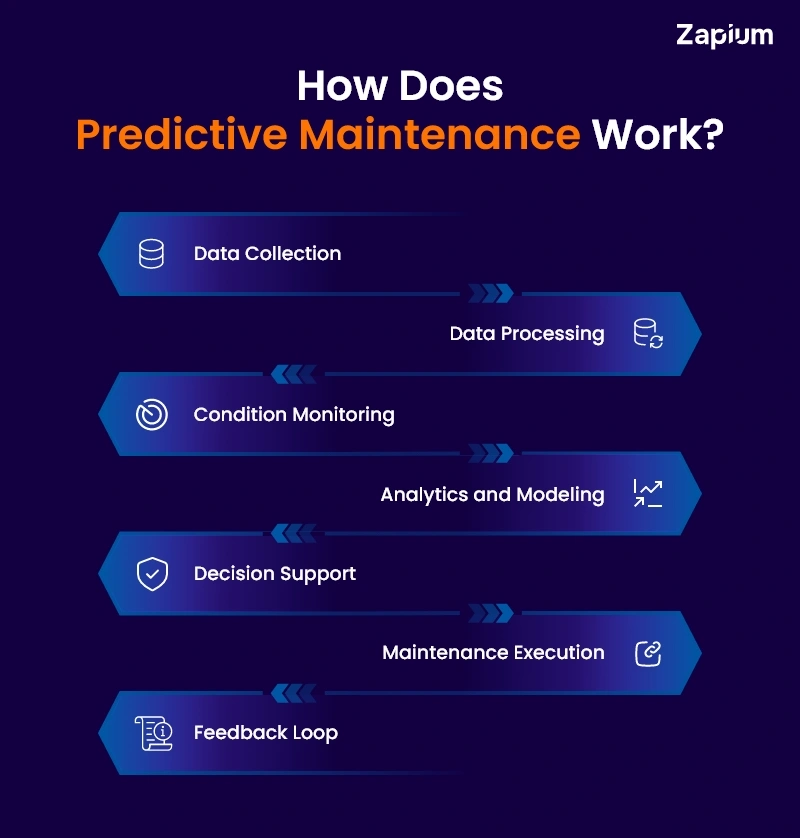
- Data Collection
Sensors capture operational parameters such as vibration, temperature, pressure, and electrical signals while equipment runs under actual load. Maintenance teams combine that real-time data with historical maintenance and failure records to establish a reliable health baseline.
- Data Processing
Engineers clean, filter, and structure collected data to remove noise, signal distortion, and inconsistencies. Proper processing produces accurate datasets that reflect real machine behavior and support dependable technical interpretation.
- Condition Monitoring
Reliability teams track selected health indicators against defined operating limits and baseline signatures. Continuous observation highlights deviations from normal patterns, revealing early signs of wear, imbalance, lubrication failure, or electrical stress.
- Analytics and Modeling
Analysts apply statistical methods and trained machine learning models to interpret trends and fault signatures. Those models detect pattern shifts, classify failure types, and estimate remaining useful life based on degradation rate.
- Decision Support
The system converts analytical findings into clear maintenance recommendations. Planners receive alerts that specify asset location, fault type, and urgency level, allowing structured scheduling instead of emergency response.
- Maintenance Execution
Technicians perform targeted repairs or component replacements within the predicted intervention window. Timely action prevents breakdown, protects surrounding components from secondary damage, and preserves production stability.
- Feedback Loop
Post-repair inspection results return to the data system for validation. Confirmed findings refine diagnostic accuracy, strengthen prediction models, and build long-term confidence in the predictive maintenance framework.
What Technologies Enable Predictive Maintenance?
Following are the key technologies that enable predictive maintenance (PdM). Each plays a distinct role in capturing, transmitting, processing, and analyzing machine data to anticipate failures and optimize asset reliability:
1. Sensors and Condition MonitoringSensors are closest to the asset and capture measurable physical behavior. They are a key part of the condition monitoring system which
- Measure vibration amplitude and frequency to detect imbalance and bearing defects
- Track temperature rise linked to friction or insulation stress
- Monitor lubricant quality through particle count and viscosity
- Aggregate time-series data under structured asset tags
IIoT provides the communication backbone that moves field data into centralized monitoring environments without manual intervention. In a PdM ecosystem, it plays a key technical role and helps
- Connect sensors and PLCs through protocols such as OPC UA or MQTT
- Transmit real-time operational data across distributed facilities
- Maintain synchronized timestamps for multi-asset comparison
- Support centralized dashboards for asset health visibility
Edge systems process data near the machine to reduce latency and manage high-frequency signals efficiently. They are central to PdM and help
- Perform signal conditioning and filtering at the source
- Execute FFT analysis for vibration diagnostics
- Extract indicators such as RMS, kurtosis, and crest factor
- Trigger local alerts when abnormal patterns appear
Cloud infrastructure stores large volumes of operational and maintenance data, enabling historical depth and cross-functional analysis, eliminating the dependence on on-premise infrastructure. In PdM, the cloud
- Stores high-frequency time-series sensor data
- Integrates maintenance logs and failure codes
- Enables long-term degradation trending
- Supports fleet-level reliability comparison across sites
The data after going through a series of cleaning operations must be converted into insights that help in taking right maintenance decisions. It is with ML and AIl that data is converted into predictive insights. Some examples include:
- Classification of fault types using labeled historical datasets
- Modelling of degradation rate and remaining useful life
- Detection multivariate anomalies across combined sensor inputs
- Recalibration of prediction accuracy using validated failure outcomes
Types of Predictive Maintenance Techniques
Types of predictive maintenance range from IoT-based sensor monitoring to thermal analysis and current and power monitoring. PdM implements advanced methods and technologies to monitor equipment health and predict potential failures.
6 main types of predictive maintenance are
- IoT-Based Sensor Monitoring
- Vibration Analysis
- Oil Analysis
- Thermal Imaging
- Ultrasonic Testing
- Current and Power Monitoring
- IoT-Based Sensor Monitoring
Parameters such as temperature, vibration, humidity, and pressure are monitored using IoT devices that collect real-time data and transmit it to central storage through an IoT network. These sensors help detect anomalies and predict failures, making them suitable for manufacturing plants, power grids, and HVAC systems. This predictive maintenance type enables real-time monitoring, reduces manual inspections, minimizes downtime, and increases the accuracy of maintenance predictions.
- Vibration Analysis
Machinery vibration patterns are monitored and analyzed to detect imbalances, misalignments or bearing issues. Vibration sensors measure vibration frequency and amplitude, which are analyzed to detect potential failures early and reduce unplanned downtime. Commonly used in rotating equipment such as motors, turbines, pumps and compressors, vibration analysis ensures smooth operations, extends equipment life, increases safety and improves maintenance efficiency.
- Oil Analysis
Lubricant quality and composition are evaluated using oil analysis to detect contamination, wear particles or chemical degradation. It is mainly used in automotive, manufacturing and energy industries to monitor engines, gearboxes, turbines and hydraulic systems. It uses advanced tools and sensors to analyze oil’s chemical and physical properties for contaminants, viscosity, oxidation and metal particles. This optimizes oil change intervals, detects early signs of equipment wear, extends asset life, reduces maintenance cost, and minimizes production halt.
- Thermal Imaging
Using infrared cameras, thermal imaging detects heat patterns and temperature variations in equipment. It shows heat signatures and hotspots that indicate overheating, friction, electrical failure, or potential failure points. Common in electrical panels, motors, power transformers, and HVAC systems, thermal imaging prevents equipment failure by spotting early signs of wear and tear, enhances safety and system reliability, and minimizes downtime and maintenance costs.
- Ultrasonic Testing
High-frequency sound waves are transmitted into materials, and reflections are analyzed to detect structural abnormalities and inconsistencies. Ultrasonic testing is used in pipelines, pressure vessels, and structural components across industries such as oil and gas, aerospace, and construction. It detects cracks, corrosion, or thinning in pipes, tanks, and machinery, as well as leaks in compressed air, gas, or steam systems. It also prevents catastrophic failures and ensures workplace safety.
- Current and Power Monitoring
Real-time electrical parameters like voltage, current, and power factor are measured and analyzed to detect overloads, inefficiencies, and impending electrical failures. This type of predictive maintenance is applied to motors, pumps, compressors, generators, lighting, and other electrical systems. It prevents unexpected shutdowns, reduces energy consumption, improves power quality, optimizes power capacity, enhances operational efficiency, and reduces operational costs.
How Is Condition-Based Maintenance Different from Predictive Maintenance?
Condition-based maintenance (CBM) and predictive maintenance (PdM) are two different maintenance approaches that are based on different decision logics. The former reacts to measurable asset conditions crossing defined limits, while the latter applies statistical and analytical models to anticipate failure before clear warning signs appear. The table below compares both these approaches across a range of parameters:
| Parameter | Condition-Based Maintenance (CBM) | Predictive Maintenance (PdM) |
|---|---|---|
Core Principle | Maintenance is triggered when monitored parameters cross predefined thresholds. | Maintenance is scheduled based on failure predictions generated through data modeling and analytics. |
Decision Logic | Rule-based decisions (e.g., vibration > limit, temperature > threshold). | Model-based decisions using algorithms, trend analysis, and probability calculations. |
Data Usage | Uses real-time condition data from sensors and inspections. | Uses historical data, real-time sensor data, and contextual variables for pattern recognition. |
Analytical Complexity | Relatively straightforward; relies on alerts and limit values. | More advanced; uses machine learning, regression models, or statistical forecasting. |
Timing of Intervention | Action occurs after a measurable deviation is detected. | Action is taken before measurable failure symptoms fully develop. |
Failure Forecasting Capability | Detects abnormal conditions but does not estimate remaining useful life (RUL). | Estimates remaining useful life and predicts probable failure windows. |
Risk Reduction Approach | Reduces unexpected breakdowns by responding to early warning signals. | Reduces risk by identifying hidden degradation patterns before alarms are triggered. |
When Should Predictive Maintenance Be Used?
Rolling out predictive maintenance (PdM) across every asset might look progressive on paper but drains budgets without proportional returns. Below we look the suitability of PdM based on assets:
- Suitable Assets for PdM
Selecting the right equipment is the first practical step before committing resources to predictive maintenance. PdM does not deliver equal value across all asset categories, so identifying where condition monitoring can genuinely influence maintenance timing and reduce operational risk becomes critical. Following are the assets that are suitable for applying PdM.
- Rotating Equipment
Motors, pumps, compressors, turbines, and gearboxes are classic PdM candidates. Mechanical imbalance, bearing wear, and misalignment produce measurable vibration signatures well before breakdown.
- High-Speed or High-Load Machinery
Machines operating under continuous stress show thermal, acoustic, or lubrication changes as degradation sets in. Predictive monitoring captures these shifts before efficiency drops or failure escalates.
- Production-Critical Assets
Equipment that forms a single point of failure in manufacturing lines, utilities, or data centers is strategically important. Predictive insights protect throughput of these assets.
- Electrical Distribution Systems
Transformers, switchgear, and circuit breakers show warning indicators such as partial discharge, insulation breakdown, and thermal anomalies. Infrared thermography and electrical signature analysis support proactive action.
- Assets With Historical Failure Data
Equipment with documented maintenance records provides a baseline for trend comparison. Predictive algorithms perform better when historical patterns exist.
- Remote or Hard-to-Access Equipment
Offshore platforms, wind turbines, remote substations, and mining equipment benefit from condition monitoring because physical inspection is difficult or expensive.
- Unsuitable Assets for PdM
Some assets simply do not justify predictive investment. Applying PdM indiscriminately creates overhead without measurable gain. These equipment are:
- Low-Cost, Easily Replaceable Components
Light bulbs, small valves, belts in non-critical systems, and inexpensive filters often cost less to replace on schedule than to monitor continuously.
- Run-to-Failure Equipment
Where failure carries minimal operational or safety impact, reactive replacement remains practical. Attempting prediction can add unnecessary complexity.
- Assets With Sudden, Random Failure Modes
Certain electronic components fail abruptly without gradual warning signs. If degradation cannot be measured, predictive monitoring provides limited value.
- Redundant Systems
When multiple backup units exist and failure of one does not disrupt operations, time-based or corrective maintenance may suffice.
- Assets With Insufficient Data Infrastructure
If sensors cannot be installed reliably, or if environmental conditions corrupt data quality, predictive analysis becomes speculative rather than actionable.
- Extremely Stable Equipment
Some systems operate under tightly controlled conditions with minimal wear variation. In such cases, time-based maintenance remains simpler and equally effective.
What Are the Benefits of Predictive Maintenance?
Predictive maintenance (PdM) is known for bringing significant turnarounds for businesses that have actively embraced it. Following are some vital benefits of PdM:
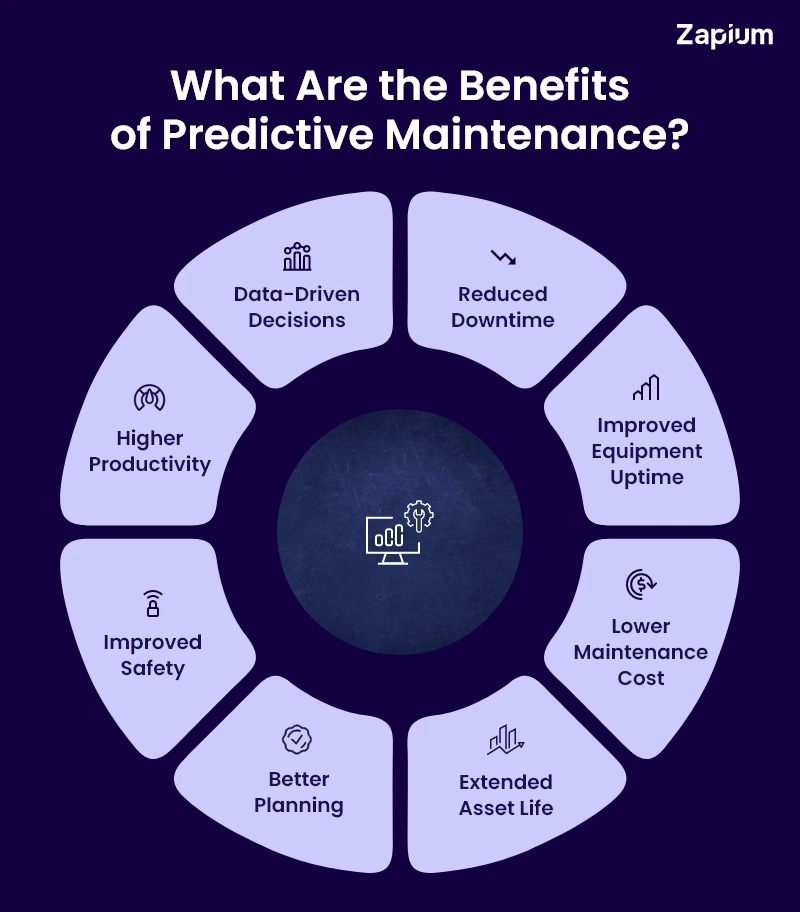
- Reduced downtime
Predictive maintenance catches problems early, helping teams fix issues before they escalate into failures. Many organizations report significant cuts in unplanned downtime – reducing it by up to 30–50 %, which keeps production moving and avoids costly stops. Predictive maintenance reduces unplanned downtime by up to 50%.
- Improved equipment uptime
By using sensor insights and analytics to predict when machines need attention, companies can keep equipment operating longer and more reliably, with many seeing 10–20 % increases in uptime and availability.
- Lower maintenance cost
Targeted maintenance cuts unnecessary work and saves money. Studies show predictive maintenance can lower overall maintenance costs by around 18–25 % compared with reactive approaches, reducing rush repairs and wasted part replacements. Predictive maintenance cuts maintenance costs 18–25%.
- Extended asset life
Early detection of wear and stress helps machines avoid catastrophic failures. Data shows predictive maintenance strategies can help extend the useful life of assets by 20–40 %, delaying expensive replacements. Predictive maintenance extends machine life 20–40%.
- Better planning
Teams can schedule maintenance during planned downtime instead of chasing emergencies. Predictive tools improve maintenance planning efficiency and reduce reactive firefighting, giving maintenance staff more runway to organize work logically. Predictive maintenance planning time reduced 10–20%.
- Improved safety
Predictive systems help reveal degrading conditions that might lead to dangerous equipment failures. By fixing problems before they occur, organizations reduce accident risks and create safer work environments. While specific safety percentages vary by study, many maintenance leaders regard safety improvement as a significant benefit of predictive approaches.
- Higher productivity
With fewer surprises and better uptime, production flows more smoothly. By reducing unplanned stops and prioritizing the right maintenance tasks, teams can focus on delivering output – many organizations report measurable productivity gains tied to predictive maintenance.
- Data-driven decisions
Predictive maintenance gives leadership real data about equipment health, failure trends, and maintenance needs. Armed with reliable analytics, companies can make informed choices about repairs, staffing, and capital investments, strengthening operational decisions.
How to Implement a Predictive Maintenance Program
1. Identify critical assetsAs a first step, it is important to evaluate the criticality of every asset because some assets are more critical than others. Evaluate assets based on:
- Impact on production (downtime cost per hour)
- Safety implications
- Environmental risk
- Repair or replacement cost
- Lead time for spare parts
- Failure history
Also, rank equipment into high, medium, and low criticality categories. Focus predictive efforts on:
- Bottleneck machines
- High-cost or long lead-time assets
- Equipment with frequent or unpredictable failures
Start with a pilot group of 5–10 high-value assets to keep the program focused and manageable.
2. Select maintenance techniquesOnce critical assets are identified, choose the right predictive techniques. Consider questions like “how does this asset typically fail?”, “what would be the most appropriate maintenance technique for this problem”
Also, it is important that you do not install every technology everywhere. Select techniques aligned with the most common and costly failure modes as predictive maintenance should be targeted, not excessive.
3. Install sensorsThe next key step is to install sensors, where you need to be aware of:
- Sensor placement (close to failure points)
- Calibration standards
- Data transmission (wired vs wireless)
- Network reliability
- Cybersecurity compliance
Installation should follow engineering standards as improper sensor placement will result in misleading data and undermine confidence in the program. Sensor deployment is not complete until the data stream is stable and trustworthy. As a result, during this phase:
- Document baseline readings
- Tag assets correctly in the system
- Validate signal quality before full rollout
Predictive analytics depends on data. Identify all data sources and build a pipeline to feed relevant data to machine learning and AI algorithms. Gather data from
- Past failure records
- Maintenance logs
- Downtime reports
- Spare part consumption
- Operating conditions
- OEM recommendations
The ETL (extract, transform, and load) pipeline should prepare the data for the context. It should clean the data, remove duplicates, standardize naming conventions, and align timestamps. These steps may seem elementary but they are critical to providing analytical systems with useful data.
5. Apply analytics and modelsOnce quality data is available, the focus shifts from condition monitoring to prediction. The objective at this stage is to convert raw signals into decision-support insights. Start with simple analytical methods to establish normal behavior, then gradually introduce predictive models as data maturity improves. Analytics has value only if it translates into action.
6. Integrate with maintenance systemsPredictive insights must feed into the maintenance workflow and so integrate the predictive platform with:
- CMMS (Computerized Maintenance Management System)
- ERP systems
- Spare parts inventory
- Work order systems
Now, when an alert gets generated, it should:
- Create a work request
- Assign priority
- Allocate technician
- Reserve spare parts
Technology adoption depends on workforce understanding and ownership. Training is essential as it helps technicians, planners, and operations teams interpret predictive insights correctly and act with confidence. The focus should be on practical application rather than theoretical concepts. Enable cross-trainings that equip technicians to understand issues surrounding not just maintenance but beyond that. Like technicians should be:
- Alert about meaning and severity levels
- Know how to interpret trend graphs
- Know how to validate model outputs during inspection
- Understand how cross-functional dependencies work
After integration and training, continuously track measurable outcomes such as reduction in unplanned downtime, MTBF improvement, maintenance cost trends, predictive versus reactive work ratio, and asset availability. Through these indicators, you will be able to gauge if predictive insights are delivering real operational value.
At the same time, review alert accuracy by analyzing false positives and missed failures. Adjust thresholds, retrain models with updated data, and recalibrate sensors if needed. Next, conduct periodic performance reviews to assess ROI and identify expansion or capability gaps.
What Are the Common Challenges in Implementing Predictive Maintenance?
Adopting predictive maintenance may look like a purely technical upgrade, but the reality is more complex. Beyond installing sensors and deploying analytics, organizations must align systems, people, processes, and budgets, as the following challenges explain:
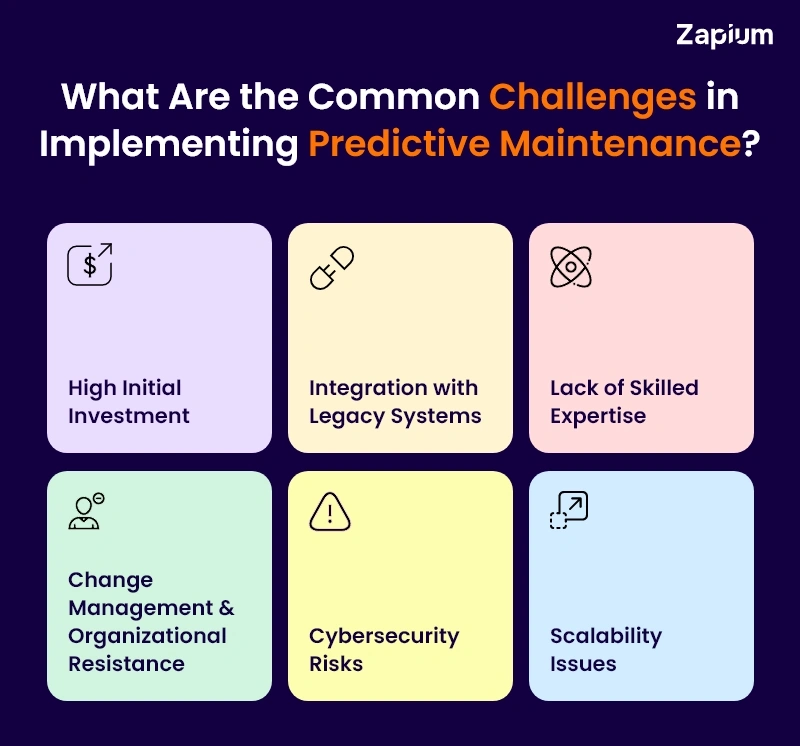
- High Initial Investment
Setting up predictive maintenance requires investment in IoT sensors, data infrastructure, predictive maintenance software platforms, and skilled professionals, which can be expensive for organizations with limited capital budgets.
- Integration with Legacy Systems
Many organizations operate on legacy infrastructure. But integrating modern predictive tools with legacy infrastructure requires customization and complex system upgrades.
- Lack of Skilled Expertise
Successful implementation demands data scientists, reliability engineers, and domain experts. To find the most talented sources is a cost-intensive exercise as it requires both time and money.
- Change Management and Organizational Resistance
Shifting from reactive or preventive maintenance to predictive strategies requires cultural change. Teams may resist new workflows, analytics-driven decisions, or automated alerts.
- Cybersecurity Risks
Connected sensors and cloud platforms increase exposure to cyber threats. Weak security controls can compromise sensitive operational data and disrupt industrial systems.
- Scalability Issues
Pilot projects may work well, but scaling predictive maintenance across multiple plants or assets requires standardized processes, robust infrastructure, and continuous model monitoring.
What Are the Best Practices for Predictive Maintenance?
The success of PdM requires not just technology adoption but disciplined execution, cross-functional collaboration, and a structured roadmap. In this endeavour, the following best practices help build a predictive maintenance program that delivers measurable business impact while scaling sustainably across operations.
- Start with high-impact assets
Focus on critical equipment that significantly affects production, safety, compliance, or revenue. Prioritizing high-value assets delivers faster ROI, stronger executive support, and measurable business impact before expanding to lower-risk equipment.
- Ensure data quality
Accurate predictions require clean, consistent, and complete data. Validate sensor readings, remove duplicates, handle missing values, and standardize formats. Poor data quality leads to unreliable models and weak stakeholder confidence.
- Use the right sensors
Select sensors based on failure modes and asset characteristics. Vibration, temperature, pressure, acoustic, or oil analysis sensors should align with known degradation patterns. Over-instrumentation increases cost without improving predictive accuracy.
- Align IT and OT teams
Predictive maintenance sits at the intersection of operations and technology. Collaboration between IT (data infrastructure, cybersecurity) and OT (equipment expertise, maintenance practices) reduces silos and accelerates deployment success.
- Integrate with CMMS
Link predictive insights with your computerized maintenance management system (CMMS). Automated work order generation, maintenance scheduling, and historical tracking convert predictions into actionable operational tasks.
- Review models regularly
Asset behavior changes due to aging, environmental conditions, and usage patterns. Retrain and validate models periodically to prevent performance drift and maintain prediction accuracy over time.
- Scale gradually
Begin with a pilot project to validate assumptions, measure savings, and refine workflows. Once proven, expand incrementally across plants, lines, or asset categories rather than attempting enterprise-wide deployment immediately.
- Track performance metrics
Monitor KPIs such as Mean Time Between Failures (MTBF), maintenance cost reduction, downtime reduction, model accuracy, and false positive rates. Clear maintenance metrics demonstrate value and guide optimization efforts.
- Secure data pipelines
Protect data flows between sensors, edge devices, cloud platforms, and analytics systems. Encryption, access control, and network segmentation reduce cybersecurity risks, especially in industrial environments.
- Maintain sensor accuracy
Regular calibration and inspection of sensors prevent drift and faulty readings. Poorly maintained sensors introduce noise that degrades predictive model reliability and operational trust.
- Standardize workflows
Define clear processes for alert validation, technician response, escalation paths, and documentation. Standardized workflows prevent confusion and help translate predictive signals into consistent maintenance actions.
- Stick to Continuous improvement
Treat predictive maintenance as an evolving capability. Continuously refine the predictive maintenance schedule by incorporating feedback from technicians, updating failure libraries, adjusting thresholds, and adopting improved analytics techniques as maturity increases.
- Follow a Standard Predictive Maintenance Checklist
Adopt a documented PdM checklist to guide implementation and ongoing monitoring activities. It keeps teams aligned, minimizes missed steps, and creates a repeatable structure that supports controlled rollout and long-term program stability.
What Are the Compliance Requirements for Predictive Maintenance?
Below are the key compliance requirements organizations must address when implementing predictive maintenance.
- ISO 55000 (Asset Management)
- ISO 9001 (Quality Management Systems)
- ISO 14224 (Reliability and maintenance data collection)
- ISO 17359 (Condition monitoring and diagnostics guidelines)
- FDA 21 CFR Part 11 (Electronic records and signatures – regulated industries)
- GMP (Good Manufacturing Practices – pharma/manufacturing)
- OSHA safety regulations
- NERC CIP (Critical Infrastructure Protection – energy sector)
- FAA / EASA continuing airworthiness regulations (aviation)
- API standards (Oil & Gas equipment and inspection standards)
- ISO 27001 (Information Security Management)
- NIST Cybersecurity Framework
- Data encryption and access control compliance policies
- Electronic audit trail and record retention compliance
- Model validation and documentation standards
- Model version control and change management procedures
- Periodic model performance monitoring and revalidation requirements
- Risk assessment documentation (e.g., FMEA, SIL where applicable)
What Are Some Examples and Use Cases of Predictive Maintenance?
Predictive maintenance (PdM) is applied where equipment downtime is expensive, safety risks are high, or asset performance directly impacts revenue. Each industry uses different data signals and failure patterns, but the objective remains the same: predict failure before it disrupts operations. Following examples of PdM across industries illustrates how this approach consistently achieves that goal.
- Manufacturing
Sensors monitor vibration, temperature, motor current, and cycle data on production equipment. Analytics detect bearing wear, misalignment, or tool degradation, allowing maintenance during planned downtime instead of interrupting operations.
- Energy and utilities
Transformer oil analysis, thermal imaging, and load monitoring identify insulation breakdown, overheating, or grid instability. Predictive models forecast component failure to prevent outages and maintain grid reliability.
- HVAC and facilities
Performance data from chillers, compressors, and air handling units is analyzed for pressure imbalance, airflow issues, or energy inefficiencies. Maintenance is scheduled before cooling or heating systems fail.
- Automotive
Telematics data tracks engine diagnostics, brake wear, battery health, and fuel patterns. Predictive algorithms flag early mechanical degradation, enabling proactive servicing across fleet vehicles.
- Aerospace
Aircraft sensors collect engine vibration, temperature, and pressure data during flights. Predictive analytics assess component fatigue and performance drift to schedule maintenance before safety-critical failures occur.
- Mining
Heavy equipment sensors track hydraulic pressure, vibration, and engine performance under extreme conditions. Predictive models detect wear patterns and structural stress, reducing unexpected breakdowns in remote sites.
- Railways
Track sensors, wheel monitoring systems, and onboard diagnostics capture vibration and temperature data. Predictive analytics identify rail cracks, wheel defects, and signal equipment failures before service disruption.
- Oil and gas
Pipeline pressure sensors, corrosion monitoring systems, and rotating equipment data detect leaks, pump degradation, and valve malfunction. Predictive models help prevent environmental incidents and production losses.
- Power generation
Turbine vibration, boiler temperature, and generator performance data are continuously analyzed. Predictive systems identify efficiency loss, blade wear, or overheating before forced shutdowns occur.
What Are the Costs Involved in Predictive Maintenance?
While long-term savings are significant, organizations must account for multiple cost components across infrastructure, talent, integration, and ongoing operations. These costs are:
- Sensor and IoT Hardware Costs: Expenses for vibration, temperature, acoustic, pressure, or current sensors installed on critical assets.
- Edge Devices and Gateways: Cost of edge computing devices that collect, preprocess, and transmit sensor data securely.
- Installation and Retrofitting Costs: Labor and engineering effort required to mount sensors and integrate them with legacy equipment.
- Data Infrastructure Costs (Cloud/On-Premise): Storage, processing power, and database expenses for handling high-frequency machine data.
- Data Integration Costs: Expenses related to integrating predictive systems with CMMS, ERP, SCADA, or MES platforms.
- Predictive Analytics Software Licenses: Subscription or licensing fees for AI and machine learning platforms, monitoring tools, or a specialized predictive maintenance solution.
- Model Development and Data Science Costs: Costs associated with building, training, validating, and refining predictive models.
- Data Engineering and Pipeline Development: Resources required to design data pipelines for ingestion, cleansing, transformation, and monitoring.
- Cybersecurity and Compliance Costs: Investments in network security, encryption, access control, and compliance certifications.
- Workforce Training and Upskilling: Training maintenance teams and engineers to interpret predictive insights and use new systems.
- Change Management and Process Redesign: Operational restructuring efforts to shift from reactive or preventive workflows to predictive strategies.
- System Testing and Pilot Program Costs: Initial proof-of-concept and validation phase expenses before scaling deployment.
- Ongoing Monitoring and Model Maintenance: Continuous costs for model retraining, recalibration, and performance evaluation.
- Maintenance of Sensors and Devices: Periodic calibration, replacement, or repair of sensors and connected devices.
- Vendor Support and Managed Services: Annual support contracts or outsourced predictive maintenance services.
- Downtime During Implementation: Temporary productivity loss during installation, testing, or system transition.
- Data Quality Management Costs: Effort required to clean, validate, and standardize machine data to maintain model reliability.
- Scalability and Expansion Costs: Additional expenses when extending predictive maintenance across new assets, plants, or regions.
Why Is Predictive Maintenance Important for Asset Lifespan?
Most equipment shows measurable signs of deterioration such as abnormal vibration, temperature rise, lubricant contamination, pressure fluctuation, or electrical imbalance. Predictive maintenance captures and analyzes these signals using sensors, condition monitoring tools, and historical performance data.
However, asset lifespan improves when maintenance is performed at the right time – not too early and not too late. Data-driven intervention windows reduce unnecessary part replacements and avoid operating equipment under harmful stress conditions. As a result, critical assets remain reliable and productive well beyond what reactive maintenance typically allows.