

Types of Work Order Requests: A Complete Guide for Maintenance Teams

Not all maintenance requests carry the same weight. Some are simple fixes that can wait a few days, while others affect safety, compliance, or critical operations. Understanding the difference early on makes it easier to handle work efficiently and avoid unnecessary disruptions.
I’ve seen firsthand how classifying work requests changes the way teams handle incoming work. Clear categories improve intake, speed up review, and make prioritization decisions much easier, so technicians and supervisors know exactly what needs to be done first.
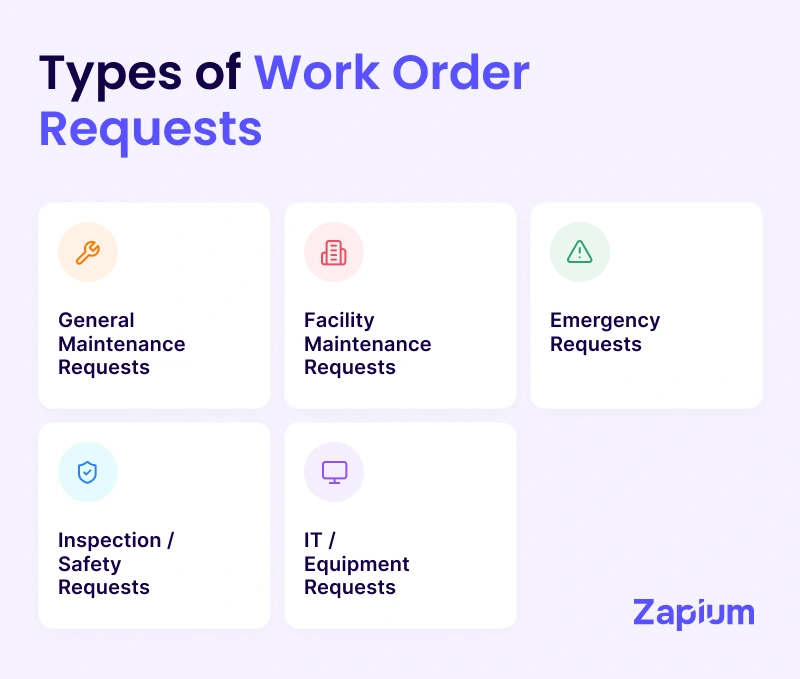
Work order request types classify maintenance requests based on erstand the different types of work ordeurgency, issue type, operational impact, or compliance requirements. Common types include general maintenance requests, facility maintenance requests, emergency maintenance requests, inspection or safety requests, and IT or equipment support requests.
In this guide, I’ll cover the most common types of work order requests used across organizations and explain why distinguishing them matters for smoother, more predictable maintenance operations.
Common Types of Work Order Requests
| Request Type | Typical Scenario | Priority Level |
|---|---|---|
General Maintenance | Routine repairs and adjustments | Low to Medium |
Facility Maintenance | Building systems issues (HVAC, plumbing) | Medium |
Emergency Maintenance | Safety hazards or equipment failures | Critical |
Inspection or Safety Requests | Audit findings and compliance issues | Medium to High |
IT or Equipment Requests | Technology or workstation issues | Medium |
How Work Order Requests Are Classified
Most maintenance organizations end up with similar request types, even if the labels differ. The structure usually forms around urgency, the nature of the issue, who or what environment the request comes from, and whether safety or compliance is at stake. In work order management, each of these dimensions exist for a practical reason tied to daily decision-making.
- By Urgency:
Urgency decides whether a job can wait or whether something else has to stop. An emergency work order request means there is real risk right now, so planned work may need to be paused to deal with it. When urgency is applied the same way every time, supervisors avoid constant priority arguments and can focus on lining up people and work instead of firefighting.
Urgency determines how quickly a request must be addressed. Emergency requests require immediate response, while routine maintenance requests can be scheduled within the normal planning cycle.
- By Nature of the Issue:
The type of problem tells you who should handle the job and how prepared they need to be. Electrical, plumbing, HVAC, mechanical, and IT issues all require different skills, tools, and safety checks. If this is not identified early, work orders get reassigned, technicians show up without the right equipment, and time is lost before any actual maintenance task begins.
The type of problem helps determine which technician, tools, and preparation will be required. Electrical faults, plumbing problems, HVAC issues, mechanical wear, and IT system failures all demand different skill sets and diagnostic approaches. Identifying the nature of the issue early prevents technicians from arriving unprepared or work orders being reassigned after dispatch, both of which waste valuable time.
- By Environment or Requester:
The setting where the issue occurs and who reports it provide critical context. A problem reported from a production floor usually carries a different operational weight than the same issue in an office space. Recognizing this situation prevents low-impact requests from overtaking work that directly affects throughput or safety.
Where the issue occurs and who reports it provides important operational context. A maintenance request from a production floor often carries higher operational impact than a similar issue reported in an office space or storage area. Requests submitted by tenants, operators, or facility staff also vary in the level of technical detail they provide. Recognizing these differences helps maintenance planners understand how the issue affects operations and prioritize accordingly.
- By Compliance or Safety Impact:
Some requests arise because regulations, audits, or safety programs are non-negotiable. These requests cannot be treated as discretionary, even if the equipment is still running. Delays here create exposure that becomes visible only during inspections or after an incident.
Some requests originate from regulatory inspections, safety observations, or audit findings. These requests may not immediately stop operations, but they carry legal or safety implications that cannot be ignored. Treating compliance-related requests the same as routine maintenance can delay corrective action and create exposure during inspections or investigations.
- By Planned vs. Unplanned Origin:
Maintenance requests are also commonly separated based on whether the work was expected or unexpected. Planned requests arise from preventive maintenance schedules, inspections, or condition monitoring observations. Unplanned requests occur when equipment fails, utilities are disrupted, or operational issues appear without warning. Distinguishing between these two helps maintenance teams protect scheduled work from being constantly displaced by reactive tasks.
Let’s now move ahead to understand the different types of work order requests used across maintenance operations.
General Maintenance Work Order Requests
General maintenance requests cover the steady background work that keeps assets usable and facilities functional. They are rarely urgent, but ignoring them long enough creates the very emergencies teams claim they cannot keep up with.
In practice, these requests are used when equipment is still operating and spaces are usable, but something is worn, misaligned, or due for attention. They come from maintenance managers, supervisors, operators or occupants who notice early signs before failure. When intake is clean, these requests feed the planned backlog and help level technician workload.
Examples show up every day. For instance, light replacements, filter changes, lubrication points that were skipped during a shutdown, or minor door and fixture repairs all land here. These tasks are mostly part of a preventive maintenance work order schedule. However, when these requests are misclassified as urgent, planned work is pushed out, and the backlog work orders grow silently.
A standardized intake thus matters because details are easy to miss. Clear asset identification, location, and a brief description prevent rework at dispatch. Teams that skip this step usually compensate by over-assigning senior technicians, which is expensive and unsustainable.
Download: General Maintenance Request Form Template
Facility Maintenance Work Order Requests
Facility maintenance requests focus on the building and its fixed systems rather than production assets. They sit at the intersection of operations, safety, and occupant experience.
These requests usually surface when something in the physical environment stops working as expected. HVAC issues, plumbing leaks, lighting failures, or electrical faults fall into this category. While not every case is urgent, many have a time component tied to comfort, safety, or business continuity.
Submission typically comes from facility managers, property managers, or designated site contacts. That separation exists for a reason. Without it, maintenance teams get pulled into tenant complaints or cosmetic work without context, while real infrastructure risks wait in line.
Upon receipt of these requests, supervisors should decide whether in-house staff can handle the issue or whether a specialist or contractor is needed. Poor classification will lead to technicians arriving without access, permits, or isolation plans, burning time before any work starts.
Download: Facility Maintenance Request Form Template
Emergency Maintenance Work Order Requests
An emergency typically means there is active risk right now. Examples include electrical hazards, major leaks threatening equipment, safety system failures, or equipment faults that could escalate into injury or catastrophic damage.
So, emergency requests exist to protect people, assets, and operations from immediate harm. They are not meant to speed up routine work or compensate for slow response elsewhere. These requests justify interrupting schedules and pulling technicians off other jobs.
Urgent and emergency are not the same thing. Urgent work needs prompt attention but can usually wait for short planning or coordination. Emergency work cannot. When teams blur this line, true emergencies compete with noise, and supervisors end up making judgement calls under pressure.
Importantly, misuse of emergency requests carries a real cost. Over time, technicians stop reacting with the required speed, supervisors hesitate before escalating, and trust in the system erodes. I have seen plants where “emergency” lost meaning because everything was marked that way, leaving leaders blind until a real incident occurred.
Download: Emergency Maintenance Request Form Template
Inspection or Safety Work Order Requests
Inspection and safety requests are triggered by findings rather than failures. They come from audits, routine inspections, or safety walks that identify conditions needing correction.
These requests matter because they surface latent risk. Fire door obstructions, damaged guards, alarm faults, or exposed wiring may not stop operations in a single day, but they represent known hazards. Treating them as low priority invites incidents that are difficult to defend after the fact.
Unlike inspection work orders that simply document conditions, safety-driven requests demand action. In most cases, they carry tighter response expectations and clearer documentation requirements. Mixing them with general maintenance obscures their purpose and delays closure.
Teams that handle these requests well, usually assign clear ownership and track them separately. Similar issues do not surface during the next audit and credibility in safety and compliance is maintained in the eyes of auditors.
Download: Inspection or Safety Work Order Requests Form Template
IT or Equipment Work Order Requests
These requests cover assets that support work rather than produce output directly. They still disrupt operations when they fail, but the response path is usually different.
Common examples include workstation issues, printer failures, network drops, or specialized equipment faults. These requests need precise information because symptoms can look similar while causes differ. When asset details are missing or there are vague descriptions, it results in slow diagnosis and increases handoffs.
Repairs or replacements may require budget sign-off, security review, or coordination with external vendors. When teams skip this step, work stalls mid-process and frustration rises on both sides.
As a result, always ensure clear separation between maintenance and IT responsibilities to avoid finger-pointing. When boundaries are unclear, requests bounce between groups while users wait without updates.
Download: IT or Equipment Work Order Requests Form Template
Planned vs Unplanned Work Order Requests
Work order requests generally fall into two broad categories viz. planned and unplanned work order requests – based on how and when the work becomes known. Below we understand each of them and how clear separation between them is essential for effective work order request handling.
- Planned Request Scenarios:
Work that is known in advance allows maintenance teams to act with intent rather than urgency. These requests usually originate from preventive schedules, recurring inspections, or condition-based observations where failure has not yet occurred. Because timing is predictable, planners can line up labor, tools, permits, and materials ahead of execution, which protects the weekly schedule and reduces avoidable interruptions.
- Unplanned Request Scenarios:
These requests are raised when equipment stops functioning, utilities are disrupted, or production risk becomes visible without warning. Unexpected failures force immediate decisions and rarely arrive at a convenient time. In day-to-day operations, unplanned work exposes weak points in asset condition tracking and is the primary reason technicians get reassigned mid-job.
Clear separation between planned and unplanned work order requests prevents reactive work from overwhelming scheduled maintenance. When both request types enter the system without distinction, planned tasks are quietly displaced and supervisors spend more time triaging than tracking work order KPIs or coordinating planned work. Treating them as separate streams allows maintenance teams to complete the work while responding decisively to genuine breakdowns, keeping labor use and schedules more stable.
During a routine inspection, a technician notices abnormal vibration in a pump. Because the asset is still operating safely, the request is logged as a general maintenance request rather than an emergency. The request is reviewed by the planner and scheduled during the next maintenance window.
How to Choose the Right Work Order Request Type
Selecting the correct work order request type is a basic but important step in any maintenance workflow. The steps below describe a simple, practical approach to choosing the right request type before the work order is created.
- Request Identification
The workflow begins when a maintenance need is raised. At this stage, the requester recognizes what triggered the request, whether it stems from a planned activity or an unexpected issue in operations.
- Nature of the Requirement
The next phase separates scheduled tasks from sudden problems. Routine inspections, periodic servicing, and planned upgrades follow one path, while breakdowns, failures, or safety-related incidents are classified differently.
- Urgency and Impact Assessment
Here, the effect of the issue on operations is evaluated, where requests linked to critical assets, safety concerns, or compliance risks receive higher priority compared to low-impact or non-critical tasks.
- Work Classification
Next, the request is categorized as corrective, preventive, inspection-based, or minor adjustment work so it aligns with standard procedures and technician expertise.
- Approval and Resource Check
Before moving forward, the workflow verifies whether approvals, spare parts, or external support are required. Some request types advance automatically, while others pause for authorization or resource confirmation.
- Final Classification and System Entry
In the last phase, the selected work order request type is confirmed and recorded in the system. The request is now ready for conversion into a digital work order through a software like computerized maintenance management system (CMMS) and can be routed, tracked, and reported consistently.
Common Mistakes When Using Work Order Request Types
Following are some common mistakes that occur when work order request types are used incorrectly. If you recognize these mistakes early, you can improve request handling and avoid problems later in the workflow.
- Using One Request Type for Everything:
When all requests are funneled through a single category, supervisors lose the ability to distinguish between work that can wait and work that cannot. The result is manual triage throughout the day, frequent reassignment, and technicians being dispatched without a clear sense of priority. What looks like simplicity at intake ends up increasing coordination effort downstream.
- Marking All Requests as Urgent:
Labeling most requests as urgent turns urgency into background noise. Schedulers stop trusting priority flags, and genuine emergencies struggle to get immediate attention. In practice, this behavior pushes planned work aside while delivering little improvement in response time for issues that truly matter.
- Missing Request Categorization:
Requests that enter the system without proper classification create confusion before any work begins. Planners and supervisors must spend time clarifying scope, trade, and priority, through back-and-forth communication. The process slows work order assignment and increases the chance that the work is routed to the wrong technician.
- Losing Request Visibility After Submission:
Once a request is submitted, it still needs ownership and visibility to move forward. Without tracking, status updates, or follow-up, requests sit unnoticed in the queue until someone escalates verbally. The breakdown undermines trust in the maintenance process and encourages people to bypass the system altogether..
Final Thoughts
In mature maintenance organizations, request classification is one of the most effective ways to prevent reactive work from overwhelming planned maintenance activities.
Work order request types influence daily decisions more than most teams realize. When classification is handled with intent, maintenance shifts from constant reaction to controlled execution, where priorities are clearer, and planning holds its ground even under pressure.
Small improvements at the request stage often prevent larger problems downstream. Clear request types help teams protect schedules, respond faster to real risk, and maintain credibility with operations without relying on last-minute firefighting.
Frequently Asked Questions About Work Order Request Types
What are the most common work order request types?
The most common work order request types include general maintenance requests, facility maintenance requests, emergency maintenance requests, inspection or safety requests, and IT or equipment support requests.
How are work order requests classified?
Work order requests are usually classified based on urgency, issue type, operational impact, and compliance requirements. These classifications help maintenance teams prioritize work and route requests to the appropriate technicians.
What is the difference between planned and unplanned work requests?
Planned work requests originate from preventive maintenance schedules or inspections, while unplanned work requests arise from unexpected failures, breakdowns, or operational disruptions.