

What Is the CRE Certification Guide and Why Does It Matter in 2026?

Professionals responsible for improving system performance increasingly rely on structured frameworks and certifications to validate their expertise. Among those credentials, the Certified Reliability Engineer (CRE) certification has gained significant recognition.
Offered by the American Society for Quality, the CRE certification demonstrates an engineer’s ability to apply statistical analysis, risk assessment, and lifecycle reliability strategies in real-world environments.
In the following guide, I take you through the various dimensions of the CRE certification in detail, including eligibility requirements, exam structure, study strategies, industry relevance, and long-term career advantages.
CRE Certification at a Glance
| Item | Details |
|---|---|
Certification |
Certified Reliability Engineer (CRE) |
Issuing Body |
American Society for Quality (ASQ) |
Accreditation |
ANSI-accredited professional certification |
Exam Questions |
165 total (150 scored + 15 unscored) |
Exam Duration |
5.5 hours |
Exam Cost |
$533 for members / $699 for non-members |
Validity |
3 years |
What Is CRE Certification?
The Certified Reliability Engineer (CRE) credential recognizes professionals who possess a strong understanding of reliability engineering principles and statistical analysis used to predict, measure, and improve system performance.
Reliability engineering focuses on the probability that a product, component, or system will perform its intended function for a specific period under defined conditions. Engineers working in this field analyze potential failures, design reliability testing strategies, and develop maintenance frameworks that reduce downtime.
The CRE certification validates competency in several areas:
- Reliability modeling and prediction
- Failure analysis and risk assessment
- Statistical reliability methods
- System design for reliability
-
Maintainability and lifecycle management
Certification holders are expected to understand both engineering theory and practical implementation. The credential therefore emphasizes real-world applications rather than purely academic knowledge.
Professionals holding CRE certification participate in activities such as:
- Developing reliability programs for manufacturing equipment
- Performing statistical failure analysis
- Designing reliability testing strategies during product development
- Improving maintenance planning and spare parts optimization
-
Evaluating risk across complex engineering systems
Such responsibilities highlight why organizations rely on certified reliability engineers to strengthen operational resilience.
Who Should Pursue CRE Certification?
The CRE certification suits professionals working across engineering, maintenance, asset management, and reliability improvement roles. Career transitions within technical fields motivate individuals to pursue the credential. Several professional paths commonly lead to CRE certification, which are:
- Transitioning into reliability roles
Professionals shifting from general engineering or operational positions pursue CRE certification to develop structured reliability knowledge. The credential strengthens understanding of failure analysis, system dependability, and reliability planning required for specialized reliability-focused responsibilities.
- Moving from maintenance to engineering
Maintenance professionals seeking engineering-oriented responsibilities benefit from CRE certification. It bridges practical maintenance experience with analytical reliability methods such as root cause analysis, reliability modeling, and maintenance strategy development used in engineering environments.
- Advancing into reliability leadership
Senior engineers and reliability specialists aiming for leadership roles pursue CRE certification to strengthen strategic decision-making. Knowledge of reliability management, performance metrics, and improvement frameworks supports professionals responsible for guiding reliability programs and teams.
- Expanding into lifecycle and risk management
Professionals working with product or asset lifecycle planning pursue CRE certification to understand reliability across design, operation, and maintenance stages. Knowledge of risk assessment, failure prevention, and lifecycle costing supports long-term asset management decisions.
What Are the Eligibility Requirements for CRE?
Before applying for the CRE exam, candidates must demonstrate relevant professional experience. The certification emphasizes practical engineering exposure rather than purely academic credentials.
The eligibility structure allows professionals with different educational backgrounds to qualify, provided they possess sufficient work experience in reliability-related roles. Through the following questions, I take you through the CRE eligibility requirements in detail.
What education and experience combinations qualify for CRE?
Eligibility depends on the combination of education level and professional experience.
Candidates generally qualify through one of the following paths:
| Education Level | Required Work Experience |
|---|---|
No degree | 8 years full-time experience |
Diploma or associate degree | Reduced experience requirement |
Bachelor’s degree or higher | Even fewer years required |
Work experience must relate to reliability engineering, quality engineering, risk management, or similar technical functions.
Does an engineering degree provide eligibility advantages?
Holding an engineering degree does not automatically guarantee success in the CRE exam, but it does offer certain advantages.
University programs introduce concepts such as probability theory, statistical analysis, and system design principles. Such topics appear frequently in reliability engineering tasks.
Candidates with engineering degrees typically find it easier to grasp topics such as:
- Probability distributions
- Reliability modeling
- Failure rate calculations
- Statistical hypothesis testing
Practical experience still remains essential, but academic preparation can accelerate the learning process during CRE exam preparation.
What counts as reliability-related work experience?
Not all engineering work qualifies as reliability experience. The certification focuses on roles where professionals analyze system performance, predict failures, or develop reliability improvement strategies.
Examples of qualifying work activities include:
- Reliability testing and modeling
- Failure analysis and root cause investigations
- Maintenance strategy development
- Risk analysis and hazard evaluation
- Reliability data analysis
- Product lifecycle reliability planning
Engineering tasks related to design validation, system modeling, and asset reliability management also contribute to eligibility.
How does ASQ verify work experience?
Candidates applying for the ASQ CRE certification must submit professional details describing their reliability-related responsibilities.
The certification body reviews:
- Job roles and responsibilities
- Duration of employment
- Engineering tasks performed
- Professional references if required
Verification procedures help maintain the credibility of the certification by confirming that applicants possess genuine engineering experience.
What Is the CRE Exam Format and Structure?
The CRE exam evaluates both conceptual knowledge and analytical problem-solving ability. Candidates must demonstrate proficiency in reliability engineering principles as well as statistical methods used to analyze system performance.
The exam typically features the following structure:
- Multiple-choice questions
- Scenario-based problem solving
- Numerical calculations related to reliability statistics
Topics covered in the exam align with the official Body of Knowledge published by the certification authority.
Key characteristics of the exam include:
- Comprehensive coverage of reliability engineering topics
- Emphasis on practical engineering applications
- Significant statistical and analytical components
Candidates preparing for the exam spend considerable time practicing numerical calculations related to reliability metrics and probability distributions.
Understanding the exam structure early in the preparation process allows candidates to plan their study approach more effectively.
What Are the CRE Exam Domains Under the ASQ Body of Knowledge?
The CRE Body of Knowledge organizes reliability engineering concepts into several technical domains. Each domain reflects a core area of expertise required for reliability professionals. The following sections explain the major knowledge areas covered in the exam.
Reliability Leadership & Management
Reliability engineering rarely functions as an isolated technical activity. Organizations typically integrate reliability programs into broader operational strategies.
Professionals working in this area focus on developing structured reliability initiatives across engineering teams and operational departments.
Key topics include:
- Strategic reliability planning
- Program deployment
- Lifecycle thinking
- Risk management frameworks
- Cost of poor reliability
Understanding these concepts allows engineers to connect reliability improvement efforts with broader business objectives.
Reliability Engineering Statistics
Statistical analysis forms the foundation of reliability engineering. Engineers rely on probability models to estimate failure rates, system availability, and reliability performance. Important topics within this domain include:
- Probability distributions such as Weibull, exponential, and normal
- Mean Time Between Failures (MTBF) calculations
- Mean Time To Repair (MTTR) analysis
- Availability calculations
- Reliability block diagrams
- Confidence intervals and hypothesis testing
Engineers use these tools to interpret failure data and evaluate system performance across operational environments.
Failure Analysis & Risk Assessment
Equipment failures carry significant operational and financial consequences. Risk-based maintenance is thus key for reliability engineers who have to investigate failure events to determine root causes and prevent recurrence. Common analytical methods include:
- Root Cause Analysis (RCA)
- Failure Mode and Effects Analysis (FMEA)
- Failure Mode Effects and Criticality Analysis (FMECA)
- Fault Tree Analysis (FTA)
- Risk Priority Number (RPN) evaluation
- Hazard analysis techniques
Each method provides structured approaches for identifying potential failure mechanisms and assessing their impact on system reliability.
Reliability Modeling & Prediction
Reliability modeling helps engineers estimate how systems behave under different operating conditions. Mathematical models and testing techniques allow engineers to forecast failure behavior before products enter full-scale operation.
Professionals working in this domain analyze performance data and apply predictive models to understand reliability trends over time.
Key topics include:
- Reliability growth models
- Accelerated life testing
- System reliability modeling
- Redundancy concepts
- Maintainability analysis
Knowledge in this area helps engineers predict potential weaknesses in system design and make informed decisions during development and testing stages.
Design for Reliability (DfR)
Reliability considerations begin during the product design phase. Design for Reliability focuses on building dependable systems by identifying potential weaknesses early in the development lifecycle.
Engineers working in this domain collaborate with product designers, testing teams, and quality specialists to evaluate design decisions and reduce failure risks.
Important topics covered include:
- Reliability in product development
- Stress-strength analysis
- Reliability testing strategies
- Design validation planning
Applying these practices allows engineering teams to identify design limitations early and introduce improvements before large-scale production begins.
Maintainability & Asset Management
Reliability performance depends not only on design quality but also on how systems are maintained throughout their operational life. Maintainability and asset management address strategies used to keep equipment functioning efficiently while minimizing downtime.
Professionals in this domain focus on maintenance planning, operational reliability, and long-term cost management.
Key topics include:
- Preventive vs predictive maintenance
- Reliability-centered maintenance (RCM)
- Spare parts optimization
- Lifecycle cost analysis
Understanding these concepts allows organizations to maintain critical assets effectively while balancing operational costs and reliability performance.
How Much Does CRE Certification Cost in 2026?
Cost considerations influence whether professionals pursue certification. The CRE certification requires exam registration fees as well as optional preparation expenses. Exam costs depend on membership status with the American Society for Quality.
What is the ASQ member exam fee?
ASQ members receive discounted exam registration fees. Membership reduces the exam cost by a significant margin compared with non-member registration. Member exam fees typically fall within the range of $400–$500 depending on the testing format and registration period.
What is the non-member fee?
Candidates who are not ASQ members usually pay higher exam fees. Non-member exam registration typically costs around $550–$700. The price difference encourages candidates to consider joining the organization before registering for the exam.
What are rescheduling and cancellation policies?
Unexpected scheduling conflicts occasionally arise during certification preparation. ASQ generally allows candidates to reschedule exam appointments within specific time limits. Policies typically include:
- Rescheduling allowed before a defined deadline
- Additional fees for late changes
- Partial refund policies for cancellations
Candidates should review the official exam policies carefully before registering.
Is ASQ membership financially beneficial before registering?
Many candidates choose to become ASQ members before registering for the CRE exam. Membership benefits extend beyond the exam fee discount. Benefits include:
- Access to professional publications
- Networking opportunities with reliability professionals
- Reduced pricing for certification exams
-
Learning resources and technical webinars
For professionals planning long-term careers in reliability engineering, membership can provide valuable professional connections and technical resources.
How Should You Prepare for the CRE Exam?
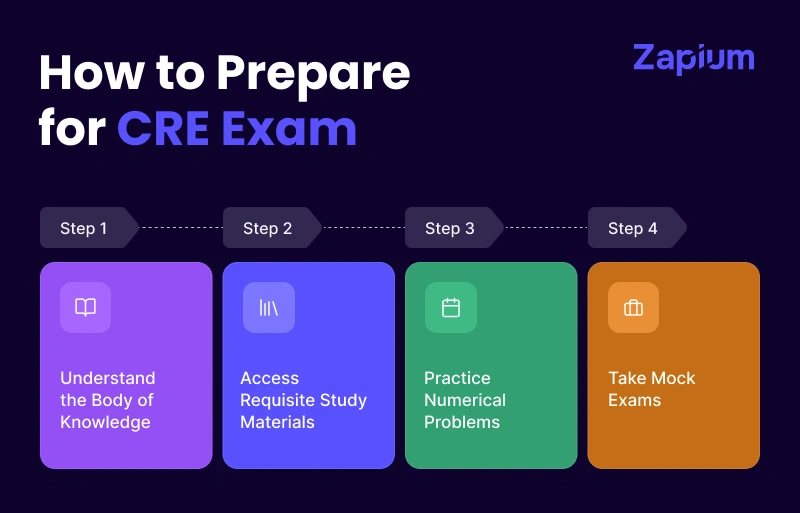
Preparing for the CRE certification requires a structured study approach. The exam covers a broad range of technical topics, including statistical analysis, reliability modeling, and maintenance strategies. Candidates should follow the below multi-stage preparation strategy:
Step 1: Understand the Body of Knowledge
Preparation begins with reviewing the official CRE Body of Knowledge. The document outlines every topic covered in the certification exam. Candidates should:
- Download the official BoK
- Review each domain carefully
- Divide topics into manageable study modules
Candidates should break the material into smaller sections to track progress and avoid feeling overwhelmed.
Step 2: Study Materials
Candidates should rely on multiple study resources to build a strong understanding of reliability engineering concepts. Important study materials include:
- Official ASQ CRE Handbook: This is a CRE study guide which acts as the primary reference aligned with the exam syllabus and reliability engineering concepts.
- Practice Question Banks: Help candidates become familiar with exam-style questions and improve problem-solving skills.
- Reliability Engineering Textbooks: Provide deeper explanations of statistical methods, reliability models, and engineering calculations.
- Online Training Programs: Structured courses that explain complex topics in a guided format.
- Study Groups: Discussions with peers help clarify difficult topics and improve conceptual understanding.
Step 3: Practice Numerical Problems
Reliability engineering relies heavily on calculations and statistical analysis. Regular practice with numerical questions helps candidates become comfortable with formulas, probability concepts, and reliability metrics. Following a structured timeline helps organize preparation effectively.
- Weeks 1–2: Foundations and Statistics Review
Focus on probability concepts, basic statistical distributions, and data interpretation used in reliability analysis.
- Weeks 3–6: Core Technical Topics
Practice calculations related to failure rates, reliability testing, life data analysis, and reliability prediction.
- Weeks 7–9: Advanced Reliability Concepts
Work on system reliability calculations, reliability growth models, and maintainability metrics.
- Weeks 10–11: Mock Exams
Begin solving full-length practice exams to evaluate preparation and improve time management.
- Week 12: Final Revision and Formula Consolidation
Review important formulas, reliability models, and commonly tested problem types.
Step 4: Mock Exams
Mock exams help candidates experience exam-like conditions and assess their readiness. Practice tests usually include questions from major reliability calculation areas such as:
- Weibull Analysis: Analyzing failure data and estimating reliability using Weibull distribution.
- Reliability Modeling: Calculating system reliability for series and parallel configurations.
- Availability Calculations: Determining system uptime using measures such as MTBF and MTTR.
- Maintainability Exercises: Solving problems related to repair time and maintenance planning.
What Are Common Challenges in CRE Preparation?
The CRE certification exam covers a wide range of reliability engineering concepts, analytical methods, and practical applications. Many professionals encounter specific difficulties while studying or attempting the exam, including the following:
- Heavy statistical content
Reliability engineering relies heavily on statistical concepts such as probability distributions, reliability modeling, and failure analysis. Candidates without a strong statistics background often find it challenging to understand formulas, interpret data sets, and apply statistical reasoning correctly.
- Time management during exam
The CRE exam contains numerous technical questions that require calculations and careful interpretation. Many candidates struggle to allocate time effectively between conceptual questions and computational problems, which may lead to rushed answers or unanswered questions.
- Interpreting complex scenario-based questions
Several exam questions present real-world reliability situations that require careful reading and analysis. Candidates must identify key details, evaluate possible causes of failure, and select the most appropriate reliability method or solution.
- Applying theory to practical engineering cases
Understanding reliability concepts theoretically is not always sufficient. The exam frequently expects candidates to apply theoretical models, reliability tools, and engineering judgment to practical situations encountered in maintenance, design, or system operations.
- Formula memorization under time pressure
The CRE exam includes multiple formulas related to reliability calculations, probability distributions, and statistical analysis. Remembering the correct formula and applying it accurately during timed conditions can be difficult for many candidates.
How Does CRE Compare to Other Reliability Certifications?
Several professional certifications address reliability, quality, and operational excellence. Each credential targets a different skill set and professional role. The Certified Reliability Engineer (CRE) certification is widely recognized for its strong focus on engineering analysis, statistical modeling, and system reliability improvement.
Other certifications such as Certified Maintenance and Reliability Professional (CMRP), Six Sigma, and Project Management Professional (PMP) also address reliability-related areas, but their objectives and knowledge domains differ. Professionals who are deciding between the two often evaluate CRE vs CMRP based on their specific role and career direction. Understanding these differences helps professionals select the certification that aligns with their career goals.
What is the difference between CRE and CMRP?
| Dimension | CRE (Certified Reliability Engineer) | CMRP (Certified Maintenance and Reliability Professional) |
|---|---|---|
Primary Focus | Reliability engineering, statistical analysis, and system performance modeling | Maintenance management and asset reliability practices |
Core Orientation | Engineering and analytical methods | Maintenance leadership and operational strategy |
Typical Professionals | Reliability engineers, design engineers, quality engineers | Maintenance managers, reliability leaders, plant supervisors |
Knowledge Coverage | Reliability modeling, life data analysis, risk assessment | Maintenance planning, asset management, equipment reliability |
Career Application | Engineering design, product reliability analysis | Maintenance operations and asset lifecycle management |
How does CRE compare with Six Sigma certifications?
| Dimension | CRE Certification | Six Sigma Certifications |
|---|---|---|
Main Objective | Improve product and system reliability | Improve process quality and reduce defects |
Key Technical Areas | Reliability modeling, failure analysis, life data analysis | Statistical process control, process improvement, DMAIC methodology |
Statistical Use | Focused on reliability statistics and probability models | Broad statistical methods for quality improvement |
Industry Application | Engineering reliability programs and product lifecycle analysis | Manufacturing, service operations, and quality improvement initiatives |
Professional Roles | Reliability engineers and product engineers | Quality engineers, process improvement specialists |
How does CRE compare with PMP for reliability professionals?
Both are respected credentials, but they serve very different career goals. If you are weighing CRE vs PMP, the table below breaks down where they differ.
| Dimension | CRE Certification | PMP Certification |
|---|---|---|
Core Focus | Technical reliability engineering | Project management and delivery frameworks |
Knowledge Domain | Reliability analysis, system modeling, maintainability | Project planning, scheduling, risk management |
Professional Orientation | Engineering and analytical roles | Leadership and project coordination roles |
Key Skills | Failure analysis, reliability prediction, statistical evaluation | Stakeholder management, resource planning, project execution |
Career Path | Reliability engineering and system performance roles | Project manager or program manager roles |
When is CRE the better choice?
CRE becomes the better option for professionals who work directly with engineering reliability problems and system performance analysis. Engineers involved in reliability modeling, statistical analysis of failure data, product life prediction, and system reliability improvement benefit the most from this certification. Professionals responsible for analyzing reliability metrics, conducting life data studies, or designing systems with high reliability requirements typically find CRE more aligned with their technical responsibilities.
What Are the CRE Recertification Requirements?
The Certified Reliability Engineer (CRE) credential requires periodic renewal to maintain its validity. Recertification confirms that professionals continue to stay active in the reliability engineering field and keep their technical knowledge up to date.
What is the recertification cycle?
The CRE certification follows a three-year recertification cycle. After earning the certification, professionals must renew it every three years by demonstrating continued professional development. Renewal typically requires earning recertification units through activities such as professional work experience, training programs, conferences, teaching, or publishing in reliability engineering topics.
What Are the Career Benefits of CRE Certification?
CRE certification offers several career and professional advantages for engineers working in reliability and quality roles. It supports salary growth, strengthens professional credibility, and helps organizations improve reliability practices and system performance, as discussed in detail below:
Salary Impact
CRE certification contributes to higher earning potential because organizations value professionals who can analyze failures, apply statistical reliability methods, and improve product performance. The credential also creates market differentiation, allowing certified engineers to stand out in competitive job markets where specialized reliability expertise is in demand.
Professional Credibility
CRE certification increases recognition in engineering roles by demonstrating advanced knowledge of reliability modeling, failure analysis, and system reliability evaluation. Such credentials also improve leadership eligibility, as organizations frequently rely on certified professionals to guide reliability initiatives and technical decision-making.
Organizational Impact
Certified reliability engineers contribute to structured reliability programs by introducing systematic reliability analysis and testing practices. Their work helps reduce operational risks and failure costs, while reliability-driven engineering strategies also lead to improved system performance and more consistent operational outcomes.
In Which Industries Does CRE Add the Most Value?
The Certified Reliability Engineer (CRE) certification is particularly valuable in industries where equipment reliability, system performance, and failure prevention directly affect safety, operational efficiency, and production continuity. Several sectors rely heavily on reliability engineering principles to maintain consistent operations and reduce costly failures.
Manufacturing
Manufacturing operations depend on reliable machinery and production systems. CRE-certified professionals help analyze equipment failures, improve maintenance strategies, and optimize production reliability to reduce downtime and maintain consistent product quality.
Oil & Gas
Oil and gas operations involve complex equipment operating in demanding environments. Reliability engineers help evaluate system risks, improve equipment reliability, and reduce the likelihood of operational disruptions or safety incidents.
Utilities and Power Generation
Power plants and utility infrastructure require continuous and stable system performance. CRE professionals help monitor equipment reliability, analyze failure trends, and improve maintenance planning to maintain uninterrupted energy supply.
Pharmaceuticals
Pharmaceutical production requires highly reliable manufacturing processes to maintain strict quality standards. Reliability engineers help improve equipment performance and production stability, reducing the risk of process interruptions that could affect product quality.
Mining
Mining operations rely on heavy machinery that operates under extreme conditions. Reliability engineering helps improve equipment durability, reduce unexpected breakdowns, and support continuous extraction operations.
Aerospace and Defense
In aerospace and defense industries, system reliability is critical for safety and mission success. CRE-certified engineers contribute to reliability modeling, failure analysis, and system testing to support the development of dependable aerospace systems.
How Does CRE Align with Modern Asset Management Strategies?
Modern asset management focuses on maximizing equipment performance, reducing operational risks, and using data to guide maintenance and reliability decisions. The Certified Reliability Engineer (CRE) certification supports these objectives by equipping professionals with analytical methods used to evaluate system performance and reliability throughout the asset lifecycle.
Lifecycle cost optimization
CRE-trained professionals analyze reliability data to reduce long-term operational and maintenance expenses. Reliability engineering techniques help organizations evaluate asset performance across the entire lifecycle, from design and installation to maintenance and replacement.
Risk-based decision making
Reliability engineers apply risk analysis methods to identify potential failure points and assess their impact on operations. Such analysis helps organizations prioritize maintenance activities and allocate resources toward the most critical assets.
Data-driven reliability modeling
CRE certification emphasizes statistical analysis and reliability modeling techniques. Engineers use operational data, failure records, and probability models to evaluate system reliability and predict future performance trends.
Support for digital transformation initiatives
Modern organizations increasingly adopt digital technologies for monitoring equipment performance. Reliability engineers contribute by interpreting system data and integrating reliability principles into digital asset management platforms.
Predictive analytics integration
CRE professionals work with predictive maintenance systems that analyze equipment data to detect early signs of failure. Integrating reliability analytics with predictive tools helps organizations reduce unplanned downtime and improve asset performance.
What Are the Most Frequently Asked Questions About CRE?
What is the CRE pass rate?
The pass rate for the Certified Reliability Engineer (CRE) exam conducted by the American Society for Quality generally ranges between 60% and 70%, although the exact percentage is not officially published every year.
Difficulty arises mainly because the exam covers multiple reliability engineering domains such as probability, risk assessment, reliability modeling, maintainability, and lifecycle analysis. Candidates who rely only on theoretical knowledge struggle with the applied statistical and analytical questions.
Structured preparation, practice exams, and familiarity with the CRE Body of Knowledge usually increase the likelihood of passing on the first attempt.
How long should you study for CRE?
Most candidates spend 3 to 6 months preparing for the exam. The exact timeline depends on prior experience with reliability engineering concepts.
Typical preparation plans include:
- 8–12 weeks for professionals already working in reliability roles
- 4–6 months for candidates who need to revise statistics, probability, and reliability modeling concepts
- Regular practice with sample questions and mock exams
Study schedules combine textbooks, reliability engineering references, and CRE exam preparation guides aligned with the CRE Body of Knowledge.
Can non-engineers apply for CRE?
Yes. The CRE certification does not require a strict engineering degree. Candidates from other technical backgrounds can apply if they meet the work experience criteria established by the American Society for Quality.
Eligibility generally depends on:
- Relevant professional experience in reliability-related roles
- Educational background
- Understanding of engineering or analytical concepts
Professionals working in quality management, maintenance planning, asset reliability, or operational analytics qualify even without a traditional engineering degree.
How many times can you retake the CRE exam?
Candidates who do not pass the exam may retake it multiple times, as long as they register again and pay the required exam fee.
The American Society for Quality allows retakes during future exam windows. Many professionals use the retake period to strengthen weaker areas such as reliability statistics, probability distributions, or reliability testing methods.
Is CRE suitable for reliability engineers?
Yes. The Certified Reliability Engineer (CRE) certification was specifically designed for professionals working in reliability engineering roles.
Reliability engineers benefit because the certification strengthens expertise in areas such as:
- Reliability modeling and prediction
- Failure analysis techniques
- Maintainability engineering
- Reliability testing and validation
- Lifecycle reliability planning
Employers recognize CRE as a professional benchmark for reliability engineering competence.
Should maintenance and asset management professionals pursue CRE?
Maintenance engineers and asset management specialists can gain significant value from the certification. Many maintenance strategies today rely on reliability principles such as:
- Root cause failure analysis (RCFA)
- Reliability-centered maintenance (RCM)
- Predictive maintenance strategies
- Asset lifecycle optimization
Knowledge covered in the CRE Body of Knowledge supports better decision-making around equipment reliability, downtime reduction, and maintenance planning.
Can operations and production managers benefit from CRE?
Yes. Operations and production leaders can also benefit from the reliability engineer certification, especially in industries where equipment reliability directly impacts productivity.
CRE knowledge helps managers:
- Understand reliability metrics such as MTBF and MTTR
- Improve equipment availability and production continuity
- Reduce operational disruptions caused by equipment failures
- Integrate reliability strategies into production planning
Organizations with complex manufacturing environments encourage operations leaders to develop reliability knowledge.
Is CRE helpful for engineering consultants?
Engineering consultants frequently work across multiple industries and reliability challenges. The Certified Reliability Engineer (CRE) credential strengthens credibility when advising organizations on reliability improvements.
Consultants apply CRE concepts when working on projects such as:
- Reliability program design
- Failure investigation and corrective actions
- Asset lifecycle optimization
- Risk-based maintenance strategies
- Reliability data analysis and modeling
Clients tend to trust consultants who hold recognized professional certifications, especially when reliability engineering decisions affect safety, operational performance, and long-term asset investment.