
RCM Certification Guide: Requirements, Cost, Exam, and Career Benefits
Unexpected equipment failures can disrupt operations, increase maintenance costs, and create safety risks across asset-intensive industries. Many organizations now rely on structured reliability practices rather than routine servicing schedules to maintain equipment performance and reduce operational interruptions.
Reliability-Centered Maintenance certification has become an important credential for professionals working with complex industrial assets and maintenance strategies. In this guide, I will explain the requirements, cost, exam structure, and career benefits of RCM certification.
RCM Certification at a Glance
| Item | Details |
|---|---|
Certification | Reliability-Centered Maintenance (RCM) Certification / RCMP |
Issuing Body | International Council on Reliability Centered Maintenance (ICRCM) and other approved training providers |
Accreditation | Industry-recognized reliability certification (varies by provider) |
Exam Questions | Typically 80–120 (varies by certification level and provider) |
Exam Duration | 2–4 hours |
Exam Cost | Approximately $300 – $1,000 (exam only); $1,000 – $5,000+ with training |
Validity | Usually 3–5 years depending on the certifying organization |
What Is RCM Certification and Why Is It Important?
RCM certification is a professional credential that validates a person’s knowledge of reliability-centered maintenance (RCM) principles and their application in managing equipment reliability and maintenance strategies. It focuses on structured methods used to determine the most effective maintenance approach for physical assets, based on failure modes, operational risks, and performance requirements.
Training and certification programs typically cover topics such as failure analysis, preventive maintenance planning, asset lifecycle considerations, and reliability improvement techniques used in industrial environments.
Growing operational complexity across asset-intensive industries has increased the need for structured reliability practices rather than relying on reactive repairs after failures occur. Organizations, as a result, increasingly favor reliability-driven maintenance strategies because unplanned downtime, safety risks, and maintenance costs can severely affect operations.
Professional credentials like RCM certification carry significant weight in maintenance and asset management careers, since they signal specialized expertise in reliability practices and structured decision-making. Employers view certified professionals as better equipped to support long-term asset performance, cost control, and risk reduction within maintenance programs.
What Is Reliability-Centered Maintenance (RCM)?
Reliability-Centered Maintenance is a structured maintenance methodology used to identify the most effective way to maintain physical assets so that they continue performing their intended functions.
The approach analyzes asset functions, possible failure modes, failure consequences, and maintenance options in order to select the most appropriate maintenance tasks. Rather than applying the same preventive schedule to all equipment, reliability-centered maintenance (RCM) focuses on reliability, operational risk, and asset criticality.
Every RCM study requires careful evaluation of system behavior and operational context, which means analysts must study each asset in detail before determining the appropriate maintenance strategy.
What Is the Core Objective of RCM?
The main objective of Reliability-Centered Maintenance is to maintain the required function of equipment while managing operational risk and maintenance costs. The approach evaluates how failures occur and selects maintenance actions that reduce the likelihood or impact of those failures, helping organizations maintain equipment reliability and operational continuity.
Organizations need to follow a structured maintenance procedure during RCM implementation to systematically evaluate functions, identify failure modes, and determine the correct maintenance actions.
How Does RCM Differ from Traditional Preventive Maintenance?
| Dimension | Reliability-Centered Maintenance (RCM) | Traditional Preventive Maintenance |
|---|---|---|
Maintenance Approach | Maintenance tasks selected after analyzing asset functions and failure modes | Preventive maintenance tasks are scheduled at fixed time or usage intervals |
Decision Basis | Risk, reliability impact, and failure consequences | Manufacturer recommendations or historical schedules |
Focus | Maintaining asset functionality and system reliability | Performing routine servicing to avoid breakdowns |
Flexibility | Maintenance strategy varies depending on asset criticality | Same schedule applied to similar equipment |
Analysis Method | Structured failure mode and consequence analysis | Limited analytical evaluation |
What Are the Key Principles of Reliability-Centered Maintenance?
Key principles that form the foundation of reliability-centered maintenance are:
- Focus on preserving the function of assets, not simply maintaining components
- Identification of asset functions and performance standards
- Analysis of failure modes and causes
- Evaluation of failure consequences on safety, operations, and costs
- Selection of the most appropriate maintenance task for each failure scenario
- Prioritization of critical assets and high-risk failures
- Use of condition-based, predictive, or preventive maintenance strategies where appropriate
- Continuous review and improvement of maintenance strategies based on operational data
What Is RCM Certification?
Reliability-Centered Maintenance certification is a professional credential that validates an individual’s knowledge and practical understanding of Reliability-Centered Maintenance principles. The certification demonstrates the ability to analyze equipment functions, identify potential failure modes, evaluate operational risks, and select suitable maintenance strategies that support asset reliability and performance.
Holding an RCM certification signals that a professional has achieved a recognized reliability designation, demonstrating verified competency in structured maintenance analysis.
What Skills Are Covered in RCM Certification?
RCM certification programs focus on developing analytical and technical skills needed to evaluate equipment reliability and design structured maintenance strategies. Professionals pursuing the certification gain competencies in several areas of reliability analysis and maintenance planning. Below is a comprehensive list of skills that include but is not limited to:
- Asset function identification and performance standards
- Failure mode and root cause analysis
- Risk and consequence evaluation for equipment failures
- Maintenance strategy selection and planning
- Preventive, predictive, and condition-based maintenance methods
- Reliability data interpretation and performance monitoring
- Maintenance optimization for critical assets
- Lifecycle thinking in asset management
What Is the Difference Between RCM Training and Certification?
| Dimension | RCM Training | RCM Certification |
|---|---|---|
Purpose | Provides education on Reliability-Centered Maintenance concepts and methods | Validates professional competency in applying RCM principles |
Focus | Learning theoretical concepts, frameworks, and maintenance analysis techniques | Assessing knowledge and practical understanding through an examination |
Outcome | Participants gain knowledge and practical exposure to RCM methods | Individuals receive a formal credential recognizing their expertise |
Evaluation | Usually includes course exercises or workshops | Typically requires passing a formal certification exam |
Recognition | Completion certificate issued by the training provider | Professional credential recognized by industry or certifying bodies |
Who Should Pursue RCM Certification?
Reliability-centered maintenance certification is valuable for professionals who must understand reliability and maintenance strategies. Typically these roles are:
- Maintenance engineers: Maintenance engineers responsible for equipment upkeep can use RCM principles to identify recurring failures and choose more effective maintenance actions.
- Reliability engineers: Reliability engineers strengthen their ability to analyze asset performance and design structured strategies aimed at reducing equipment failures.
- Asset managers: They gain a better understanding of lifecycle planning and maintenance prioritization across large portfolios of physical assets.
- Plant managers and operations leaders: These roles benefit from RCM knowledge when aligning maintenance planning with production reliability and operational performance.
- Maintenance planners and supervisors: Maintenance planners and supervisors can schedule maintenance tasks more effectively by considering asset criticality and potential failure impact.
- Professionals transitioning into reliability roles: Professionals shifting toward reliability-focused careers gain analytical frameworks used to study failures and recommend maintenance improvements
What Types of RCM Certifications Are Available?
Professionals interested in Reliability-Centered Maintenance can pursue several types of certifications depending on their experience level, career goals, and industry requirements. Some certifications focus specifically on RCM methodology, while others include reliability engineering, asset management, or maintenance optimization concepts that incorporate RCM principles.
What Are Entry-Level RCM Certifications?
Entry-level certifications introduce the basic concepts of reliability analysis, asset functions, and maintenance strategy selection.
- RCM Level 1 Certification
- Reliability-Centered Maintenance Practitioner (RCMP) Level I
- Maintenance and Reliability Professional (CMRP)
What Are Advanced RCM Practitioner Certifications?
Advanced certifications focus on deeper analysis, facilitation of RCM studies, and leadership in reliability improvement initiatives.
- RCM Level 2 Certification
- Reliability-Centered Maintenance Practitioner (RCMP) Level II
- Reliability-Centered Maintenance Facilitator Certification
Are There Industry-Recognized Reliability Certifications That Include RCM?
Several reliability engineering certifications cover RCM concepts along with broader reliability analysis methods.
- Certified Reliability Engineer (CRE)
- Certified Maintenance and Reliability Professional (CMRP)
- Certified Maintenance and Reliability Technician (CMRT)
Are There Certifications Linked to Asset Management Frameworks?
Some certifications connect reliability practices with asset lifecycle management and organizational asset strategies.
- Certified Asset Management Professional (CAMP)
- ISO 55001 Lead Implementer Certification
- ISO 55001 Lead Auditor Certification
Do Companies Offer Corporate or In-House RCM Certifications?
Many organizations and consulting firms offer specialized internal programs designed to train employees on RCM methodologies used within their operations.
- Corporate RCM Practitioner Certification
- Enterprise Reliability Program Certification
- In‑House RCM Facilitator Certification
Which Organizations Provide RCM Certification?
Following organizations offer different levels of training and certification such as RCM practitioner, facilitator, or reliability engineering credentials that incorporate RCM principles:
- International Reliability Centered Maintenance Certification Committee (IRCC)
- International Council on Reliability Centered Management (ICRCM)
- Aladon Network
- Reliability Engineers Academy
- Asset Performance Institute
- Society for Maintenance and Reliability Professionals (SMRP)
- American Society for Quality (ASQ)
- Industrial RCM Consulting
What Are the Eligibility Requirements for RCM Certification?
RCM certification programs generally expect candidates to possess a technical background and some exposure to maintenance or reliability practices. Although exact requirements vary across certification bodies, most programs outline a combination of education, industry experience, and familiarity with reliability analysis concepts. To become an RCM expert through the certification, following are the basic requirements that must be met:
- Educational qualifications
Many certification providers recommend a background in engineering, mechanical disciplines, industrial technology, or technical diploma programs related to maintenance and equipment management.
- Work experience requirements
Practical experience in maintenance, reliability engineering, asset management, or industrial operations is commonly expected, ranging from one to several years depending on certification level.
- Prior reliability or maintenance training prerequisites
Some certification programs require completion of approved RCM training courses or workshops before candidates become eligible to sit for the certification exam.
- Recommended background knowledge
Familiarity with reliability tools such as Failure Modes and Effects Analysis (FMEA), maintenance planning methods, and basic risk assessment practices helps candidates understand RCM methodology more effectively.
What Topics Are Covered in an RCM Certification Curriculum?
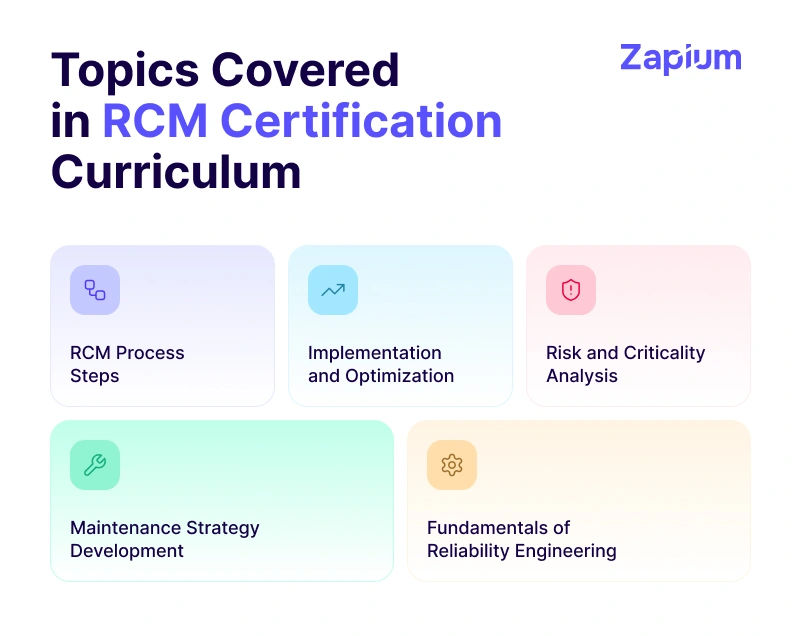
RCM certification programs introduce reliability engineering concepts along with structured methods used to analyze equipment failures and develop maintenance strategies. The curriculum typically covers the following areas.
Fundamentals of Reliability Engineering
Basic reliability engineering concepts help professionals understand how equipment performance and failure behavior are measured and analyzed.
- Reliability metrics (MTBF, MTTR, failure rate): These metrics measure equipment reliability, repair time, and the frequency at which failures occur in operational systems.
- Reliability block diagrams: Graphical models used to represent system components and their relationships when evaluating overall system reliability.
- System reliability concepts: Principles used to analyze how individual components affect the reliability and performance of the entire system.
RCM Process Steps
The RCM methodology follows a structured process used to study equipment functions and identify appropriate maintenance actions.
- System selection and information gathering: The process begins by selecting critical systems and collecting technical, operational, and maintenance data.
- Functional analysis: Defines the intended functions and performance expectations of a system or equipment.
- Functional failure identification: Identifies conditions where equipment fails to perform its intended function.
- Failure mode and effects analysis:Examines possible causes of failures and evaluates how those failures affect system performance.
- Failure consequences classification: Categorizes failures based on their impact on safety, operations, environment, or costs.
- Task selection logic: Uses structured decision logic to determine the most suitable maintenance action for each failure mode.
Risk and Criticality Analysis
RCM certification programs also teach techniques used in risk-based maintenance and how to evaluate the mpact of equipment failures.
- Risk matrix development: A risk matrix helps assess the likelihood and severity of potential equipment failures.
- Asset criticality ranking: Equipment is ranked based on operational importance and the consequences of failure.
- Consequence evaluation: Failure impacts are evaluated across multiple dimensions including safety risks, operational disruption, environmental effects, and financial losses.
Maintenance Strategy Development
After analyzing failures and risks, the next step focuses on selecting appropriate maintenance strategies.
- Preventive maintenance: Scheduled maintenance activities performed at regular intervals to reduce the likelihood of equipment failure.
- Predictive maintenance: Maintenance decisions based on performance data and monitoring techniques that predict equipment failures.
- Condition-based maintenance: Maintenance actions triggered by real-time equipment condition monitoring.
- Run-to-failure strategy: Certain non-critical components are allowed to operate until failure before replacement.
- Redesign recommendations: Engineering modifications may be suggested when maintenance actions cannot adequately manage failure risks.
Implementation and Optimization
The final stage revolves around applying RCM findings and improving maintenance programs over time.
- Developing RCM documentation: RCM studies are documented to record analysis results, maintenance tasks, and decision logic.
- Integrating RCM into CMMS: Maintenance tasks and schedules are incorporated into computerized maintenance management systems (CMMS).
- Continuous improvement: Operational data is monitored to refine maintenance strategies and improve reliability outcomes.
What Does the RCM Certification Exam Look Like?
The exam format varies by certification body, but most assessments combine theoretical questions with practical scenarios related to equipment reliability and maintenance planning.
- Exam format: Most RCM certification exams include multiple-choice questions and scenario-based problems that test the ability to apply RCM principles in real operational situations.
- Duration: The exam typically lasts between two to four hours depending on the certification level and the number of questions included.
- Question focus: Questions cover reliability metrics, failure mode analysis, risk assessment, maintenance strategy selection, and interpretation of RCM decision logic.
- Practical application: Some certification programs include case-based questions where candidates analyze equipment failures and recommend suitable maintenance actions.
- Passing criteria: Candidates usually need to achieve a minimum passing score set by the certification provider to receive the certification credential.
How Should You Prepare for the RCM Certification Exam?
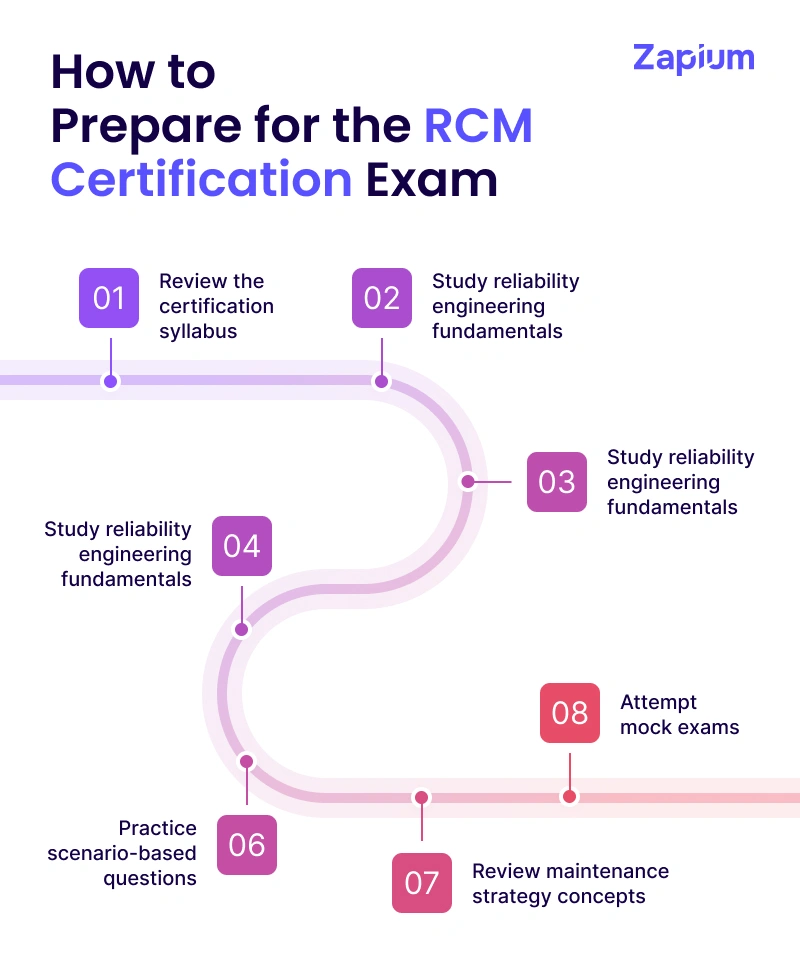
The following is a clear preparation workflow to help candidates cover the required topics systematically:
- Review the certification syllabus: Begin by studying the official exam syllabus to understand the topics, reliability concepts, and RCM process steps included in the exam.
- Study reliability engineering fundamentals: Build a strong foundation in reliability metrics, system reliability concepts, and failure analysis methods such as FMEA.
- Learn the RCM methodology step by step: Focus on the complete RCM process including functional analysis, failure mode identification, consequence evaluation, and maintenance task selection.
- Use training courses or study materials: Enroll in recognized RCM training programs or use structured study guides that explain reliability concepts and maintenance strategy development.
- Practice scenario-based questions: Work through sample questions and case studies to develop the ability to apply RCM principles in practical equipment reliability situations.
- Review maintenance strategy concepts: Revise preventive, predictive, and condition-based maintenance strategies along with asset criticality and risk evaluation methods.
- Attempt mock exams: Practice full-length mock tests to become familiar with exam timing, question patterns, and decision-based reliability questions.
How Much Does RCM Certification Cost?
The cost of RCM certification varies widely depending on the certification provider, training format, and certification level. In many cases, the total cost includes training fees, examination fees, and certification or registration charges.
1. Entry-level certification examSome introductory RCM certification exams may cost relatively little; for example, a Level-1 exam offered with certain training programs can be included with a course or offered at a small additional fee.
2. Training-based certification programsMany RCM certifications are delivered through training courses followed by an assessment. Facilitator-level programs that include training and mentoring can cost several thousand dollars—for instance, one RCM facilitator course is listed at about $5,299, with extended mentoring packages reaching around $9,999.
3. Typical cost rangeAcross different providers, RCM certification programs fall within the following broad ranges:
- Basic certification or exam only: Roughly $100–$500
- Training plus certification programs: Typically $1,000–$5,000+ depending on course depth
- Advanced facilitator-level programs: May exceed $5,000 when extensive training and mentoring are included.
Actual fees vary based on the organization offering the certification, whether the training is online or instructor-led, and whether the program includes workshops, mentoring, or implementation support.
How Long Is RCM Certification Valid?
The validity of RCM certification depends on the organization that issues the credential. Some certifications remain valid indefinitely once earned, while others require periodic renewal to confirm that professionals remain active in reliability and maintenance practices.
In programs that require renewal, certifications are commonly valid for three to five years, after which professionals may need to complete continuing education, submit professional activity records, or retake an assessment to maintain the credential.
What Are the Benefits of RCM Certification?
RCM certification offers advantages both for individual professionals and for organizations that rely on reliable equipment performance.
What Benefits Do Individuals Gain From RCM Certification?
- Career growth opportunities: RCM certification helps professionals qualify for reliability-focused roles and advancement opportunities within maintenance, engineering, and asset management functions.
- Higher salary potential: Specialized reliability knowledge increases professional value, which can lead to better compensation in maintenance and engineering careers.
- Professional credibility: Holding an RCM credential demonstrates structured knowledge of reliability practices, strengthening professional reputation among employers and industry peers.
- Expanded reliability engineering skills: Certification training builds analytical skills related to failure analysis, maintenance planning, and reliability strategy development.
How Do Organizations Benefit From RCM Certification?
- Reduced equipment downtime: RCM-based maintenance strategies help organizations identify potential failure risks early and reduce unexpected equipment breakdowns.
- Improved asset reliability: Structured analysis of asset functions and failures supports more reliable equipment performance across operational systems.
- Lower maintenance costs: Targeted maintenance activities reduce unnecessary servicing while focusing resources on critical equipment issues that streamlines revenue cycle management.
- Stronger risk management: RCM methods evaluate failure consequences and help organizations manage operational, safety, and financial risks.
- Structured maintenance decision processes: Maintenance teams follow systematic analysis methods rather than relying on routine schedules or reactive repairs.
What Career Opportunities Exist After RCM Certification?
The RCM certification can open pathways to several reliability and maintenance-focused roles across asset-intensive industries such as manufacturing, energy, transportation, and infrastructure management. These roles are:
- Reliability engineer
- Maintenance manager
- Asset integrity engineer
- Reliability consultant
- Maintenance planner
- Operations excellence specialist
What Are Current Industry Demand Trends?
Reliability-Centered Maintenance (RCM) is gaining stronger adoption across asset-intensive industries as organizations shift from reactive maintenance to data-driven reliability strategies. Key trends being seen are:
- Growing adoption of predictive and data-driven maintenance
Organizations increasingly integrate IoT sensors, analytics, and AI technologies into maintenance programs, allowing real-time monitoring and predictive maintenance aligned with RCM practices.
- Rising demand in asset-intensive industries
Industries such as manufacturing, energy, oil and gas, transportation, aerospace, and healthcare rely heavily on RCM to maintain reliability, safety, and operational continuity.
- Increasing need for skilled reliability professionals
As organizations implement RCM programs, demand for trained reliability engineers, maintenance specialists, and certified RCM practitioners continues to grow.
- Growth driven by Industry 4.0 and digital transformation
Smart manufacturing initiatives, automation, and connected industrial systems are accelerating the adoption of reliability-centered maintenance methods and software tools.
- Expansion in emerging industrial markets
Regions in Asia-Pacific are experiencing rapid RCM adoption due to industrialization, infrastructure development, and investments in modern manufacturing systems.
How Does RCM Certification Compare With Other Maintenance Certifications?
Maintenance and reliability professionals evaluate multiple certifications when planning career growth. Each credential focuses on a different aspect of asset performance, operational efficiency, or maintenance strategy. Comparisons below will clarify where reliability-centered maintenance (RCM) certification stands among other widely pursued certifications.
How Does RCM Certification Compare With CMMS Certifications?
| Dimension | RCM Certification | CMMS Certification |
|---|---|---|
Primary Focus | Focuses on reliability strategy and failure prevention through structured analysis of assets. | Focuses on operating and managing computerized maintenance management systems. |
Scope of Learning | Covers failure modes, reliability analysis, maintenance task selection, and risk prioritization. | Covers system configuration, work order management, scheduling, and maintenance data tracking. |
Skill Orientation | Analytical and engineering-focused approach to maintenance planning. | System administration and operational management of maintenance software. |
Application | Used for designing reliability-based maintenance strategies for critical assets. | Used for managing maintenance operations and digital maintenance records. |
Career Relevance | Valuable for reliability engineers, maintenance strategists, and asset reliability specialists. | Useful for maintenance planners, CMMS administrators, and maintenance coordinators. |
How Does It Compare With Asset Management Certifications?
| Dimension | RCM Certification | Asset Management Certifications |
|---|---|---|
Primary Focus | Focuses on reliability analysis and maintenance decision-making for individual assets. | Focuses on lifecycle management of assets at an organizational level. |
Scope | Concentrates on failure analysis, reliability modelling, and maintenance planning. | Covers asset lifecycle planning, governance, financial planning, and strategic asset management. |
Level of Application | Applied mainly at equipment and system level. | Applied at enterprise or infrastructure management level. |
Decision Perspective | Engineering-driven reliability decisions. | Strategic and financial decision-making for asset portfolios. |
Typical Professionals | Reliability engineers, maintenance engineers, and technical specialists. | Asset managers, infrastructure managers, and strategic planners. |
How Does It Compare With Lean or Six Sigma Certifications?
| Dimension | RCM Certification | Lean / Six Sigma Certifications |
|---|---|---|
Primary Focus | Improves asset reliability through structured maintenance analysis. | Improves process efficiency and quality through statistical improvement methods. |
Core Methodology | Reliability-centered maintenance analysis and failure mode evaluation. | Process improvement tools such as DMAIC, statistical analysis, and waste reduction techniques. |
Application Area | Maintenance strategy and asset reliability improvement. | Manufacturing processes, operational workflows, and service efficiency. |
Technical Orientation | Maintenance engineering and reliability analysis. | Data-driven process optimization and quality management. |
Professional Roles | Reliability engineers, maintenance strategists, and asset reliability specialists. | Process improvement specialists, quality engineers, and operations managers. |
When Should Professionals Choose RCM Certification?
Following are the scenarios when professionals should consider pursuing RCM certification:
- Transitioning from traditional maintenance roles to reliability-focused engineering roles.
- Working with critical industrial equipment where failure prevention and risk analysis are essential.
- Adopting reliability-based maintenance strategies for high-value assets.
- When engineers need structured methods for analyzing failure modes and selecting maintenance tasks.
- Professionals want deeper expertise in reliability analysis rather than software tools or process optimization frameworks.
- When working in industries such as oil and gas, power generation, aviation, or heavy manufacturing where reliability engineering plays a key role.
What Common Mistakes Should Candidates Avoid?
Candidates preparing for RCM certification sometimes focus only on passing the exam and overlook important aspects of reliability practice, ending up committing these common mistakes:
- Choosing certifications without verifying accreditation
Selecting a certification without checking the credibility of the issuing organization may reduce the professional value of the credential.
- Ignoring practical experience
RCM methodology relies heavily on real-world maintenance knowledge, so relying only on theory without operational exposure can limit understanding.
- Studying only for the exam instead of understanding RCM methodology
Focusing solely on exam preparation may lead to memorization rather than developing the analytical thinking required for reliability analysis.
- Underestimating reliability data analysis
RCM decisions depend on interpreting failure data, so overlooking reliability metrics and data analysis can weaken maintenance strategy development.
How Can You Choose the Right RCM Certification?
Here are some key factors you can consider when selecting an RCM certification program.
- Industry relevance
Choose a certification that is widely used in industries such as manufacturing, energy, aviation, or infrastructure where reliability practices are critical.
- Global recognition
Certifications recognized by established professional organizations carry greater credibility across companies and international job markets.
- Depth of curriculum
Review the curriculum to confirm that it covers core RCM methodology, reliability analysis techniques, and maintenance strategy development.
- Hands-on training components
Programs that include case studies, workshops, or practical reliability analysis exercises offer stronger real-world learning.
- Reviews from past participants
Feedback from professionals who completed the certification can provide insights into course quality, instructor expertise, and practical usefulness.
- Budget considerations
Compare training fees, exam costs, and additional expenses to select a certification that fits within your professional development budget.
Frequently Asked Questions (FAQs)
Is RCM Certification Worth It for Maintenance Professionals?
RCM certification can be valuable for professionals working in asset-intensive industries where equipment reliability directly affects operational performance. The credential demonstrates structured knowledge of failure analysis, maintenance strategy development, and reliability planning. Many organizations prefer certified professionals because they are better prepared to analyze asset failures and recommend data-driven maintenance decisions.
Can RCM Certification Be Completed Online?
Yes, many training providers offer RCM certification programs through online learning platforms. These programs typically include virtual training sessions, recorded lectures, reliability case studies, and an online certification exam. Some advanced facilitator certifications may still include workshops, mentoring sessions, or practical assignments conducted remotely.
How Difficult Is the RCM Certification Exam?
The difficulty level depends on the certification provider and the level of the credential. Entry-level certifications usually focus on reliability fundamentals and basic RCM concepts, while advanced certifications test deeper knowledge of failure analysis, risk evaluation, and maintenance decision logic. Candidates with practical maintenance or reliability experience find the exam easier to navigate.
Can RCM Certification Help Professionals Move Into Reliability Engineering Roles?
Yes. RCM certification serves as a stepping stone for professionals transitioning from traditional maintenance roles into reliability engineering positions. The certification builds analytical skills related to equipment failure analysis, reliability metrics, and maintenance strategy planning, which are essential competencies for reliability engineers.
How Long Does It Take to Prepare for an RCM Certification Exam?
Preparation time varies depending on prior experience and the depth of the certification program. Professionals with maintenance or reliability backgrounds may prepare within a few weeks by reviewing reliability concepts and practicing case-based questions. Candidates new to reliability engineering may require several months of study, especially if they need to build familiarity with reliability metrics, failure analysis, and maintenance strategy frameworks.