

CRE vs PMP for Reliability Engineers: Which Certification Should You Choose?

Among the most widely discussed credentials for reliability engineers are Certified Reliability Engineer (CRE) and Project Management Professional (PMP) certifications. Although both can support career advancement for engineers working with industrial systems, their focus areas differ significantly.
Reliability engineers who are considering professional certification find themselves weighing a key question: should they deepen their technical expertise through reliability-focused certification, or should they transition toward project leadership and management responsibilities?
I will explore the purpose, competencies, career paths, and practical considerations associated with both certifications, providing a comprehensive CRE vs PMP career comparison so reliability engineers can determine which credential aligns better with their professional goals.
Why Are Certifications Important for Reliability Engineers?
Reliability engineering has grown into a specialized discipline that blends statistical analysis, systems engineering, and maintenance strategy development. Modern industrial systems generate massive operational data, and organizations expect engineers to translate that information into practical decisions that improve equipment uptime and reduce operational risk.
Professional certification plays a role in validating those capabilities.
Employers in sectors such as manufacturing, energy, and aerospace frequently look for engineers who demonstrate formal expertise in reliability analysis methods. Certification programs help standardize that expertise by establishing a recognized body of knowledge and verifying that professionals understand key analytical frameworks.
Another advantage of certification lies in career differentiation. Many engineers gain practical experience through plant operations, maintenance engineering, or system design roles. However, certifications allow professionals to formally demonstrate their knowledge of reliability modeling, failure analysis, and risk management principles.
Some certifications also broaden career opportunities. Engineers working in reliability roles may eventually move into consulting, asset performance optimization, or technical leadership positions. Having recognized credentials can help signal readiness for those responsibilities.
What Is CRE Certification?
Certified Reliability Engineer certification is a reliability professional credential by American Society for Quality (ASQ) designed for engineers who focus on reliability analysis, system performance evaluation, and failure prevention strategies. The CRE certification validates knowledge related to reliability engineering methodologies used across manufacturing, aerospace, electronics, healthcare equipment, and industrial systems.
What Core Competencies Are Covered in CRE Certification?
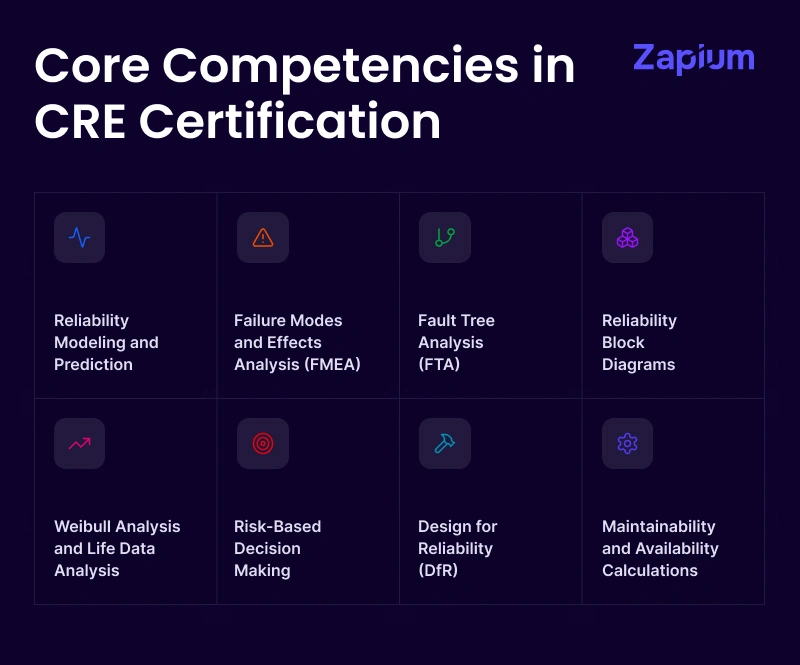
CRE certification focuses on engineering methods used to evaluate system reliability and operational risk. These competencies combine statistical modeling, system analysis, and engineering decision frameworks. Several core technical domains are typically included.
Reliability Modeling and Prediction
Reliability modeling allows engineers to estimate how systems behave over time. Engineers leverage predictive maintenance to analyze how individual components interact within larger systems and determine the probability that a system will perform its intended function during a specified operating period.
Failure Modes and Effects Analysis (FMEA)
Failure Modes and Effects Analysis is a structured methodology used to identify possible failure scenarios within systems or components. Engineers systematically evaluate potential failure modes, determine their causes, and assess the potential impact on system performance.
Fault Tree Analysis (FTA)
Fault Tree Analysis focuses on identifying the root causes of system failures through logical modeling. Engineers construct hierarchical diagrams that represent the combinations of component failures that could lead to system-level failure events.
Logical gates such as AND and OR relationships are used to represent how individual component failures interact within the overall system.
Reliability Block Diagrams
Reliability block diagrams visually represent system architecture and how individual components contribute to overall reliability. Engineers use these diagrams to model series and parallel system structures.
Weibull Analysis and Life Data Analysis
Life data analysis focuses on evaluating failure patterns based on observed operational data. Engineers collect information about component failures over time and apply statistical methods to identify reliability trends. Weibull analysis is commonly used because it can model different types of failure behavior, including early failures, random failures, and wear-out failures.
Risk-Based Decision Making
Reliability engineers frequently support decisions that involve balancing cost, risk, and system performance. Risk-based decision frameworks help engineers evaluate multiple options and select strategies that minimize operational disruption while controlling maintenance expenses.
Design for Reliability (DfR)
Design for Reliability practices focus on incorporating reliability considerations during early engineering stages. Instead of addressing failures after products enter operation, engineers design systems with reliability objectives from the start. DfR activities include reliability testing, component stress analysis, redundancy planning, and reliability verification during product development cycles.
Maintainability and Availability Calculations
Reliability engineering does not only focus on preventing failures; it also examines how quickly systems can return to service after failures occur.
Maintainability metrics measure how efficiently maintenance activities can restore equipment functionality. Availability metrics combine reliability and maintainability information to determine the percentage of time a system remains operational.
What Are the Eligibility Requirements for CRE Certification?
Professionals interested in CRE certification must meet certain educational and professional experience requirements. The certification is designed for engineers who already work with reliability engineering methods or related analytical disciplines. Eligibility requirements generally combine formal education with practical engineering experience.
Education and Work Experience Combinations
Different combinations of education and work experience typically qualify candidates for CRE certification.
Engineers holding a bachelor’s degree in engineering or a related technical discipline need several years of professional experience working in reliability, quality engineering, or system performance analysis. Professionals with advanced degrees may qualify with fewer years of experience because graduate education includes coursework related to reliability modeling, statistics, and engineering risk analysis.
Candidates who do not hold formal engineering degrees can sometimes qualify through extended professional experience in reliability-focused roles. However, they may need a longer track record of work involving reliability analysis, maintenance engineering, or system performance improvement.
Engineering and Quality Background Preference
CRE certification programs typically favor professionals with engineering, quality assurance, or manufacturing backgrounds. Many candidates come from disciplines such as mechanical engineering, electrical engineering, industrial engineering, or systems engineering.
Quality engineering professionals who work with failure analysis, reliability testing, and process improvement frameworks may also pursue this certification.
What Career Paths Are Available After CRE Certification?
CRE certification can open several specialized career opportunities within reliability engineering and asset performance management. Professionals who hold the credential take on roles that focus on analyzing system failures, improving product reliability, and supporting long-term operational efficiency. Some common career paths include the following roles.
Reliability Engineer
Reliability engineers focus on identifying potential failure points in systems and designing strategies that reduce equipment downtime. Their work frequently includes reliability testing, failure data analysis, and system modeling.
Senior Reliability Specialist
Senior reliability specialists typically handle complex reliability investigations and guide organizational reliability improvement initiatives. These professionals lead failure investigations and implement reliability-centered maintenance strategies.
Asset Performance Engineer
Asset performance engineers concentrate on optimizing equipment performance within operational environments such as manufacturing plants, energy facilities, or industrial production lines.
Reliability Consultant
Organizations sometimes rely on external consultants when evaluating system reliability or developing enterprise-level reliability programs. Consultants analyze operational data, recommend reliability strategies, and support implementation of reliability improvement initiatives.
Engineering Risk Analyst
Engineering risk analysts evaluate the potential impact of system failures and help organizations make decisions that balance operational performance with safety considerations.
What Is PMP Certification?
Project Management Professional (PMP) certification represents one of the most widely recognized credentials for professionals responsible for managing projects across industries.
While CRE certification focuses on technical reliability analysis, PMP certification concentrates on planning, executing, and controlling projects within defined constraints. Engineers who pursue PMP certification move toward leadership roles where they coordinate cross-functional teams and oversee project delivery.
What Skills and Competencies Are Covered in PMP Certification?
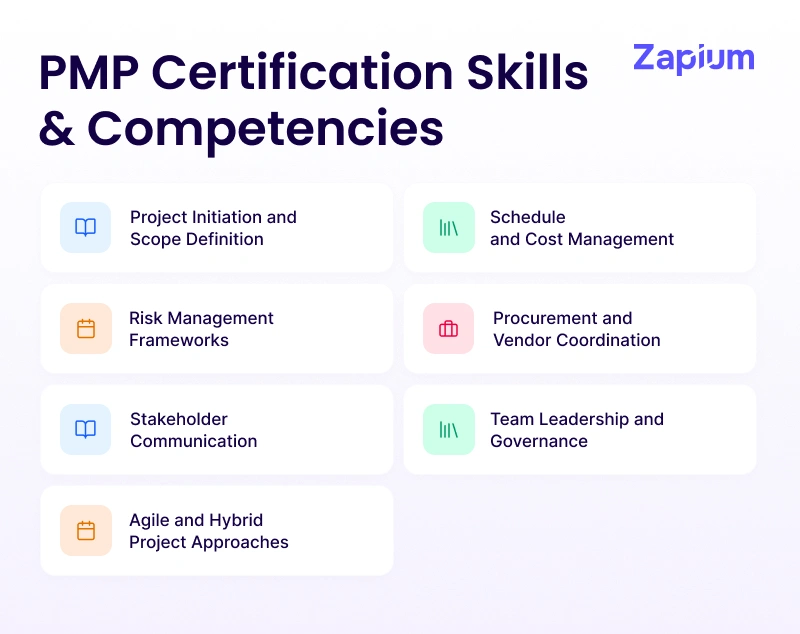
PMP certification focuses on structured methods for managing projects from initiation through completion. The certification emphasizes leadership skills, communication strategies, and operational planning frameworks that help teams deliver projects successfully. Several competency areas define the PMP body of knowledge.
Project Initiation and Scope Definition
Project managers must clearly define project objectives and boundaries before work begins. Scope definition helps teams understand deliverables, performance expectations, and project limitations.
Schedule and Cost Management
Projects typically operate within strict timelines and budget constraints. Project managers use scheduling frameworks to plan tasks, assign resources, and track progress toward completion. Cost management techniques help organizations estimate project expenses, allocate budgets, and monitor spending throughout project execution.
Risk Management Frameworks
Projects frequently encounter uncertainties related to technical challenges, supply chain disruptions, or regulatory changes. Risk management frameworks allow project teams to identify potential risks, assess their impact, and develop mitigation strategies.
Procurement and Vendor Coordination
Large engineering projects depend on external vendors, equipment suppliers, and specialized service providers. Procurement planning helps organizations select appropriate vendors, negotiate contracts, and coordinate delivery schedules.
Stakeholder Communication
Engineering projects involve numerous stakeholders, including management teams, technical specialists, regulatory authorities, and external partners. Project management certification for engineers offers knowledge on effective communication strategies that help project managers keep stakeholders informed about project progress, emerging challenges, and major decisions.
Team Leadership and Governance
Successful project execution requires coordinated effort from multiple teams. Project managers must provide leadership, resolve conflicts, and maintain accountability across project participants. Governance frameworks define roles, responsibilities, and decision-making structures that guide project execution.
Agile and Hybrid Project Approaches
Modern engineering projects increasingly adopt agile or hybrid project management methodologies. Agile frameworks emphasize flexibility, iterative development cycles, and continuous feedback. Hybrid approaches combine traditional planning methods with agile practices to accommodate complex engineering environments where requirements evolve over time.
What Are the Eligibility Requirements for PMP Certification?
PMP certification requires candidates to demonstrate both educational qualifications and significant project management experience. The certification is designed for professionals who already participate in planning, coordinating, or managing projects within their organizations. Because project management responsibilities vary across industries, the eligibility framework focuses on documenting practical experience leading or contributing to project activities.
Education Requirements and Project Management Experience
Candidates typically qualify for PMP certification through one of several combinations of formal education and project management experience.
Professionals who hold a bachelor’s degree or an equivalent qualification generally need several years of project management experience. That experience must include participation in project planning, execution, monitoring, and closure activities.
Individuals without a four-year degree can still qualify, but they must demonstrate a longer period of project management experience. The additional experience requirement compensates for the absence of formal higher education.
For reliability engineers, this experience may come from managing engineering upgrades, maintenance improvement initiatives, equipment installation projects, or plant modernization programs.
Mandatory Project Hours and Training Contact Hours
In addition to professional experience, PMP candidates must also complete formal training in project management concepts.
Training programs typically cover topics such as project scheduling techniques, risk management strategies, stakeholder communication practices, and leadership approaches for cross-functional teams.
Candidates must document the required number of project management training hours before they can sit for the certification exam.
These requirements help confirm that candidates possess both theoretical knowledge and practical experience managing projects within structured frameworks.
What Career Paths Are Available After PMP Certification?
PMP certification opens several leadership-oriented career opportunities for engineers and technical professionals. Reliability engineers who transition toward project management roles pursue PMP certification to strengthen their ability to coordinate complex engineering initiatives. Common career paths after PMP certification include the following.
Project Manager in Engineering or Maintenance
Engineering project managers oversee initiatives such as equipment installations, plant upgrades, system redesign projects, or infrastructure improvements. Their responsibilities include planning project timelines, managing budgets, coordinating engineering teams, and tracking project performance metrics.
Program Manager
Program managers supervise multiple related projects that collectively support larger organizational objectives. Rather than focusing on a single project, they coordinate several initiatives simultaneously.
Technical Project Lead
Technical project leads guide engineering teams working on complex technical implementations. Their responsibilities combine technical oversight with project coordination.
Operations Project Manager
Operations project managers focus on projects that improve operational processes within manufacturing plants, logistics networks, or service operations.
What Are the Core Differences Between CRE and PMP?
Both CRE and PMP are globally recognized certifications. Although both certifications can benefit reliability engineers, maintenance and asset management professionals, they differ significantly in their focus, skill development areas, and career outcomes, as highlighted below.
| Feature | CRE (Certified Reliability Engineer) | PMP (Project Management Professional) |
|---|---|---|
Primary Focus | Technical Depth: Reliability engineering, statistics, and risk evaluation. | Management Breadth: Project planning, execution, and leadership. |
Core Skills | Statistical modeling, failure analysis, and system optimization. | Team coordination, negotiation, and communication strategies. |
Domain | Specifically for Quality & Reliability disciplines. | Cross-industry (IT, Construction, Business, etc.). |
Problem Solving | Analytical and mathematical engineering solutions. | Organizational planning and stakeholder management. |
Exam Style | Technical problem solving and reliability mathematics. | Application of PM principles and project governance. |
Industry Fit | Manufacturing, Aerospace, and Engineering services. | Any field requiring structured project delivery. |
When Should a Reliability Engineer Choose CRE Certification?
Certain professional situations make ASQ CRE certification particularly valuable for reliability engineers.
Working in Asset-Intensive Industries
Industries that depend on complex equipment—such as manufacturing, energy production, transportation, and aerospace— require specialists who can analyze reliability data and improve equipment performance.
Focus on Root Cause Analysis and Reliability Modeling
Professionals who regularly perform failure analysis, reliability testing, or system modeling find CRE certification closely aligned with their daily responsibilities. The certification strengthens analytical skills needed to interpret failure patterns and identify design improvements.
Technical Specialist Career Path
Some engineers prefer remaining within technical specialist roles rather than transitioning into management positions. CRE certification supports careers centered on engineering expertise, system analysis, and reliability strategy development.
Reliability-Centered Maintenance (RCM) Involvement
Organizations implementing reliability-centered maintenance programs frequently rely on engineers with strong reliability analysis backgrounds. CRE certification is great for those who participate in developing maintenance strategies that prioritize equipment reliability and operational risk reduction.
When Should a Reliability Engineer Choose PMP Certification?
PMP certification becomes valuable when reliability engineers begin managing projects or leading multidisciplinary engineering teams.
Managing Capital Projects or Plant Upgrades
Engineers responsible for overseeing major equipment installations, facility upgrades, or modernization initiatives require strong project management skills. PMI PMP certification helps professionals manage budgets, schedules, and project coordination responsibilities effectively.
Leading Cross-Functional Engineering Teams
Projects frequently involve collaboration between design engineers, maintenance teams, procurement departments, and external vendors. Project management training helps engineers coordinate these diverse groups while maintaining alignment with project objectives.
Transitioning Into Managerial Roles
Many engineers eventually move into management positions where they supervise teams and oversee organizational initiatives. PMP certification supports that transition by providing structured leadership and project planning frameworks.
Managing Budgets, Vendors, and Project Schedules
Large engineering projects involve complex financial planning and vendor coordination activities. Project managers must track expenses, manage procurement contracts, and monitor project milestones throughout the project lifecycle.
How Do CRE and PMP Compare in Salary and Career Growth?
Salary and long-term career growth influence certification decisions. Both CRE and PMP certifications can improve earning potential, but the impact varies depending on job role, industry, and professional experience. Below we analyze CRE vs PMP salary comparison along with the impact both make on career progression.
Salary Trends for CRE Professionals
The Certified Reliability Engineer (CRE) remains a high-value niche credential within the American engineering sector, commanding an average annual salary of approximately $121,045. While the baseline for reliability roles starts around $90,000, senior professionals and those moving into Director of Engineering positions can see total compensation reach $165,000 or more.
Because the CRE requires deep statistical and technical expertise, it serves as a “force multiplier” for earnings in specialized fields like defense, aerospace, and medical device manufacturing.
Salary Trends for PMP Professionals
In the U.S., the Project Management Professional (PMP) certification provides one of the most significant “certification premiums” in the workforce, with holders earning a median salary of $135,000. This represents a 33% increase over non-certified project managers, who average roughly $101,000 according to the most recent PMI Salary Survey.
Long-term career growth is equally aggressive, as PMP-certified managers with over 10 years of experience report median earnings exceeding $170,000 as they move into executive-level project governance.
Impact of Industry and Geographic Location
Earnings for both certifications are heavily dictated by sector and city, with the Pharmaceutical ($133,246), Aerospace ($129,732), and Consulting ($129,208) industries offering the highest median pay for certified professionals.
Geographically, high-cost-of-living tech and industrial hubs like San Francisco, New York, and Washington D.C. see the highest salary floors, paying 15–25% above the national average. Conversely, while manufacturing-heavy states in the Midwest offer lower nominal salaries, the relative “buying power” for a CRE or PMP in those regions remains high due to lower local costs.
Long-Term Career Growth Potential
Both certifications can support long-term professional growth, but they lead to different types of career trajectories.
CRE certification supports careers focused on technical specialization, advanced engineering analysis, and reliability program leadership.
PMP certification typically supports career progression toward management roles that oversee projects, programs, and organizational initiatives.
The choice between the two credentials depends on whether an engineer prefers deep technical expertise or leadership responsibilities.
Can Reliability Engineers Pursue Both CRE and PMP Certifications?
Yes, reliability engineers can pursue both certifications during different stages of their careers. Rather than serving as alternatives, CRE and PMP can complement each other.
Complementary Value of Technical Expertise and Leadership
Reliability engineering projects frequently require both technical analysis and structured project management. Engineers may design reliability improvement programs, lead equipment modernization projects, or coordinate cross-functional teams working on system upgrades. Holding both certifications allows professionals to combine analytical expertise with project leadership capabilities.
Strategic Career Advantages in Large Enterprises
Large organizations implement enterprise-wide reliability improvement initiatives that span multiple facilities or business units. These programs frequently require coordination between engineering teams, operations managers, and executive leadership. Professionals who understand both reliability engineering concepts and project management methodologies may play key roles in guiding these initiatives.
How Do CRE and PMP Apply in Different Industry Scenarios?
The relevance of each certification depends on the industry environment where reliability engineers work.
Manufacturing Environment
Manufacturing facilities rely heavily on equipment reliability to maintain production efficiency. Reliability engineers working in these environments frequently analyze equipment failures, evaluate maintenance strategies, and recommend improvements that increase production uptime.
Oil and Gas or Utilities
Energy production facilities operate high-value assets where equipment reliability directly affects safety and production capacity. Reliability engineers in these industries focus on risk analysis, failure investigation, and reliability modeling for complex systems such as turbines, pipelines, and power generation equipment.
Aerospace and Defense
Aerospace and defense systems operate under strict reliability and safety requirements. Engineers working in these sectors analyze component lifetimes, evaluate system redundancy, and conduct probabilistic risk assessments. CRE certification aligns strongly with these technical activities.
How Difficult Are the CRE and PMP Exams?
Both certifications require significant preparation, but their difficulty stems from different types of knowledge.
CRE Exam Preparation Requirements
CRE exam preparation focuses heavily on reliability mathematics, statistical distributions, and engineering analysis techniques. Candidates must understand concepts such as life data analysis, reliability modeling, and probabilistic risk evaluation. Preparation includes studying reliability engineering textbooks, practicing statistical calculations, and reviewing case studies related to system failures.
PMP Exam Preparation Requirements
PMP exam preparation emphasizes project management frameworks and scenario-based decision making. Candidates must study project management principles related to scope planning, scheduling methods, risk mitigation strategies, stakeholder communication practices, and leadership approaches. Preparation includes formal training courses, practice exams, and studying structured project management frameworks.
What Is the Cost and Return on Investment for CRE certification vs PMP certification?
Certification costs represent another factor that professionals consider before pursuing credentials.
Certification Fees
In the United States, the PMP (Project Management Professional) and CRE (Certified Reliability Engineer) certifications represent distinct financial investments with significant long-term returns. For 2025–2026, the PMP exam fee is $405 for PMI members and $555–$675 for non-members.
Joining the Project Management Institute (PMI) costs $139 annually (plus a $10 application fee), which effectively reduces the initial exam cost. In contrast, the CRE certification from the American Society for Quality (ASQ) carries an exam fee of $450 for members and $550 for non-members
Study Materials and Training Investment
Candidates purchase study guides, practice exams, or training courses to prepare for certification exams.
CRE preparation materials frequently focus on reliability engineering methods and statistical analysis techniques.
PMP preparation programs usually include project management training courses designed to meet mandatory training requirements.
Renewal Requirements
Certified Reliability Engineer (CRE)
ASQ requires recertification every three years to ensure continued competence in reliability engineering.
- Recertification Units (RUs): You must earn 18 RUs during your cycle.
- Ways to Renew:
- Recertification by Journal: Submit documentation of activities like employment (up to 10.8 RUs), professional development (webinars, courses), or giving back (volunteering, membership).
- Recertification by Exam: Alternatively, you can choose to retake the full CRE exam.
Project Management Professional (PMP)
PMI utilizes the Continuing Certification Requirements (CCR) program to maintain the PMP credential.
- Professional Development Units (PDUs): Candidates must earn 60 PDUs every three years.
- PDU Breakdown:
- Education (Min 35 PDUs): Must align with the PMI Talent Triangle (Ways of Working, Power Skills, and Business Acumen), with at least 8 PDUs in each area.
- Giving Back (Max 25 PDUs): Includes volunteering, mentoring, or creating project management content.
Career Return on Investment
For many professionals, certification can improve career opportunities, salary prospects, and professional credibility.
CRE certification may lead to specialized engineering roles with greater responsibility for system reliability and operational performance.
PMP certification may open opportunities for project leadership roles that involve managing large engineering initiatives.
The overall return on investment depends on how effectively professionals use their certification to expand their responsibilities and career opportunities.
How Should Reliability Engineers Decide Between CRE and PMP?
Choosing the right certification requires careful reflection on professional goals and job responsibilities.
Self-Assessment Checklist
Engineers considering certification may benefit from evaluating their current work activities and long-term career interests. Questions to consider may include:
- Do current responsibilities focus more on technical analysis or project coordination?
- Does career growth involve technical specialization or management leadership?
- Do future career plans include overseeing engineering projects or developing reliability strategies?
Preference for Analytics or Leadership
Professionals who enjoy analyzing data, studying system failures, and applying statistical reliability models prefer CRE certification.
Engineers who prefer coordinating teams, planning project schedules, and managing organizational initiatives may find PMP certification more aligned with their interests.
Specialist vs Managerial Career Goals
CRE certification generally supports specialist engineering roles, while PMP certification supports managerial or leadership roles.
Understanding personal career preferences helps guide the decision between these two paths.
Short-Term and Long-Term Career Planning
Some engineers begin their careers focusing on technical reliability analysis and later transition into leadership roles.
In such cases, professionals may pursue CRE certification early in their careers and consider PMP certification later as their responsibilities expand.
Industry Expectations
Certain industries place greater emphasis on reliability engineering expertise, while others prioritize project delivery capabilities.
Understanding industry expectations can help engineers determine which certification carries greater value within their field.
What Is the Final Verdict on CRE vs PMP for Reliability Engineers?
In the Certified Reliability Engineer vs PMP comparison, we see that both certifications offer valuable professional benefits, but they serve different career objectives. Here are more insights.
Strengths of CRE Certification
CRE certification strengthens technical credibility in reliability engineering. It supports professionals who focus on system reliability, failure analysis, and reliability improvement strategies. Along with Certified Maintenance & Reliability Professional (CMRP), and six sigma, it is one of the essential certifications for reliability engineers and maintenance professionals.
Engineers pursuing careers in reliability engineering, asset performance management, or engineering risk analysis find CRE certification particularly valuable.
Strengths of PMP Certification
PMP certification develops leadership and project coordination capabilities. It supports professionals responsible for planning and executing engineering projects within organizational environments.
Engineers managing infrastructure upgrades, system implementations, or large technical initiatives benefit from PMP certification.
Situational Recommendations for Reliability Engineers
Reliability engineers working primarily in technical roles related to system performance analysis may find CRE certification more aligned with their expertise.
Engineers transitioning toward leadership positions that involve managing engineering teams and coordinating large projects may benefit more from PMP certification.
Aligning Certification Choice With Long-Term Career Goals
Certification decisions reflect long-term professional aspirations.
Engineers who want to become recognized reliability specialists may prioritize CRE certification. Those who want to guide large engineering initiatives and lead multidisciplinary teams may pursue PMP certification.
Ultimately, selecting the right certification depends on how reliability engineers envision their future roles within engineering organizations.