

Maintenance operations don’t break down because of lack of effort. Most failures come from poor structure around how work gets requested, tracked, and completed across teams and assets. From what I’ve seen, gaps in coordination tend to create more disruption than the actual technical issues, especially when there is no clear work order management approach in place.
Work orders bring that structure into place. Different types exist for a reason; each aligned with a specific operational need. Knowing how they function, how they are prioritized, and how they move through execution gives maintenance teams a clearer path to control downtime, manage costs, and maintain consistency across day-to-day operations, forming the backbone of effective maintenance management.
What Is a Maintenance Work Order and Its Importance?
A maintenance work order is a formal document that defines a specific maintenance task. It outlines what needs attention, who is responsible, required materials, timelines, and completion details. It acts as a single source of truth for maintenance activities, connecting planning, scheduling, and execution within a structured work order process. Following reasons explain the importance of maintenance work order:
- Clear task definition: Each job comes with precise instructions, reducing back-and-forth between teams.
- Ownership and accountability: Assigned personnel are clearly identified, making tracking and follow-up straightforward.
- Structured planning of resources: Labor, tools, and spare parts are aligned before work begins, reducing idle time.
- Maintenance history tracking: Every completed work order builds a record that helps identify recurring failures and long-term asset behavior.
- Operational visibility: Managers gain a real-time view of pending, active, and completed tasks across facilities.
- Support for compliance and audits: Documented work orders provide traceability required in regulated industries.
11 Core Maintenance Work Orders
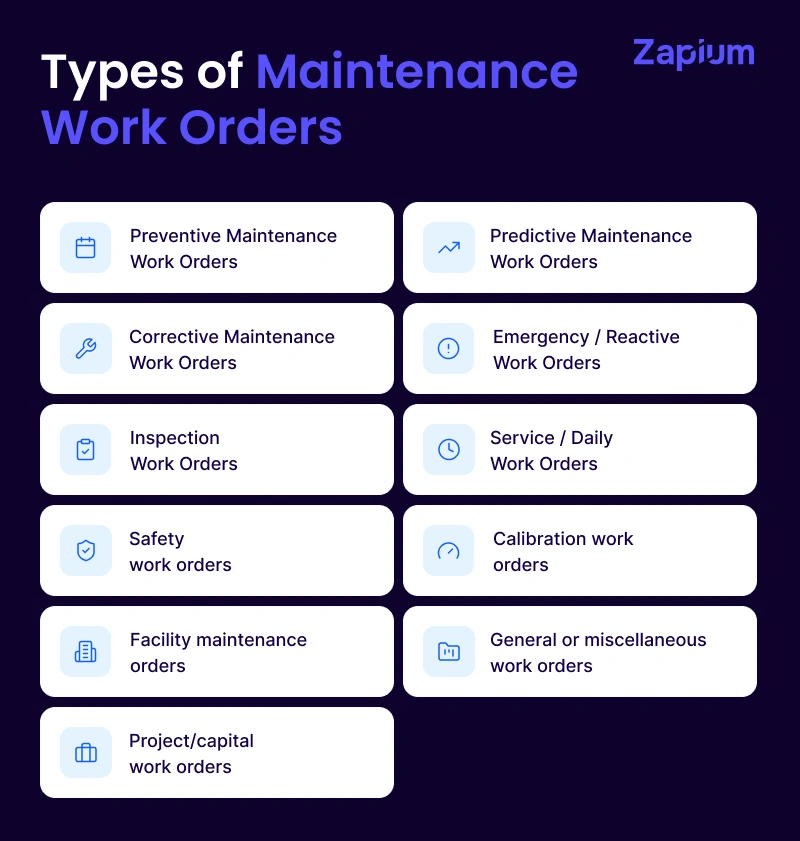
Maintenance teams rely on a mix of work order types to manage both planned and unplanned activities. Each type addresses a specific operational need, helping teams maintain control over assets while balancing efficiency, cost, and response time.
1. Preventive Maintenance Work Orders
Preventive maintenance work orders are planned in advance and scheduled at regular intervals. These tasks are designed to schedule maintenance activities based on time, usage cycles, or manufacturer recommendations and are a part of the broader planned maintenance work orders that follow predefined schedules.
Typical activities include lubrication, cleaning, part replacements, and routine system checks. These are common preventive maintenance tasks that keep equipment stable.
Organizations that rely on preventive work orders tend to experience fewer unexpected failures. Planned downtime makes scheduling easier and reduces disruptions to production.
Over time, consistent preventive maintenance improves asset lifespan and reduces the likelihood of major repairs. It also gives maintenance teams more control over their workload instead of reacting to breakdowns.
2. Predictive Maintenance Work Orders
Predictive maintenance work orders are triggered based on equipment condition rather than fixed schedules. These tasks rely on real-time data collected from sensors, monitoring systems, and performance analytics.
Changes in vibration, temperature, or pressure indicate potential issues. Once these signals cross defined thresholds, a digital work order is generated automatically.
This approach allows maintenance teams to act only when needed. It avoids unnecessary servicing while still preventing failures.
Organizations adopting predictive strategies gain better control over maintenance timing. Equipment downtime becomes more manageable, and resources are used more efficiently. Data-driven insights also improve decision-making across maintenance planning.
3. Corrective Maintenance Work Orders
Corrective maintenance work orders are created when an issue is identified but does not require immediate shutdown. The goal is to fix the problem before it worsens.
These issues are initiated through inspections or a work request submitted by operators or technicians. Tasks may include part replacements, adjustments, or minor repairs.
Corrective work orders help maintain operational stability without interrupting production unnecessarily. They allow teams to schedule fixes at the right time rather than reacting under pressure.
Balancing corrective work with preventive efforts helps organizations maintain control over equipment performance. It also reduces the chances of small issues escalating into major failures.
4. Emergency / Reactive Work Orders
Emergency or reactive work orders are issued when equipment fails unexpectedly or creates an immediate operational or safety risk. These situations require quick action and override planned schedules.
Examples include sudden machine breakdowns, electrical failures, or safety hazards that disrupt operations.
The main objective of emergency maintenance work orders is to restore functionality as fast as possible. Reducing response time in such cases directly impacts mean time to repair, which is a key metric for maintenance performance.
Reducing emergency work orders remains a priority for most organizations, as unplanned downtime tends to increase costs and strain resources.
5. Inspection Work Orders
Inspection work orders are used to evaluate the condition of equipment and systems. These tasks focus on identifying early signs of wear, damage, or inefficiency so teams can proactively manage maintenance activities.
Technicians follow predefined checklists and document their observations. Findings from inspections lead to preventive or corrective actions.
Regular inspections give maintenance teams better visibility into asset conditions. They also support long-term planning by highlighting patterns that may not be visible through day-to-day operations.
6. Service / Daily Work Orders
Service or daily work orders cover routine tasks that keep facilities running smoothly. These include cleaning, minor adjustments, and basic servicing activities that help teams consistently perform maintenance without heavy planning.
Although these tasks are simple, they play a steady role in maintaining operational consistency. Small issues are addressed early before they grow into larger problems.
Daily work orders also help teams stay organized and maintain a consistent workflow without heavy planning requirements.
Other Common or Extended Types
Beyond core categories, several specialized work orders address unique operational requirements and help streamline maintenance processes across departments. These types support compliance, precision tasks, and large-scale improvements, helping maintenance teams handle a broader range of responsibilities across different environments.
7. Safety work orders
Safety work orders focus on identifying and resolving risks that could affect personnel or operations. These tasks may include repairing faulty equipment, addressing structural concerns, or fixing electrical hazards.
Organizations treat safety-related work orders with high importance because work orders ensure that risks are documented, tracked, and resolved systematically.
8. Calibration work orders
Calibration work orders deal with adjusting equipment to maintain accuracy. Instruments used in production, testing, or measurement require regular calibration to produce reliable results.
These tasks are usually scheduled at defined intervals, and work orders include precise calibration standards, tolerances, and measurement references.
9. Facility maintenance orders
Facility maintenance work orders handle building-related systems such as HVAC, plumbing, lighting, and structural components.
These tasks contribute to maintaining a functional and safe work environment. Well-maintained facilities support productivity and reduce disruptions caused by infrastructure issues.
10. General or miscellaneous work orders
General work orders capture tasks that do not fall into predefined categories. These may include one-off fixes, minor adjustments, or unique maintenance requests.
They add flexibility to the maintenance system, allowing teams to address unexpected needs without disrupting structured workflows.
11. Project/capital work orders
Project or capital work orders are associated with large-scale initiatives such as equipment upgrades or facility expansions.
These tasks require planning, budgeting, and coordination across multiple teams. They align with long-term maintenance strategies rather than routine maintenance activities.
How Are Work Orders Prioritized and Categorized?
Work orders are prioritized and categorized to bring order to maintenance operations and help teams decide what needs attention first without confusion. Work order software streamlines this process by helping track tasks, assign responsibilities, and maintain real-time visibility across operations.
Modern systems such as a computerized maintenance management system (CMMS) further strengthen this process by centralizing data, automating workflows, and enabling better coordination between teams. Within such platforms, tasks are handled as CMMS work orders, making it easier to standardize execution and reporting.
Categorization groups work orders based on their nature. Common categories include preventive, predictive, corrective, inspection, and emergency. Each category signals the intent of the task and helps route it to the right team or technician. It also supports reporting, since organizations can track how much effort goes into planned versus unplanned work.
On the other hand work order prioritization focuses on execution order. Once categorized, each work order is evaluated based on urgency, impact on operations, and available resources. Teams use this structure to decide whether a task should be handled immediately or scheduled later.
What Does Prioritizing Work Orders Mean?
Prioritizing work orders refers to assigning a level of importance to each maintenance task so that teams can focus on the most critical issues first.
In real-world operations, multiple work orders compete for limited resources such as labor, tools, and time. Without a prioritization approach, teams may end up addressing less critical tasks while more serious issues remain unresolved.
Priority decisions are usually influenced by how a task affects production, safety, and asset performance. A failing component in a critical production line will naturally rank higher than a minor issue in a non-essential area.
A structured prioritization approach allows maintenance managers to allocate resources with better control, reduce downtime, and maintain operational balance even during high workloads.
What Are the Priority Levels for Work Orders?
Work orders are divided into priority levels to guide how quickly each task should be addressed and how resources should be assigned.
- High Priority
These tasks require immediate action. They are typically linked to safety risks, compliance issues, or production stoppages. Delays in handling such work orders can lead to significant operational losses or hazards.
- Medium Priority
These tasks affect performance but do not completely disrupt operations. They still require timely attention, but they can be scheduled within a short time frame rather than addressed instantly.
- Low Priority
Minor issues fall into this category. These tasks have minimal impact on operations and can be handled during planned maintenance windows.
- Planned / Scheduled
These include routine maintenance activities that follow predefined schedules. They are usually part of preventive or predictive maintenance programs.
How Are Work Orders Ranked by Impact, Urgency, Safety, or Cost?
Work orders are ranked using multiple evaluation criteria that help maintenance teams determine their relative importance. Instead of relying on guesswork, organizations use structured factors to guide decision-making.
- Impact on operations
Tasks that directly affect production output or critical processes are ranked higher. A failure in a key production asset will always take precedence over non-essential repairs.
- Urgency of the issue
Some problems require immediate action due to their nature. Delaying these tasks can lead to rapid deterioration or operational disruption.
- Safety considerations
Any issue that poses a risk to employees or violates safety regulations is treated as a top priority. Addressing safety concerns quickly reduces the chances of accidents.
- Cost implications
Certain maintenance tasks may become more expensive if delayed. Early intervention can prevent higher repair or replacement costs.
- Asset criticality
Equipment that plays a central role in operations is given higher importance in ranking decisions.
- Risk of downtime
Tasks that could lead to unplanned downtime are prioritized to maintain continuity in operations.
How Are Work Orders Created and Executed?
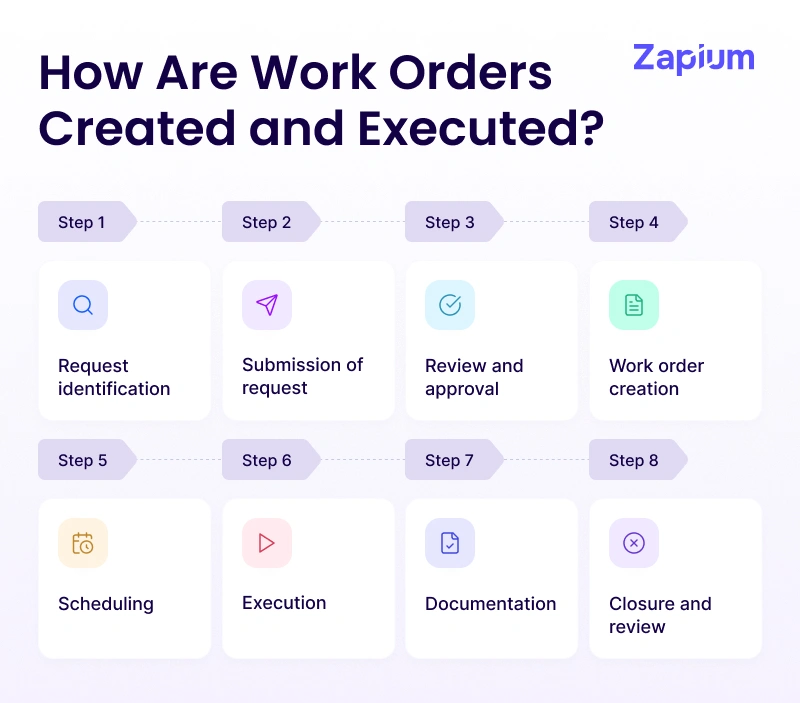
Work orders follow a structured workflow that moves from identification to completion. A defined process helps maintenance teams maintain clarity and consistency across all tasks. Here is a typical workflow:
- Request identification
A maintenance need is identified through inspections, operator feedback, or monitoring systems. This step marks the starting point of the process.
- Submission of request
The issue is logged into a maintenance system with initial details such as asset name, problem description, and location.
- Review and approval
Supervisors assess the request based on priority, impact, and available resources. Only relevant and valid requests move forward.
- Work order creation
Detailed information is added, including task instructions, assigned personnel, required tools, spare parts, and estimated timelines.
- Scheduling
The work order is placed into the maintenance schedule. Priority level and resource availability determine when the task will be executed.
- Execution
Technicians carry out the work as defined. They follow instructions and record any observations during the process.
- Documentation
After completion, details such as time spent, materials used, and outcomes are recorded for future reference.
- Closure and review
Supervisors verify the work and formally close the work order, completing the workflow.
How Using the Right Type of Work Order Improves Maintenance Outcomes
Using the right type of work order plays a direct role in shaping maintenance performance across an organization. Each type serves a specific purpose, and selecting the correct one helps teams align their actions with operational needs.
Preventive and predictive work orders support long-term asset stability by addressing issues before they lead to failure. Corrective work orders help resolve identified problems in a controlled manner, while emergency work orders restore operations during unexpected breakdowns.
Specialized work orders such as safety, calibration, and project-based tasks bring additional structure to maintenance activities. They allow teams to handle compliance requirements, precision tasks, and large-scale initiatives without disrupting routine workflows.
A well-structured approach to work order selection improves visibility into maintenance activities, supports better planning, and helps teams allocate resources with greater accuracy.