

Operational stability often depends on making the right call at the right time when it comes to equipment upkeep. I have seen how small delays or early interventions can quickly impact costs, performance, and overall workflow.
Condition based and predictive approaches offer two distinct ways to guide those decisions. Both rely on data and monitoring, yet they differ in how and when action gets taken, which directly influences efficiency and reliability. Below, I offer a closer look at the condition-based maintenance vs predictive maintenance difference, their benefits, limitations, and practical use and help in choosing the approach that aligns better with a structured maintenance program.
What Is Condition-Based Maintenance?
Condition-based maintenance is a maintenance method where equipment is monitored in real time, and maintenance work is carried out only when data shows signs of wear, damage, or declining performance. Instead of following a fixed schedule, teams rely on sensors, inspections, and performance metrics to decide the right time to perform maintenance on assets.
What Are the Benefits of Condition-Based Maintenance?
Following are some notable benefits of condition-based maintenance, explaining how the maintenance approach leads to smarter decisions and better use of resources across operations:
- Maintenance is triggered by actual asset condition
Work gets scheduled based on real performance data rather than fixed timelines, allowing teams to act only when needed and avoid unnecessary servicing that adds little value.
- Reduces unnecessary routine maintenance
Routine maintenance tasks that don’t match current asset health get minimized, helping businesses cut labor costs, reduce spare part usage, and avoid disruptions caused by excessive maintenance activities.
- Helps detect issues before failure
Early warning signs from sensors and monitoring tools allow teams to catch faults at an early stage, preventing sudden breakdowns and reducing the risk of costly emergency repairs.
- Improves maintenance efficiency
Time and resources get allocated more effectively since teams focus only on assets that need attention, leading to streamlined workflows and better productivity across maintenance operations.
- Supports better asset reliability
Assets perform more consistently when maintenance aligns with their actual condition, lowering failure rates and helping organizations maintain steady operations without frequent interruptions or unexpected downtime.
What Are the Cons of Condition-Based Maintenance?
While condition-based maintenance offers clear advantages, a few limitations can make it harder to adopt in some environments.
- Higher initial setup cost
Sensors, monitoring tools, and supporting systems require upfront investment, which can be a challenge for smaller organizations or those with limited maintenance budgets.
- Dependence on accurate data
Decisions rely heavily on data quality, so incorrect readings or faulty sensors can lead to missed issues or unnecessary maintenance actions.
- Requires skilled workforce
Teams need technical expertise to interpret data and manage monitoring systems, which may require training or hiring specialized personnel.
- Complex implementation
Setting up condition monitoring across multiple assets can be time-consuming, especially when integrating with existing systems and workflows.
- Not suitable for all assets
Some equipment may not support condition monitoring or may not justify the cost, making traditional maintenance methods more practical in certain cases.
What Are the Types of Condition-Based Maintenance?
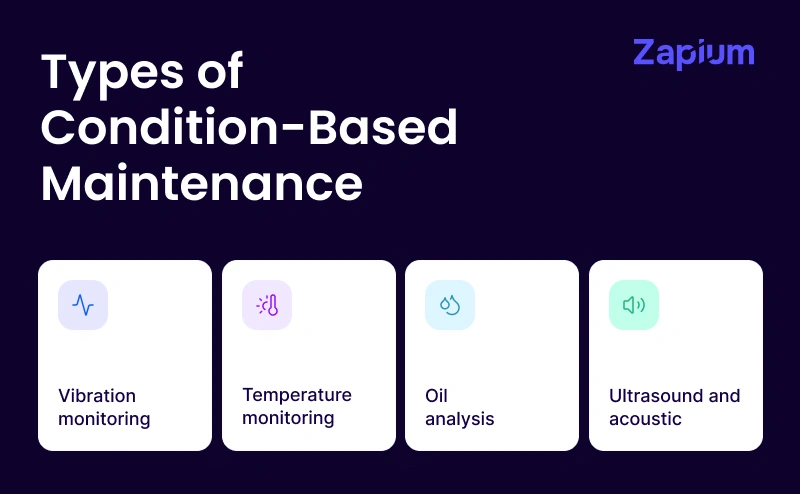
Condition-based maintenance relies on different monitoring techniques, each designed to track specific asset conditions and catch early signs of problems. These techniques are:
- Vibration monitoring
Sensors track vibration patterns in rotating equipment like motors and pumps, helping teams identify imbalance, misalignment, or bearing wear before serious damage occurs.
- Temperature monitoring
Heat levels are tracked across components to spot abnormal increases, which often signal issues like friction, overload, or electrical faults in machines and systems.
- Oil analysis
Fluid samples get examined to detect contamination, metal particles, or chemical changes, offering insights into internal wear and overall equipment health.
- Ultrasound and acoustic monitoring
High-frequency sound waves help detect leaks, electrical discharge, or mechanical faults that are not easily heard, allowing early intervention before visible damage appears.
What Are Common Examples of Condition-Based Maintenance?
Following are the real-world condition-based maintenance examples that show how data-driven actions help teams step in at the right time and avoid unnecessary work.
- Replacing a bearing after vibration exceeds threshold
Maintenance teams monitor vibration levels and replace the bearing only when readings cross a defined limit, preventing damage while avoiding early replacement that wastes usable component life.
- Servicing HVAC equipment after abnormal temperature readings
Unusual temperature spikes in HVAC systems signal performance issues, prompting timely servicing that keeps systems running efficiently and avoids sudden breakdowns during critical usage periods.
- Changing lubricant after oil contamination is detected
Oil analysis reveals contamination or degradation, leading to lubricant replacement only when quality drops, which helps protect internal components and extends overall equipment life.
- Inspecting electrical systems after thermal anomalies appear
Thermal imaging highlights hotspots in electrical systems, guiding inspections to specific problem areas and reducing the risk of failures, short circuits, or potential safety hazards.
What Is Predictive Maintenance?
Predictive maintenance is a maintenance technique that uses data, analytics, and monitoring tools to forecast when equipment is likely to fail so maintenance can be done at the right time. Instead of reacting to breakdowns or following a fixed schedule, teams rely on trends, sensor data, and performance patterns to plan repairs in advance.
What Are the Benefits of Predictive Maintenance?
Predictive maintenance brings a more proactive approach to asset care, using data-driven insights to guide smarter and more timely maintenance decisions. Prominent benefits of predictive maintenance include:
- Uses data to forecast likely failure
Advanced analytics and sensor data help identify patterns that signal potential failures, allowing teams to act early and avoid unexpected breakdowns that disrupt operations.
- Minimizes unplanned downtime
Early detection of issues allows maintenance teams to fix problems before they escalate, keeping equipment running smoothly and reducing costly interruptions in production or service delivery.
- Improves maintenance scheduling accuracy
Maintenance activities get planned based on actual equipment condition and performance trends, leading to better timing, fewer disruptions, and more efficient use of resources.
- Reduces unnecessary part replacement
Parts are replaced only when data indicates wear or risk of failure, helping businesses avoid premature replacements and reduce expenses tied to spare parts and labor.
- Supports longer asset life and better planning
Consistent monitoring and timely action help extend equipment lifespan, while reliable data supports long-term planning, budgeting, and more informed asset management decisions.
What Are the Cons of Predictive Maintenance?
While predictive maintenance offers strong advantages, a few challenges can make adoption more demanding for some organizations.
- High implementation cost
Advanced sensors, analytics platforms, and supporting infrastructure require significant upfront investment, which can be difficult for smaller businesses or those with tight budgets.
- Requires advanced technology and tools
Reliable data collection and analysis depend on modern systems, and older equipment may need upgrades or replacements to support predictive capabilities.
- Dependence on data quality and accuracy
Poor-quality data or faulty sensors can lead to incorrect predictions, causing missed failures or unnecessary maintenance actions that affect operations and costs.
- Needs skilled data analysis expertise
Interpreting complex data patterns requires trained professionals, so companies may need to invest in hiring specialists or upskilling existing maintenance teams.
- Complex integration with existing systems
Bringing predictive tools into current workflows can take time, especially when aligning with legacy systems, processes, and organizational structures.
What Are the Types of Predictive Maintenance?
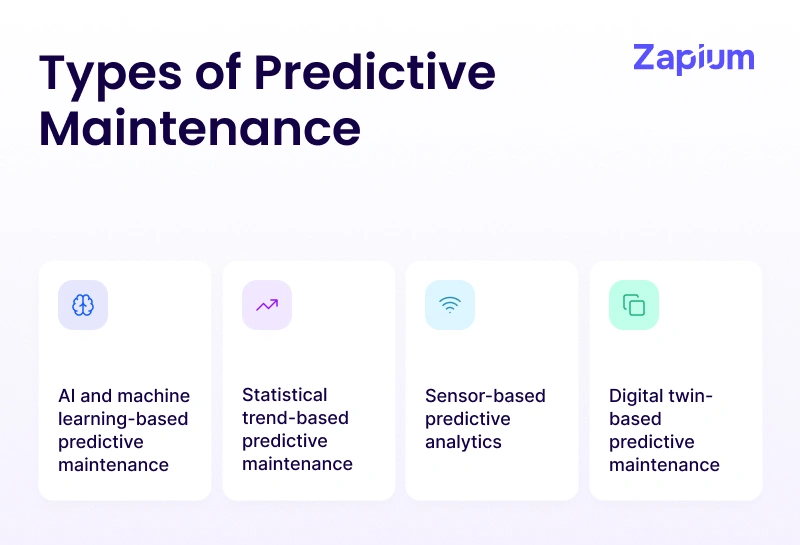
Predictive maintenance uses different approaches to analyze data and anticipate failures, each suited to specific operational needs and levels of technological maturity.
- AI and machine learning-based predictive maintenance
Advanced algorithms analyze large volumes of historical and real-time data to detect complex patterns, helping teams predict failures with higher accuracy and continuously improve maintenance decisions over time.
- Statistical trend-based predictive maintenance
Historical performance data gets analyzed to identify trends and thresholds, allowing teams to forecast potential issues based on patterns and make timely maintenance decisions without relying on complex models.
- Sensor-based predictive analytics
Data from sensors tracking vibration, temperature, pressure, and other parameters helps detect irregular behavior, enabling maintenance teams to act before equipment performance drops or failures occur.
- Digital twin-based predictive maintenance
Virtual models of physical assets simulate real-world conditions, allowing teams to test scenarios, monitor performance, and predict failures with greater precision using real-time and historical data.
What Are Common Examples of Predictive Maintenance?
Following are notable predictive maintenance examples that demonstrate how the maintenance approach helps in keeping the operations smooth through data and analytics:
- Predicting motor failure from vibration trends over time
Continuous tracking of vibration patterns highlights gradual changes that signal wear or imbalance, allowing teams to plan maintenance before the motor fails and disrupts operations.
- Forecasting pump seal wear using pressure and temperature data
Pressure and temperature readings reveal stress on pump seals, helping teams anticipate wear and schedule replacements before leaks or failures impact system performance.
- Identifying likely battery failure from performance patterns
Battery output, charge cycles, and voltage trends point to declining health, enabling early replacement planning and reducing the risk of sudden power-related disruptions.
- Predicting conveyor breakdown from sensor and usage data
Sensor data combined with usage patterns helps detect strain, misalignment, or component fatigue, allowing maintenance teams to address issues before a full conveyor system breakdown occurs.
What Is the Difference Between Condition-Based Maintenance and Predictive Maintenance?
Condition-based maintenance and predictive maintenance often get grouped together, but their approach, data usage, and execution differ. The following table clarifies the difference between CBM and PdM:
| Aspect | Condition-Based Maintenance (CBM) | Predictive Maintenance (PdM) |
|---|---|---|
Approach | Responds to the current condition of equipment and triggers action when signs of wear or issues appear | Forecasts future failures using patterns and trends, allowing teams to act before problems occur |
Data Use | Relies on real-time data and predefined thresholds to decide when maintenance is needed | Combines historical and real-time data to predict when failures are likely to happen |
Technology | Uses basic monitoring tools like sensors and inspection systems | Uses advanced analytics, AI, and machine learning for deeper insights |
Maintenance Timing | Takes action once a measurable change or issue is detected | Takes action in advance, based on predicted failure timelines |
Complexity | Simpler to implement and manage with fewer technical requirements | More complex, requiring data infrastructure, analytics tools, and skilled expertise |
How Do Condition-Based Maintenance and Predictive Maintenance Compare With Other Maintenance Strategies?
Different maintenance strategies bring different strengths to the table, and comparing them helps businesses choose the right approach based on cost, risk, and operational priorities.
Condition-Based Maintenance vs Preventive Maintenance
Condition-based maintenance depends on real-time equipment condition, with actions triggered when performance indicators cross defined limits. Preventive maintenance follows a fixed schedule based on time, usage, or manufacturer recommendations.
CBM adapts to actual asset behavior, while preventive maintenance stays consistent regardless of current condition, even if the equipment is still performing normally.
Predictive Maintenance vs Preventive Maintenance
Predictive maintenance analyzes historical and real-time data to forecast when failures are likely to occur. Preventive maintenance relies on predefined intervals without considering data-driven predictions.
PdM focuses on anticipating future issues through trends and patterns, while preventive maintenance focuses on routine servicing at regular intervals.
Predictive Maintenance vs Reactive Maintenance
Predictive maintenance uses data insights to identify potential failures in advance and guide timely action. Reactive maintenance takes place only after equipment has already failed.
PdM works proactively based on predictions, while reactive maintenance operates as a response to breakdowns after they happen.
How Do Organizations Measure Condition-Based and Predictive Maintenance Performance?
Organizations measure condition-based maintenance performance by continuously monitoring real-time asset data, checking whether maintenance actions are triggered at the right thresholds, and reviewing how those actions impact equipment condition and operational stability over time.
The process focuses on linking sensor inputs with timely interventions and verifying that assets perform as expected after maintenance, thus bringing operational stability and enhancing uptime.
For predictive maintenance, the process centers on analyzing historical and real-time data to evaluate how accurately models forecast failures and guide maintenance decisions. Teams regularly compare predicted outcomes with actual events, refine algorithms, and assess whether early interventions prevent breakdowns and improve overall operational consistency.
What Is Condition Monitoring Accuracy?
Condition monitoring accuracy is a measure that describes how closely sensor data and monitoring systems reflect the true condition of an asset. High accuracy means the data reliably captures issues like wear, faults, or performance drops without false alarms or missed problems.
How Do Maintenance Teams Track Predictive Maintenance Effectiveness?
Teams need a clear way to check whether predictive maintenance is actually delivering better results in day-to-day operations. The following are the metrics used to track predictive maintenance effectiveness:
- Mean Time Between Failures (MTBF)
- Mean Time To Repair (MTTR)
- Downtime reduction
- Maintenance cost savings
- Prediction accuracy
How Should Organizations Choose Between Condition-Based and Predictive Maintenance Strategies?
Picking the right maintenance strategy depends on a mix of operational priorities, available data, and internal capabilities. The decision becomes clearer when examined through the following three questions.
What Factors Influence Maintenance Strategy Selection?
Following are the practical considerations that shape how organizations decide on a maintenance strategy:
- Asset criticality
Assets that directly impact production or safety often require more advanced approaches, while less critical equipment can be managed with simpler methods.
- Availability of sensor data
Access to real-time and historical data determines whether condition tracking or predictive modeling can be effectively applied.
- Budget and technical resources
Investment capacity and access to tools, infrastructure, and skilled personnel play a major role in selecting the right strategy.
- Maintenance team maturity
Teams with experience in data analysis and advanced tools are better equipped to handle predictive approaches, while others may rely on simpler condition-based methods.
- Failure impact on operations
If equipment failure leads to major downtime or losses, organizations tend to adopt more data-driven and proactive maintenance strategies.
When Is Condition-Based Maintenance the Right Approach?
Condition-based maintenance works well when organizations have access to real-time monitoring but limited historical data or advanced analytics capabilities. It suits environments where assets show clear, measurable indicators of wear and where immediate condition changes can guide maintenance decisions.
When Is Predictive Maintenance the Right Approach?
Predictive maintenance fits scenarios where large volumes of historical and real-time data are available, and organizations can use advanced analytics to forecast failures. It is ideal for critical assets where early intervention and precise timing can prevent costly disruptions.