


When equipment starts failing, the real test lies in how quickly issues are identified and brought under control without disturbing ongoing operations. The way teams respond to faults, plan repairs, and handle recurring issues often decides how stable and predictable the system remains over time.
In this discussion, I examine corrective maintenance from a practical angle, covering its types, working approach, key advantages, limitations, and selection factors, with a focus on real operational scenarios. I look at how different strategies align with asset criticality, failure patterns, and resource availability to keep systems running with minimal disruption.
What Is Corrective Maintenance in Maintenance Management?
In maintenance management, corrective maintenance refers to actions taken after a fault has occurred to restore equipment functionality. Along with preventive and predictive maintenance, corrective maintenance remains a key part of the maintenance strategy in most maintenance-centric organizations.
Maintenance teams rely on a work order system to assign and track repairs. Corrective maintenance involves identifying the issue, executing repairs, and validating performance.
Organizations often use a computerized maintenance management system to manage asset data, track failures, and document repair history.
Why Is Corrective Maintenance Important for Equipment Reliability and Operations?
Corrective maintenance matters because unresolved faults push equipment beyond acceptable operating limits, leading to performance instability and higher failure frequency. Timely repair of failed components restores functional accuracy and prevents load redistribution across connected systems. Without such intervention, minor defects escalate into secondary damage, increasing downtime and repair complexity while reducing reliability indicators like MTBF.
Operational flow depends on how quickly faults get contained and resolved. Corrective maintenance programs reduce production interruptions by bringing assets back online in a controlled manner, rather than allowing failures to disrupt entire processes. Maintenance records from these interventions expose recurring fault patterns, helping teams refine planning and spare part readiness, which directly supports consistent throughput and minimizes disruptions in tightly coupled production environments.
What Are the Main Types of Corrective Maintenance Strategies
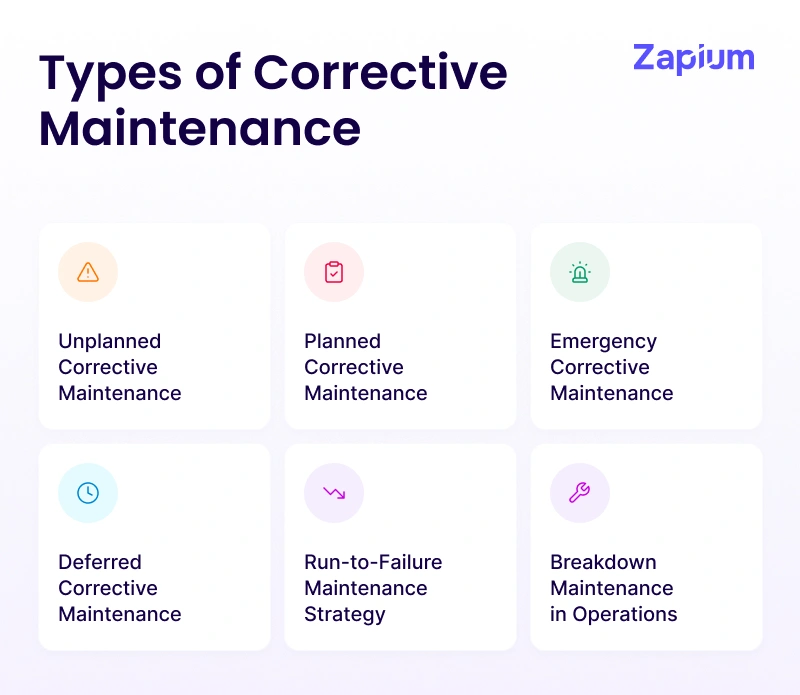
Different corrective maintenance strategies align with how failures are detected, prioritized, and executed across operational environments, based on asset criticality, failure impact, and repair planning requirements.
1. Unplanned Corrective Maintenance (Reactive Maintenance)
Triggered immediately after failure detection without prior scheduling. Teams diagnose faults on-site, isolate defective components, and restore functionality, typically without predefined resources or spare part allocation.
2. Planned Corrective Maintenance (Scheduled Repairs)
It is a type of maintenance where repairs are scheduled after fault identification but before total failure. Maintenance teams plan downtime, arrange spare parts, and allocate resources to fix known defects under controlled conditions.
3. Emergency Corrective Maintenance (Critical Repairs)
Executed when critical equipment failure halts operations or creates safety risks. Immediate intervention via emergency repair focuses on rapid fault isolation and restoration, with priority access to skilled technicians and essential components.
4. Deferred Corrective Maintenance (Delayed Repairs)
Non-critical faults are intentionally postponed based on risk assessment. Equipment continues operating with known defects, aligning with cases where assets are allowed to run despite minor issues.
5. Run-to-Failure Maintenance Strategy
Assets operate until complete functional failure occurs. No intervention takes place during degradation; maintenance teams replace or repair components only after failure disrupts normal equipment operation.
6. Breakdown Maintenance in Operations
Focuses on restoring equipment after sudden operational failure. Maintenance teams respond to unexpected breakdowns by diagnosing root causes and performing repairs required to resume standard production activities.
How Does Corrective Maintenance Work in Industrial Maintenance Processes
Corrective maintenance begins when a fault is detected through alarms, operator reports, or system diagnostics. Maintenance teams isolate the issue using error codes, inspection data, and testing tools to identify the failed component. Once confirmed, they proceed with repair or replace actions, followed by system recalibration to restore equipment performance within defined operating parameters.
After restoration, teams validate equipment functionality through trial runs and performance checks. Maintenance records capture fault details, actions taken, and parts used, creating a reference for recurring issues. These records support future planning, spare part control, and quicker fault resolution in similar failure scenarios. A structured corrective maintenance process ensures that every corrective task is tracked and executed systematically. Common corrective maintenance examples across industries include fixing a motor fault, replacing a damaged belt, or repairing a sensor.
What Are the Key Benefits of Corrective Maintenance Strategies
Corrective maintenance strategies align repair actions with actual equipment failure, shaping how resources, costs, and maintenance efforts are managed across different asset categories, as the following benefits explain:
- Lower maintenance planning effort
Planning requirements for corrective maintenance tasks remain minimal since actions begin after fault detection. Teams focus on diagnosing and fixing issues rather than building detailed preventive schedules or allocating resources in advance.
- Cost-effective for non-critical assets
Non-critical equipment operates until failure without frequent servicing costs. Expenses stay limited to repair or replacement, avoiding ongoing maintenance spending for assets with low operational impact and maintenance costs stay low.
- No unnecessary maintenance actions
Maintenance occurs only when faults appear, eliminating routine servicing of components
still in working condition. Resources are used strictly for actual failures rather than time-based or condition-based maintenance.
- Simple implementation and execution
Execution follows a straightforward process – detect failure, diagnose the issue, and perform repair. No complex monitoring systems or predictive tools are required, making it easy to apply across basic operational setups.
What Are the Limitations and Risks of Corrective Maintenance
Corrective maintenance carries operational risks too since actions begin only after equipment failure. These limitations are:
- Unexpected equipment downtime
Failures occur without warning, forcing immediate shutdown of equipment. Lack of prior planning delays response time, especially when spare parts or technical resources are not readily available.
- Increased production disruption risk
Sudden breakdowns interrupt process flow and halt dependent systems. In tightly coupled operations, a single equipment failure can cascade across multiple stages, affecting output continuity.
- Potential safety hazards
Equipment operating until failure may degrade beyond safe limits. Mechanical wear, electrical faults, or control failures can expose operators and systems to unsafe working conditions during breakdown events.
- Higher long-term repair and replacement costs
Delayed intervention allows faults to worsen, leading to extensive damage. Repairs may require major component replacements instead of minor fixes, increasing overall maintenance expenditure over time.
- Reduced equipment lifespan
Continuous operation under degrading conditions accelerates wear on critical components. Repeated stress without timely intervention shortens asset life and increases the frequency of complete equipment replacement.
How Do Different Types of Corrective Maintenance Compare with Each Other
Different industrial corrective maintenance types vary based on timing, failure criticality, and cost control, shaping how maintenance teams prioritize repairs and allocate resources across operational environments.
- Planned vs unplanned corrective maintenance
Planned corrective maintenance schedules repairs after fault detection, allowing resource allocation and controlled downtime. Unplanned corrective maintenance reacts immediately after failure, with no prior scheduling, leading to sudden stoppages and reactive execution.
- Emergency vs deferred corrective maintenance
Emergency maintenance addresses critical failures that halt operations or create safety risks, requiring immediate action. Deferred corrective maintenance delays non-critical repairs, allowing equipment to operate with known faults until a suitable maintenance
window.
- Run-to-failure vs breakdown maintenance
Run-to-failure maintenance strategy allows assets to operate until complete functional loss before intervention. Breakdown maintenance focuses on repairing equipment after unexpected failure, with emphasis on restoring operation rather than pre-defined failure acceptance.
- Cost impact across maintenance types
Planned and deferred approaches distribute repair costs more predictably through scheduling. Unplanned and emergency types lead to fluctuating expenses due to urgent resource use, expedited parts procurement, and extended downtime impact.
How to Choose the Right Corrective Maintenance Strategy for Your Equipment
Selecting a corrective maintenance strategy starts with assessing asset criticality, failure behavior, and its role within operations. Equipment with low impact and predictable failure patterns suits run-to-failure, whereas critical systems require planned or emergency response structures. Evaluation of failure data, mean time between failures (MTBF), and spare availability helps determine whether immediate repair or scheduled intervention fits operational limits.
Decision-making also considers downtime tolerance, repair complexity, and system dependencies. Equipment linked to continuous production demands rapid response, while isolated units allow deferred action. CMMS data connects failure history with resource planning, guiding execution timelines and strategy selection.
What Factors Influence Corrective Maintenance Strategy Selection
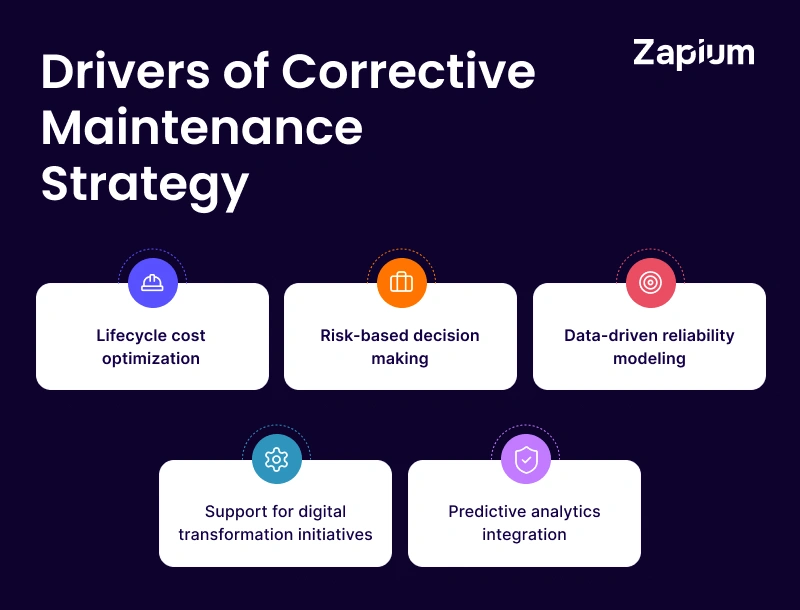
Following are the factors that influence corrective maintenance strategy selection, based on operational impact, risk levels, and equipment-specific conditions:
- Asset criticality
Critical assets supporting core operations require faster response strategies, while non-critical equipment can operate under delayed repair approaches without significantly affecting overall system performance.
- Cost of downtime
High downtime costs push toward rapid corrective actions, while lower-impact equipment allows flexible repair timing. Financial impact directly influences whether immediate or deferred intervention is selected.
- Safety requirements
Equipment linked to safety systems demands immediate corrective action after failure. Faults in such assets cannot be delayed due to risk exposure to personnel, environment, or operational infrastructure.
- Equipment condition and lifecycle stage
Aging equipment with frequent failures may require quicker interventions or replacement decisions, while newer assets with stable performance can tolerate delayed corrective actions based on failure severity.
- Spare parts and resource availability
Availability of critical spares and skilled technicians affects repair timing. Limited resources may lead to deferred maintenance, while readily available parts support immediate corrective execution.
When Should Corrective Maintenance Be Used Instead of Preventive Maintenance
Corrective maintenance is preferred over preventive maintenance in specific operational situations where scheduled servicing does not add measurable value. Scenarios include:
- Low-criticality equipment
Used when asset failure does not affect core operations, such as auxiliary systems or backup components, where downtime has minimal impact on production or service delivery.
- Cost-sensitive components
Applicable when the cost of routine maintenance exceeds the cost of repair or replacement after failure, making run-to-failure a more practical choice.
- Short-life or replaceable parts
Suitable for consumables like belts, fuses, or filters that wear out quickly and are more efficient to replace after failure rather than maintain on a fixed schedule.
- Predictable or non-critical failure patterns
Works well when failure does not lead to cascading system issues, allowing teams to respond after breakdown without affecting interconnected equipment.
- Limited maintenance resources
Used when workforce, tools, or spare parts are constrained, allowing teams to prioritize corrective actions over routine inspections and servicing.