
When I started looking closely at how businesses handle their assets, one thing became clear pretty quickly. Most problems don’t come from a lack of tools, but from a lack of structure. I have seen teams juggling maintenance, tracking, and reporting without a unified system, which leads to delays, higher costs, and avoidable downtime.
That’s where enterprise asset management (EAM) comes into the picture. In this blog, I’ll walk through how EAM actually works, what it includes, and why it plays such a critical role in keeping operations steady, predictable, and easier to manage.
How Does Enterprise Asset Management Work?
Following is the workflow that explains how enterprise asset management (EAM) operates in a structured and step-by-step manner:
- Asset Registration and Configuration
Every asset is logged with key details such as specifications, location, ownership, and lifecycle data, creating a centralized record that supports tracking, compliance, and informed decision-making.
- Maintenance Planning and Scheduling
Planned activities are mapped based on usage patterns, asset criticality, and historical data, helping teams stay ahead of failures while balancing workloads and minimizing operational disruptions.
- Asset Condition Monitoring
Sensors, inspections, and performance checks track real-time asset health indicators, allowing early detection of anomalies and reducing the chances of sudden breakdowns or costly emergency repairs.
- Work Order Generation
When maintenance needs arise, the system automatically creates detailed work orders outlining required tasks, tools, timelines, and priorities, keeping operations organized and actionable.
- Task Assignment and Allocation
Work orders are distributed to technicians based on skill sets, availability, and location, improving accountability while reducing delays caused by unclear responsibilities or inefficient task allocation.
- Maintenance Execution and Tracking
Technicians perform assigned tasks while updating progress in real time, allowing managers to monitor completion status, identify bottlenecks, and maintain operational transparency throughout the process.
- Data Documentation and Recording
Every action, repair, and inspection result is recorded systematically, building a reliable history that supports audits, compliance requirements, and future maintenance planning decisions.
- Performance Analytics and Reporting
Collected data is analyzed to uncover trends, measure asset efficiency, and highlight improvement areas, enabling businesses to optimize maintenance strategies and make data-backed operational decisions.
Why Is Enterprise Asset Management Important for Modern Businesses?
At enterprise scale, asset management decisions compound quickly — a 1% improvement in uptime across hundreds of assets translates to significant revenue recovery. McKinsey research shows that large organisations implementing CMMS-enabled predictive maintenance decrease machine downtime by 30–50%, making the choice of asset management framework a board-level financial consideration.
A structured approach like enterprise asset management helps businesses stay organized, reduce risks, and make smarter operational decisions. Let’s discuss this in more detail:
- Minimizes Unplanned Downtime
Regular monitoring and scheduled maintenance reduce unexpected failures, keeping operations stable and avoiding costly disruptions that can impact productivity and service delivery.
- Extends Asset Lifespan
Timely servicing and proper usage tracking prevent premature wear and tear, allowing businesses to get maximum value from their investments over a longer period.
- Improves Cost Control
Better planning reduces emergency repairs and unnecessary replacements, helping organizations allocate budgets more effectively and maintain predictable maintenance expenses.
- Enhances Operational Efficiency
Clear workflows, task allocation, and centralized data streamline maintenance activities, allowing teams to work faster and with fewer errors or delays.
- Supports Data-Driven Decisions
Access to historical and real-time data helps managers identify patterns, optimize maintenance schedules, and make informed decisions about asset utilization and upgrades.
- Ensures Compliance and Audit Readiness
Accurate documentation and tracking make it easier to meet regulatory requirements and maintain records required for inspections and audits.
- Increases Workforce Productivity
Defined roles, automated work orders, and efficient scheduling reduce confusion, enabling teams to focus on execution rather than coordination challenges.
- Strengthens Asset Visibility
A centralized EAM system provides complete visibility into asset status, location, and performance, helping businesses maintain control across multiple sites and operations.
What Are the Key Features of Enterprise Asset Management?
Enterprise Asset Management systems bring multiple capabilities under one roof, allowing businesses to manage assets systematically while keeping operations efficient and data-driven. Each feature plays a specific role in maintaining control and improving performance. These features are:
Asset Lifecycle Management
Offers asset management tools that aid in the complete journey of an asset from procurement to disposal. These tools help businesses track usage, plan upgrades, control costs, and make informed long-term investment decisions.
Work Order Management
Handles the creation, tracking, and completion of maintenance tasks, keeping activities organized. Additionally, work order management provides clear instructions, timelines, and accountability for every assigned job.
Preventive Maintenance Scheduling
Schedules routine inspections and servicing based on time or usage patterns, reducing the risk of unexpected failures and maintaining consistent asset performance over time.
Real-Time Asset Tracking and Monitoring
Uses sensors and connected systems to monitor asset location, condition, and performance continuously, allowing quick responses to issues and better operational visibility.
Inventory and Spare Parts Management
Maintains accurate records of spare parts availability, usage, and replenishment, preventing stockouts and overstocking while supporting smooth maintenance operations.
Data-Driven Analytics and Reporting
Analyzes historical and real-time data to identify trends, measure efficiency, and highlight improvement areas, enabling smarter maintenance strategies and business decisions.
Mobile Access and Service Requests
Allows technicians and teams to access systems, update tasks, and raise service requests from mobile devices, improving responsiveness and reducing delays in communication and execution.
What Types of Assets Are Managed by Enterprise Asset Management?
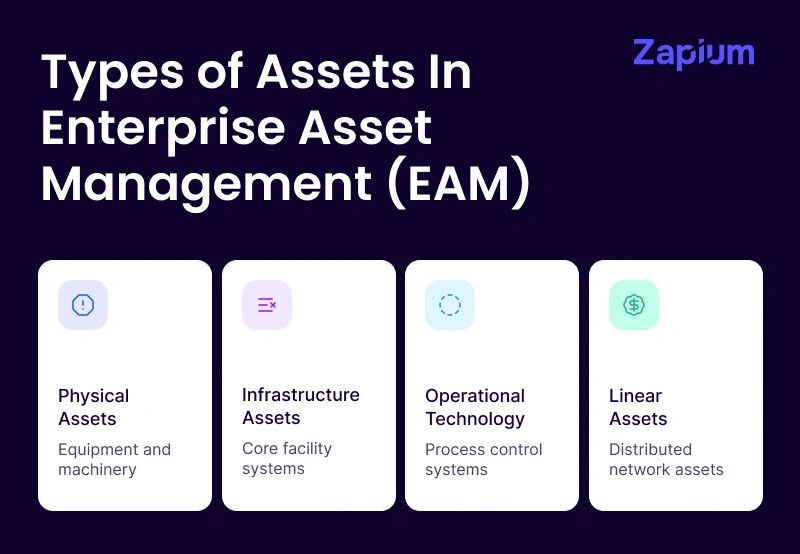
Following are various categories of assets used in enterprise asset management (EAM) and the elements they comprise:
Physical Assets
These are tangible assets directly used in day-to-day operations and require regular upkeep to maintain performance and reliability.
- Production equipment: Used in core operations to carry out essential tasks, requiring routine maintenance and monitoring to avoid disruptions in output and workflow continuity.
- Manufacturing machinery: High-value machines used in production lines that need precise servicing, calibration, and performance tracking to maintain quality and efficiency.
- Vehicles: Includes transport and logistics units that require maintenance scheduling, fuel tracking, and usage monitoring to stay operational and cost-efficient.
- Buildings: Structures that house operations and teams, requiring periodic inspections and maintenance to maintain safety, compliance, and usability.
- Facilities: Operational spaces such as plants or warehouses that need coordinated maintenance to support uninterrupted business activities.
Infrastructure Assets
These are large-scale assets that support public services and industrial systems, distributed across multiple locations.
- Water utilities: Systems responsible for water supply and distribution that require continuous monitoring to prevent leaks, failures, and service interruptions.
- Power plants: Energy generation assets that depend on strict maintenance schedules to sustain consistent output and operational safety.
- Pipeline networks: Used for transporting liquids or gases, requiring regular inspection to detect leaks, corrosion, or structural issues.
- Roads and bridges: Critical transport infrastructure that needs routine evaluation and maintenance to maintain safety and long-term usability.
Operational Technology Assets
These assets are responsible for controlling and monitoring industrial processes, making them essential for automation and system efficiency.
- Control systems: Manage and regulate operational processes, requiring consistent monitoring to maintain accuracy and system stability.
- SCADA systems: Provide centralized control and real-time monitoring of distributed assets, helping operators respond quickly to changes or issues.
- PLCs: Programmable controllers used for automation tasks, requiring regular updates and checks to maintain precise machine control.
- MES systems: Track and manage production processes on the shop floor, helping maintain visibility and control over manufacturing activities.
Linear Assets
These are assets that extend over long distances and require location-based monitoring and maintenance strategies.
- Pipelines: Transport systems for oil, gas, or water that require continuous inspection to maintain flow efficiency and prevent failures.
- Railways: Track networks that need scheduled maintenance and monitoring to maintain safety and uninterrupted transportation.
- Highways: Road networks that require periodic inspection and repair to handle traffic loads and maintain driving conditions.
- Transmission lines: Used for power distribution, requiring monitoring to prevent outages and maintain consistent energy flow.
- Cable networks: Communication or power cables that require maintenance to avoid disruptions and maintain connectivity across regions.
What Are the Benefits of Using Enterprise Asset Management?
A key benchmark for enterprises asset management: Industry Best Practices Metrics identifies a planned versus reactive ratio of 85–90% as the best-in-class standard, against an industry average that sits at just 55–65%.
Following are some notable benefits of using enterprise asset management (EAM), showing how EAM brings structure and visibility to how assets are handled:
- Extends asset lifespan and return on investment
Regular asset maintenance and proper tracking prevent premature wear, allowing assets to operate longer while delivering better value against the initial investment.
- Increases equipment uptime and productivity
Planned servicing and quick issue resolution keep equipment running consistently, reducing idle time and allowing teams to maintain steady operational output.
- Reduces unplanned downtime and failures
Continuous monitoring and preventive strategies help identify issues early, lowering the risk of sudden breakdowns that disrupt operations and impact business continuity.
- Lowers overall maintenance costs
Proactive maintenance reduces emergency repairs and unnecessary replacements, helping businesses control expenses and allocate budgets more effectively.
- Enables real-time data-driven decisions
Access to live and historical data allows managers to make informed choices about maintenance schedules, asset usage, and performance improvements.
- Improves asset reliability and performance
Consistent monitoring and timely servicing keep assets operating at optimal levels, reducing performance fluctuations and maintaining dependable operations.
- Streamlines maintenance workflows and work orders
Automated processes and clear task management simplify maintenance activities, improving coordination, reducing delays, and increasing overall team efficiency.
What Challenges Do Organizations Face When Implementing EAM?
Rolling out enterprise asset management comes with practical hurdles that can slow adoption if not addressed early. Following are some of them, with each impacting cost, timelines, and overall system effectiveness in some way:
- High initial investment costs
Implementing EAM requires spending on enterprise asset management software solutions, infrastructure, training, and process changes, making it a significant upfront commitment for organizations with limited budgets.
- Complex system integration
Connecting EAM with existing systems like ERP or IoT platforms can be technically demanding, requiring careful planning to avoid data silos and operational inconsistencies.
- Data migration challenges
Transferring legacy data into the new system can be time-consuming, with risks of data loss, duplication, or inaccuracies if not properly validated and structured.
- User adoption resistance
Employees may hesitate to shift from familiar processes to a new system, leading to slow adoption unless proper training and change management strategies are in place.
- Extended deployment timelines
Large-scale implementations take longer due to customization, integration, and testing requirements, delaying the realization of expected benefits.
What Are the Different Types of Enterprise Asset Management?
Enterprise Asset Management solutions come in different deployment models, allowing businesses to choose an approach that fits their operational needs, infrastructure, and scalability expectations.
- Cloud-Based EAM
Hosted on remote servers and accessed via the internet, offering flexibility, lower upfront costs, automatic updates, and easy scalability without heavy reliance on in-house infrastructure.
- On-Premise EAM
Installed and managed within an organization’s own servers, providing greater control over data, customization, and security, but requiring higher initial investment and ongoing maintenance efforts.
- Hybrid EAM Solutions
Combines both cloud and on-premise setups, allowing businesses to keep critical data on-site while leveraging cloud capabilities for scalability, accessibility, and extended functionalities.
- Mobile EAM Applications
Designed for use on smartphones and tablets, enabling technicians to access asset data, update work orders, and manage tasks in real time while working in the field.
Cloud-Based vs On-Premise Enterprise Asset Management (EAM)
Choosing between cloud-based and on-premise enterprise asset management (EAM) depends on how a business balances cost, control, scalability, and IT capabilities. The differences below highlight how each model fits different operational needs.
| Basis | Cloud-Based EAM | On-Premise EAM |
|---|---|---|
Deployment | Hosted on remote servers and accessed via the internet, eliminating the need for local installation | Installed on in-house servers and managed within the organization’s IT environment |
Initial Cost | Lower upfront investment with subscription-based pricing models | Higher initial cost due to hardware, licenses, and setup requirements |
Maintenance | Vendor handles updates, backups, and system maintenance | Internal teams are responsible for updates, security, and system upkeep |
Scalability | Easily scalable based on business needs without major infrastructure changes | Scaling requires additional hardware and configuration, making it slower and costlier |
Accessibility | Accessible from anywhere with internet connectivity, supporting remote operations | Typically limited to internal networks unless additional remote access setups are configured |
Data Control | Data is stored on vendor-managed servers, offering less direct control | Full control over data storage, security policies, and system configurations |
Customization | Limited customization compared to on-premise setups | Greater flexibility to customize based on specific business requirements |
Implementation Time | Faster deployment with minimal setup required | Longer implementation due to installation, configuration, and testing processes |
Security Responsibility | Shared responsibility with the service provider managing core security measures | Fully managed by the organization, requiring dedicated security resources |
IT Dependency | Lower reliance on internal IT teams | High dependency on in-house IT for management and troubleshooting |
What Are the KPIs and Metrics Used in EAM?
Following are the maintenance metrics that help businesses track how well assets and maintenance strategies are performing.
- Mean Time Between Failures (MTBF): Indicates the average time an asset operates before a failure occurs, helping assess reliability and identify how frequently equipment breaks down over a period.
- Mean Time to Repair (MTTR): Measures the average time required to repair an asset after a failure, reflecting how quickly maintenance teams can restore equipment to normal working condition.
- Overall Equipment Effectiveness (OEE): Evaluates overall performance by combining availability, performance, and quality, giving a clear picture of how efficiently equipment is being utilized in operations.
- Planned Maintenance Percentage (PMP): Shows the ratio of planned maintenance activities compared to total maintenance work, indicating how proactive a maintenance strategy is versus reactive actions.
- Asset Uptime and Availability: Tracks the amount of time assets remain operational and ready for use, highlighting reliability and the ability to support continuous operations.
- Maintenance Cost per Asset: Calculates the total maintenance expense associated with each asset, helping businesses monitor cost efficiency and identify high-maintenance equipment.
What Are the Various Industries That Use Enterprise Asset Management?
Various sectors use EAM in a way that aligns with its operational complexity and regulatory requirements, as we see:
Manufacturing
Production environments depend on high machine availability and precision. EAM supports preventive maintenance for assembly lines, tracks equipment performance, and reduces downtime that can disrupt production schedules and output targets.
Oil and Gas
Operations span upstream, midstream, and downstream assets such as rigs, pipelines, and refineries. EAM helps manage asset integrity, schedule inspections, and meet strict safety and environmental compliance standards in high-risk conditions.
Utilities and Power Generation
Power plants, transmission lines, and distribution networks require continuous monitoring. EAM enables outage management, load-based maintenance planning, and regulatory reporting to maintain uninterrupted energy supply.
Healthcare and Pharmaceuticals
Hospitals and production facilities rely on critical equipment with strict compliance requirements. EAM tracks medical devices, schedules calibration, and maintains audit trails to meet regulatory standards and ensure patient safety.
Transportation and Logistics
Fleets, warehouses, and distribution assets require constant coordination. EAM helps manage vehicle maintenance, optimize asset utilization, and reduce delays in supply chain operations.
Mining and Natural Resources
Heavy equipment operates in harsh environments with high wear and tear. EAM supports condition-based maintenance, tracks equipment health, and minimizes downtime that can significantly impact production output.
Government and Public Sector
Public infrastructure, utilities, and municipal assets need long-term maintenance planning. EAM helps manage budgets, track asset conditions, and maintain transparency for compliance and public accountability.
Facilities and Real Estate
Commercial buildings, campuses, and property portfolios require ongoing maintenance. EAM supports space management, tracks facility assets, and schedules maintenance to maintain occupant comfort and operational efficiency.
What Should Enterprise Asset Management Include?
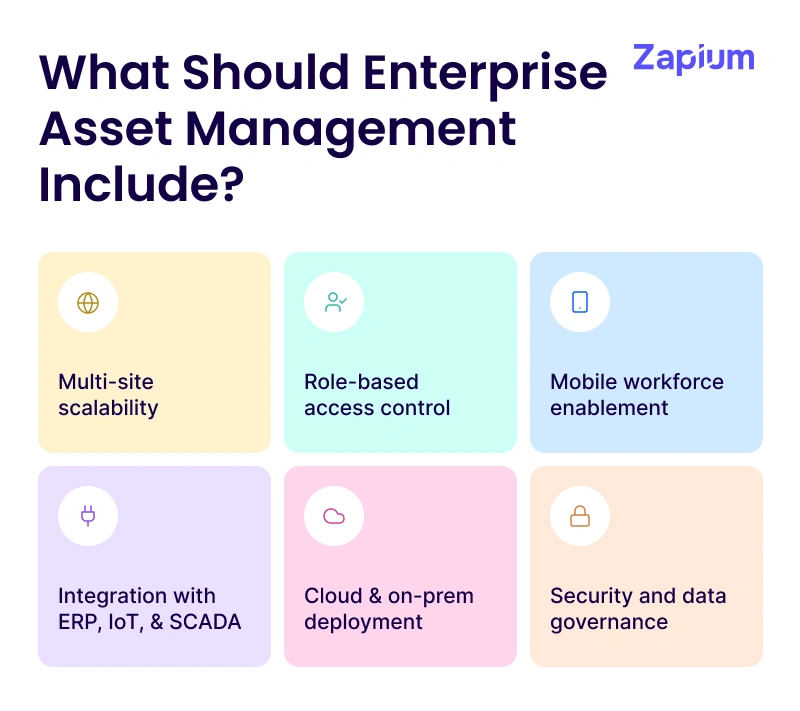
A well-structured EAM system should go beyond basic tracking and support large-scale operations, secure access, and seamless connectivity across business systems. The following components define a capable and future-ready EAM setup.
- Multi-site and enterprise scalability
Supports operations across multiple locations, allowing centralized control while accommodating growing asset volumes, users, and workflows without performance issues.
- Role-based access control
Defines user permissions based on roles, restricting access to sensitive data while allowing teams to perform relevant tasks securely and efficiently.
- Mobile workforce enablement
Equips field teams with mobile access to asset data, work orders, and updates, improving response time and reducing delays in maintenance execution.
- Integration with ERP, IoT, and SCADA
Connects with business systems and real-time monitoring tools to enable data flow, automate processes, and provide a unified operational view.
- Cloud and on-premise deployment options
Offers flexibility to choose deployment models based on business needs, balancing scalability, control, and infrastructure capabilities.
- Security and data governance
Implements data protection measures, access controls, and compliance frameworks to safeguard critical asset information and maintain regulatory standards.
What Are the Best Practices for Implementing EAM?
Following are the proven practices for implementing enterprise asset management. I have seen how sticking to them reaps huge benefits for maintenance and operations teams.
- Define clear objectives and implementation goals
Set specific goals such as reducing downtime, improving asset visibility, or lowering costs, giving the implementation a clear direction and measurable success criteria.
- Conduct comprehensive asset inventory and audit
Document all assets with accurate details, helping build a reliable foundation for the system and avoiding gaps or inconsistencies during deployment.
- Ensure data quality and migration accuracy
Clean, validate, and standardize legacy data before migration to prevent errors, duplication, and unreliable reporting in the new system.
- Provide adequate user training and support
Train teams on system usage and workflows, reducing resistance while helping users adopt the system confidently and use it effectively.
- Start with a pilot program before full rollout
Test the system on a smaller scale to identify issues, refine processes, and minimize risks before implementing it across the entire organization.
- Integrate with existing systems strategically
Plan integrations with ERP, IoT, and other systems carefully to enable smooth data flow and avoid operational disruptions or data silos.
- Monitor KPIs and measure success continuously
Track performance metrics regularly to evaluate progress, identify improvement areas, and adjust strategies for better long-term results.
What Is the Difference Between EAM and CMMS?
Enterprise asset management and computerized maintenance management systems (CMMS) are two different systems as clarified below:
| Basis | EAM | CMMS |
|---|---|---|
Scope | Covers the entire asset lifecycle from procurement to disposal | Focuses mainly on maintenance activities and work order management |
Objective | Optimizes asset performance, lifecycle value, and business outcomes | Improves maintenance efficiency and reduces equipment downtime |
Asset Coverage | Includes physical, infrastructure, and operational technology assets | Primarily deals with equipment and machinery maintenance |
Lifecycle Management | Manages complete lifecycle including acquisition, operation, and retirement | Limited to maintenance phase of the asset lifecycle |
Maintenance Capabilities | Includes preventive, predictive, and reliability-centered maintenance | Primarily supports preventive and corrective maintenance |
Integration | Integrates with ERP, IoT, finance, and other enterprise systems | Limited integrations mainly related to maintenance operations |
Data Utilization | Uses enterprise-wide data for strategic decision-making | Uses maintenance data for operational improvements |
User Base | Used by multiple departments such as operations, finance, and management | Primarily used by maintenance teams and technicians |
Scalability | Designed for large, multi-site, enterprise-level operations | Suitable for small to mid-sized operations or specific departments |
Cost and Complexity | Higher cost with broader functionality and implementation complexity | Lower cost with simpler implementation and focused features |
How Does EAM Differ from ERP Systems?
Enterprise Asset Management focuses specifically on managing the lifecycle, performance, and maintenance of physical assets. It provides detailed control over asset tracking, preventive maintenance, work orders, and reliability, helping businesses reduce downtime and extend asset lifespan.
Enterprise Resource Planning, on the other hand, manages broader business processes such as finance, procurement, human resources, and supply chain operations. While ERP systems may include basic asset-related features, they lack the depth of maintenance and asset performance capabilities that EAM systems are designed to handle.
What Are the ROI and Cost Considerations for EAM?
For evaluating the ROI of enterprise asset management, you need to look at both direct financial gains and long-term operational improvements, along with the costs involved in implementation and upkeep. Here, the following elements are important:
- Initial implementation costs
Includes EAM software licensing, infrastructure setup, customization, and consulting services, making it one of the most significant upfront investments.
- Operational and maintenance costs
Ongoing expenses cover system maintenance, updates, support services, and internal IT involvement required to keep the system running efficiently.
- Training and change management costs
Investments in user training and process alignment are necessary to drive adoption and avoid productivity loss during the transition phase.
- Reduction in unplanned downtime
Improved maintenance planning lowers unexpected failures, leading to higher uptime and
reduced revenue loss caused by operational disruptions.
- Lower maintenance and repair expenses
Preventive strategies reduce emergency repairs and extend asset life, cutting down on frequent replacements and high repair costs.
- Improved asset utilization
Better tracking and scheduling allow businesses to use assets more efficiently, reducing idle time and maximizing output from existing resources.
- Inventory optimization
Accurate spare parts management reduces excess inventory and avoids stockouts, helping optimize inventory management efforts, control carrying costs and improve availability.
- Productivity gains
Automated workflows and better coordination enable teams to complete tasks faster, reducing manual effort and improving overall efficiency.
- Data-driven decision making
Access to accurate data helps identify cost-saving opportunities, optimize maintenance strategies, and support better capital planning.
- Long-term return on investment
Despite initial costs, sustained improvements in uptime, cost control, and asset performance management contribute to measurable financial returns over time.
How to Choose the Right Enterprise Asset Management?
In order to choose the most appropriate enterprise asset management system, you need to make a balanced evaluation of business needs, technical compatibility, and long-term value. Key considerations include:
- Evaluate asset complexity and organizational size
Assess the number, type, and criticality of assets along with operational scale, helping determine whether a basic or enterprise-grade solution is required.
- Identify industry-specific requirements
Different industries have unique compliance, safety, and operational needs, so selecting a solution tailored to those requirements improves relevance and effectiveness.
- Assess integration ecosystem compatibility
Check how well the EAM system connects with existing tools like ERP, IoT platforms, and other business systems to maintain seamless data flow and avoid silos.
- Calculate total cost of ownership
Look beyond initial costs by considering implementation, customization, training, maintenance, and upgrade expenses to understand the true long-term investment.
- Review vendor maturity and support capabilities
Evaluate the vendor’s experience, industry presence, and support services to ensure reliable assistance, regular updates, and long-term system stability.
What Are the Future Trends in Enterprise Asset Management?
The following trends are shaping how businesses are going to manage assets in the coming years. They are pushing organizations toward smarter, more connected, and data-driven asset management operations:
- AI and Machine Learning Integration
AI-driven models analyze historical and real-time data to predict failures, optimize maintenance schedules, and improve decision-making with minimal human intervention.
- IoT and Sensor Connectivity
Connected sensors continuously capture asset data such as temperature, vibration, and usage, enabling real-time monitoring and faster responses to performance issues.
- Digital Twin Technology
Virtual replicas of physical assets allow businesses to simulate performance, test scenarios, and predict outcomes, helping improve planning and reduce operational risks.
- Cloud-Based Deployment Models
Cloud adoption continues to grow due to scalability, flexibility, and lower infrastructure dependency, allowing organizations to manage assets across multiple locations with ease.
- Mobile-First and AR/VR Solutions
Mobile platforms and augmented or virtual reality tools support field technicians with real-time data access, remote assistance, and guided maintenance procedures.
- Advanced Analytics and Big Data
Large volumes of asset data are analyzed to uncover patterns, improve forecasting, and support strategic decisions that enhance efficiency and long-term asset performance.