
What is Preventive Maintenance Program: A Comprehensive Guide


Preventive maintenance is the disciplined practice of maintaining equipment before it fails, based on planned intervals, known wear patterns, and operating context. In real operations, it exists to keep assets predictable, not perfect. The goal is to intervene early enough that failures stay manageable and scheduled, rather than disruptive and urgent.
Across plants and facilities, preventive maintenance (PM) becomes the backbone of maintenance control once operations grow beyond firefighting. When executed well, it creates stability in work orders, spare usage, labor planning, and shutdown coordination. On the contrary, poor PM practices could result in disastrous consequences. In the sections that follow, we explore every dimension of preventive maintenance to give you a clear, comprehensive understanding.
How Does Preventive Maintenance Work?
Typically preventive maintenance works through a planned routine rather than last-minute fixes. Equipment is reviewed at predefined intervals through scheduled maintenance inspections, followed by timely part replacements based on wear patterns and service life. The cycle closes with system checks such as calibration, lubrication, and controlled test runs to confirm everything operates as expected.
The frequency of these activities depends on how critical the asset is and how intensively it is used. Equipment tied directly to production or safety is serviced more often, while non-critical assets follow wider maintenance windows.
Several factors shape this cadence, including operating conditions, historical breakdown data, and manufacturer guidance. Maintenance teams rely on inspection tools, diagnostic devices, and computerized maintenance management system (CMMS) to plan tasks and record outcomes.
Execution remains the responsibility of maintenance teams, with supervisors coordinating schedules and reviewing results.
Why is Preventive Maintenance Important ?
Preventive maintenance is based on the idea of sustained maintenance actions which are conducted based on a schedule without waiting for a failure to happen. Instead of responding to breakdowns, with preventive maintenance organizations commit to maintaining assets continuously so performance stays within expected boundaries and disruptions remain rare.
The difference between planned and unplanned maintenance is not marginal. Data from the U.S. Department of Energy shows that effective preventive maintenance programs can reduce equipment downtime by 25–30%. In parallel, findings from the Uptime Institute highlight that unplanned failures cost several times more than planned work due to lost production, overtime labor, and emergency procurement.
Over time, preventive maintenance brings operational balance. Workloads level out, parts consumption becomes easier to predict, and maintenance budgets face fewer surprises. Maintenance shifts from damage control to deliberate execution.
Types of Preventive Maintenance
Preventive maintenance is not a single method applied uniformly. Different assets demand different triggers based on how they fail and what happens when they do. And so there exist different types of preventive maintenance, which are:
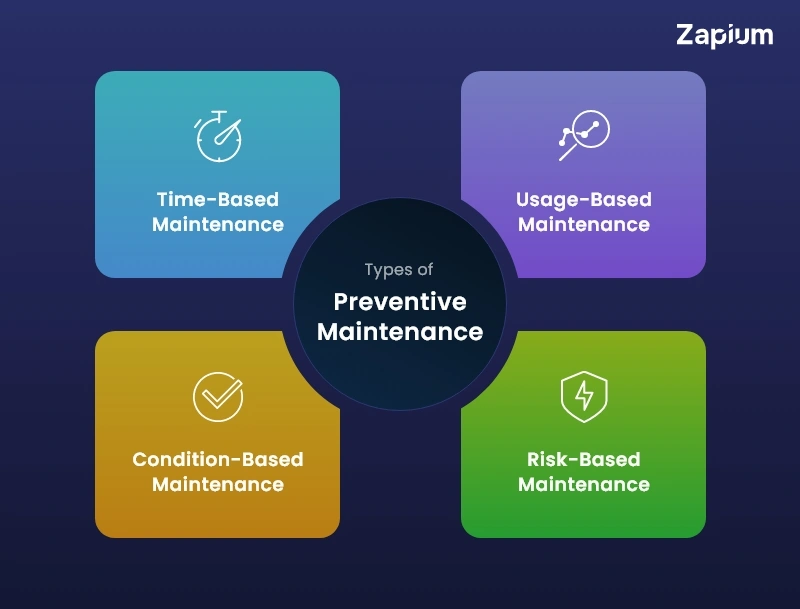
- Time-Based Maintenance
Time-based maintenance schedules work at fixed intervals such as weekly, monthly, or annually. It is most effective for components with predictable wear regardless of usage, such as seals, filters, and safety devices.
In practice, time-based tasks are easy to schedule and easy to audit, which is why they dominate compliance-driven environments. But the method also comes with a risk of over-maintenance, where parts are replaced early without evidence of degradation, thereby increasing cost and labor without improving reliability.
- Usage-Based Maintenance
Usage-based maintenance triggers tasks based on operating hours, cycles, or production output. It aligns better with equipment such as motors, conveyors, and rotating equipment as they experience wear proportional to use.
This maintenance approach works well when usage data is reliable. When usage tracking is weak or manually entered, schedules drift and either miss interventions or flood the system with inaccurate work orders.
- Condition-Based Maintenance
Condition-based maintenance responds to measured indicators such as vibration, temperature, noise, or visual wear. It allows maintenance to intervene closer to actual failure onset rather than relying on estimates.
In real operations, condition-based maintenance succeeds only when technicians trust the signals and management accepts that not all intervals are fixed. When condition data is ignored or overruled by calendar pressure, the benefit disappears.
- Risk-Based Maintenance
Risk-based maintenance prioritizes assets based on failure consequence rather than likelihood alone. Equipment with high safety, environmental, or production impact receives tighter control even if failure is rare.
This method is common in mature operations but requires honest discussion about risk tolerance. When everything is labeled critical, prioritization collapses and planners revert to blanket schedules.
What Are the Benefits of Preventive Maintenance?
Preventive maintenance delivers value only when it transforms how work is carried out on the floor. The following are the benefits of preventive maintenance, illustrating why its consistent implementation truly makes a difference. Each benefit below highlights a direct operational outcome I have observed repeatedly in facilities where preventive maintenance moved from theory into daily practice.
- Reduced Downtime
Preventive maintenance lowers downtime by stopping failures before they interrupt production. Industry studies from McKinsey show plants with structured preventive programs experience 30–50% fewer unplanned stoppages, because issues are corrected during scheduled windows instead of halting operations mid-cycle. The benefit is continuity, not just faster recovery.
- Extend Asset Lifespan
Equipment deteriorates fastest when minor defects are ignored. Preventative maintenance keeps wear within acceptable limits, which directly delays replacement. IBM reports assets maintained preventively operate 20–40% longer than those run to failure, allowing organizations to extract full value from capital investments instead of replacing equipment prematurely.
- Save Costs
Preventive maintenance reduces costs by eliminating expensive failure-driven work. Emergency repairs introduce overtime, rush shipping, and secondary damage. The U.S. Department of Energy estimates reactive maintenance costs three to five times more than planned work. Preventative programs convert volatile expenses into predictable, lower-cost activities.
- Improved Safety
Breakdowns create unsafe conditions—time pressure, unstable equipment, and incomplete isolation. Preventive maintenance shifts work into controlled settings. OSHA-related data shows facilities with proactive maintenance practices experience significantly fewer maintenance-related injuries, because tasks are planned, hazards identified in advance, and safety procedures followed without urgency.
- Improved Efficiency
Maintenance efficiency improves when work is planned instead of improvised. Technicians spend more time executing tasks and less time diagnosing failures or sourcing parts. Gartner analysis indicates planned maintenance can be up to twice as productive as reactive work, directly increasing wrench time and reducing operational disruption.
- Better Resource Management
Preventive maintenance stabilizes how labor and materials are used. Crews can be scheduled logically, and spare parts stocked based on known demand. SMRP benchmarks show organizations with high preventive adoption achieve over 70% planned work, while reactive environments suffer overtime spikes and chronic parts shortages.
- Enhanced Reliability & Dependability
Reliability improves when failures become rare and equipment behavior becomes predictable. Preventive maintenance reduces variability, not just breakdowns. IBM reliability studies note that consistent equipment performance improves operator confidence, leading to better loading decisions and steadier throughput—even when headline uptime figures change only marginally.
- Help with Predictable Budgeting
Preventive maintenance supports budgeting by removing surprise repairs. Gartner has found organizations with strong preventive discipline forecast maintenance costs far more accurately than reactive peers. When spending follows a preventive maintenance plan instead of incidents, finance teams gain control and maintenance stops being a source of recurring budget overruns.
What Are the Common Challenges in Implementing Preventive Maintenance?
Theoretically, preventive maintenance looks straightforward, but multiple roadblocks stand in the way of real-world executions. These challenges are:
- Reactive maintenance culture
Teams accustomed to firefighting breakdowns struggle to shift focus toward planned work, especially when urgent repairs continue to dominate daily schedules.
- Insufficient management buy-in
When there is no leadership support, preventive tasks get deprioritized during production pressure. Consequently this reduces adherence to schedules and weakens long-term reliability outcomes.
- Difficulty measuring ROI
If you are not able to quantify how much you are saving by avoiding failures or extending asset life, it becomes difficult to justify ongoing investment in preventive maintenance.
- Technology adoption challenges
Indifference towards adopting useful technologies like CMMS, financial bottlenecks, and continuing with traditional workflows make it difficult to digitize the preventive maintenance processes.
What Are Some Examples of Preventive Maintenance?
Across industries, preventive maintenance adapts to equipment type, operating environment, and risk exposure. The preventive maintenance examples discussed below explain how PM is typically applied in practice.
- Equipment Maintenance
Every equipment must undergo preventive maintenance to remain operational. The equipment will comprise all machines directly and indirectly involved in production or service delivery. In preventive maintenance, technicians conduct tasks like lubrication, alignment checks, inspections and replacement before the machine gives any sign of failure.
- Facility Maintenance
Facilities require preventive maintenance to keep the physical environment stable and safe for daily operations. This category includes buildings, HVAC systems, electrical infrastructure, plumbing, lighting, and safety installations. Under preventive maintenance, teams carry out activities such as filter replacements, belt and motor inspections, electrical load checks, drainage cleaning, and routine safety testing.
- Vehicle Maintenance
In case of vehicle maintenance, assets such as delivery vans, service vehicles, and heavy transport units undergo tasks like oil and fluid changes, brake and suspension inspections, tire rotation, and battery testing. preventive maintenance of vehicles help meet considerations associated with mileage, engine hours, and operating conditions.
- IT Systems Maintenance
IT equipment is as important as a machine involved in core processes in any operations. In a digital ecosystem like IoT, these systems must be maintained for operational continuity. IT preventive maintenance includes updates, backups, hardware inspections. Teams keep ascertaining that they are working in sync with the equipment in the core processes and in the event of disruptions take necessary actions to prevent failures.
- Power Supply Maintenance
Power supply systems require preventive maintenance to keep operations running without interruption. This category covers transformers, generators, switchgear, UPS systems, panels, and cabling that support equipment and facilities. Preventive maintenance activities include load testing, insulation checks, thermal scanning, battery health inspections, tightening of connections, and verification of backup power readiness.
- Building Exterior Maintenance
Building exteriors undergo constant exposure to weather, pollution, and structural stress, making preventive maintenance essential for long-term integrity. Preventive tasks typically involve roof inspections, sealant checks, crack repairs, gutter cleaning, corrosion treatment, and surface restoration. Performing these activities on a scheduled basis prevents water ingress, structural deterioration, and costly repairs that often emerge only after visible damage appears.
- Energy Systems Maintenance
Preventive maintenance activities involve performance testing, calibration of sensors, inspection of inverters and panels, cleaning of components, and verification of energy output against expected benchmarks. Routine attention is quite critical as it helps control energy losses, supports compliance with efficiency targets, and prevents degradation that can quietly impact operational costs.
How to Develop a Preventive Maintenance Program
Below we explain how you can develop a preventive maintenance program by breaking the process into clear, practical steps. It shows how to decide what equipment to focus on, how maintenance work is planned and scheduled, and how the program is reviewed and adjusted as conditions change.
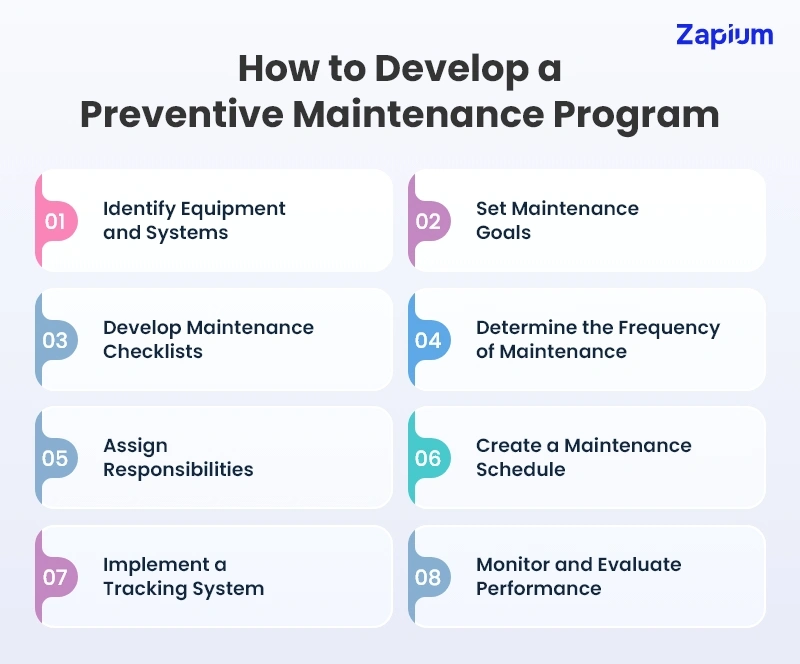 1. Identify Equipment and Systems
 Start by confirming which assets genuinely threaten continuity, safety, or regulatory standing if they fail. This requires walking the operation with people who understand where production actually breaks, rather than relying on asset lists or system hierarchies alone.
At this stage, differentiation matters more than completeness. Equipment should be treated as critical only if its failure creates one or more of the following conditions:
- Stops or severely disrupts production
- Introduces safety or compliance exposure
- Triggers cascading failures across processes
Once critical assets are defined, articulate what each category of preventive work is designed to prevent. Goals convert maintenance from routine maintenance activity into targeted risk reduction. For most operations, goals will fall into a small number of clear categories such as:
- Avoid unplanned stoppage
- Slow or control degradation
- Reduce safety exposure
- Stabilize operational performance
Checklists translate experience into consistent action by steering technicians toward observable conditions and informed judgment, not just task completion. To do that, they must reflect how equipment actually behaves in the field – what to inspect, how abnormal conditions show up, and which signs demand escalation.
As technicians feed back recurring issues and early warning patterns, effective maintenance checklists evolve. That continuous refinement keeps inspections relevant and prevents checklists from turning into static documents.
4. Determine the Frequency of MaintenanceSetting maintenance frequency is a risk decision constrained by operational reality. Initial intervals should reflect how equipment is used, the environment it operates in, and known failure behavior.
Frequency decisions are typically influenced by:
- Operating hours or duty cycles
- Environmental stress such as heat, dust, or moisture
- Historical failure and inspection data
The critical point is that these intervals are starting assumptions. They must be reviewed and adjusted as evidence accumulates. Frequencies that are too aggressive create skipped work, while those that are too loose allow degradation to progress unnoticed.
5. Assign ResponsibilitiesMake one role accountable for execution and follow-through, even if multiple people are involved. Someone must own whether preventive tasks were completed properly and whether findings were addressed.
Where this breaks down, responsibility is spread so thin that missed work is discovered only after failure. Clear ownership keeps preventive maintenance from becoming optional during busy periods.
6. Create a Maintenance ScheduleTranslate preventive maintenance tasks into a calendar that teams can realistically execute. The work here is defining the PM schedule by deciding when each task will be performed, who will perform it, and what access or downtime is required.
Start by aligning tasks with production downtime, planned shutdowns, and realistic labor availability. Group related tasks to reduce repeat access and unnecessary stoppages. Once agreed, the schedule should be treated as a commitment, not a suggestion.
7. Implement a Tracking SystemUse a system that records what was planned, what was done, and what was found. The action here is enforcing timely and accurate feedback, not just installing software.
In many operations I’ve seen, the CMMS exists but discipline does not. When findings are not recorded or follow-ups are not triggered, preventive maintenance becomes blind repetition with no learning loop.
8. Monitor and Evaluate PerformanceSet a regular review cadence to examine whether preventive maintenance is doing what it was intended to do. Reviews should focus on recurring issues, missed work, and failures that occurred despite preventive activity.
The action here is analysis, not reporting. Look for patterns across assets and time to determine whether tasks remain relevant, intervals are appropriate, and preventive work is intercepting failures early enough. Adjustments to tasks or frequency should follow directly from these reviews.
What Are the Best Practices for Preventive Maintenance?
Following are the best practices to implement preventive maintenance. These practices help maintenance teams track performance, plan work effectively, and adjust maintenance activities as operating conditions change.
- Follow Manufacturer Recommendations
Use manufacturer guidance as the baseline, then adjust maintenance tasks and intervals using actual operating conditions, load patterns, environment, and documented failure behavior.
- Maintain Detailed Records
Record what was inspected, what was found, and what was corrected immediately after work to preserve context and build reliable asset history for future decisions.
- Use Condition-Based Monitoring
Apply condition monitoring where failure progression is measurable, allowing data trends to trigger maintenance actions before performance degradation turns into functional failure.
- Standardize Procedures
Standard procedures define maintenance is performed, keeping inspection quality consistent across technicians, shifts, and locations while reducing variability caused by individual work habits.
- Prioritize Critical Equipment
Focus preventive effort on assets whose failure impacts safety, production continuity, regulatory compliance, or downstream systems rather than spreading effort evenly across all equipment.
- Optimize Spare Parts Inventory
Stock parts based on failure likelihood, criticality, and supplier lead time, avoiding excess inventory while preventing delays caused by unavailable high-risk components.it.
- Ensure Proper Training
Train technicians to recognize abnormal conditions, early warning signs, and failure patterns so inspections support informed judgment instead of simple task completion.
- Perform Inspections Regularly
Stick to inspection intervals teams can realistically sustain, balancing asset risk, workforce availability, and operational constraints to prevent skipped or rushed maintenance activities.
- Use a Computerized Maintenance Management System (CMMS)
Use a CMMS to schedule work, capture inspection findings, track asset history, and automatically trigger corrective actions based on defined maintenance rules.
- Monitor KPIs (Key Performance Indicators)
Track indicators that show whether preventive maintenance reduces failures, stabilizes workloads, and lowers emergency work, rather than focusing only on task completion rates.
- Plan for Downtime
Schedule preventive work during planned shutdowns or access windows so maintenance aligns with operations instead of competing with production priorities.
- Review and Adjust Regularly
Revisit maintenance tasks, frequencies, and priorities as assets age, usage patterns shift, and failure data reveals what is no longer effective.
What Are the Compliance Requirements for Preventive Maintenance?
In practice, preventive maintenance is expected to align with the following compliance frameworks and regulatory considerations. Across all these requirements, the expectation is that preventive maintenance activities are structured, traceable, and demonstrably effective in controlling risk.
- OSHA (Occupational Safety and Health Administration) or equivalent local safety regulations
- ISO 55001 – Asset Management
- ISO 9001 – Quality Management Systems
- NFPA codes and standards for fire protection and life safety systems
- EPA and environmental authority regulations governing emissions, waste, and hazardous materials
- GMP (Good Manufacturing Practices) in regulated manufacturing environments
- FDA equipment and maintenance controls where applicable
- IEC equipment safety standards
- ASME codes for pressure systems and mechanical equipment
- Electrical safety codes such as NEC or local equivalents
- Building and fire safety codes enforced by local authorities
- Industry-specific regulatory bodies for sectors such as healthcare, energy, utilities, and aviation
How to Perform Preventive Maintenance Inspections?
The steps below explain how preventive maintenance inspections should be planned, executed, and reviewed so that issues are detected early and maintenance decisions are based on facts rather than assumptions.
- Define the Inspection Scope
Start by deciding what needs inspection and why. Identify assets to be inspected, define inspection objectives, determine inspection frequency, and specify operating or shutdown conditions under which inspections will occur. List regulatory, safety, and operational requirements that must be checked during inspection.
- Prepare Inspection Checklists
Create structured checklists tailored to each asset or asset type. Preventive maintenance checklists should cover visual checks, measurements, operating conditions, and known failure points so inspections stay consistent regardless of who performs them.
- Gather Required Tools and Safety Gear
Before inspection begins, confirm all tools, measuring devices, calibration equipment, and personal protective gear are ready. Verify instrument calibration status, tool availability, access equipment, lockout devices, and safety permits required to perform the inspection safely.
- Perform the Physical Inspection
Inspect the asset according to the checklist while it is operating or safely isolated, as required. Look for wear, leaks, abnormal noise, vibration, temperature changes, alignment issues, and signs of early degradation.
- Record Findings Immediately
Document observations at the point of inspection instead of relying on memory. Record measurements, note deviations, capture photographs where required, and log inspection results in maintenance records or the CMMS system.
- Identify and Classify Issues
Evaluate each finding and classify issues by severity, urgency, and risk. Distinguish between acceptable wear, emerging faults, and critical defects to prioritize corrective actions correctly.
- Trigger Follow-Up Actions
Convert inspection findings into actionable work orders, parts requests, or condition-based maintenance tasks. Assign responsibility, set target completion dates, and link inspection results to corrective maintenance activities.
- Review Inspection Trends
Analyze inspection history to identify recurring faults, asset degradation patterns, and inspection effectiveness. Use trends to support better scheduling, asset replacement decisions, and maintenance strategy adjustments.
- Standardize and Train
Refine inspection procedures based on lessons learned and standardize them across teams and sites. Update checklists, revise inspection instructions, and train technicians on revised procedures and reporting requirements.
What Are the Costs Involved in Preventive Maintenance?
Preventive maintenance spreads its cost across people, operations, systems, and decision-making, which show up far beyond the maintenance budget itself. Some costs are planned and visible, while others surface quietly through lost capacity, coordination effort, and capital tied up over time. Let’s take a closer look:
- Maintenance labor time: Paid hours spent on inspections, servicing, supervision, planning, and reporting even when no faults are found.
- Overtime and shift premiums: Extra wage costs created when maintenance must fit around production schedules or shutdown windows.
- Contractors and specialist services: Fees paid to external technicians, inspectors, OEM representatives, and calibration providers.
- Spare parts consumption: Routine replacement of wear parts such as filters, belts, seals, and consumables regardless of asset condition.
- Spare parts inventory holding: Capital locked in stock, along with storage, handling, insurance, and write-offs for obsolete parts.
- Tools and inspection equipment: Purchase, maintenance, certification, and replacement of tools, testing devices, and safety gear.
- Maintenance planning effort: Time spent defining maintenance intervals, preparing job plans, reviewing histories, and updating maintenance strategies.
- Engineering and reliability support: Cost of analysis, reviews, and technical input required to design and adjust preventive programs.
- Maintenance software and data systems: Licensing, integration, administration, and ongoing ownership of CMMS or EAM platforms.
- Data management and reporting: Effort required to clean asset data, close work orders, and produce performance and compliance reports.
- Planned downtime: Lost production or service capacity when assets are intentionally taken offline for maintenance.
- Operational rescheduling: Cost of rearranging production plans, labor rosters, and deliveries around maintenance activities.
- Cross-functional coordination: Time spent by operations, safety, procurement, finance, and IT to support maintenance work.
- Compliance and regulatory effort: Expenses related to inspections, audits, permits, documentation, and statutory maintenance checks.
- Safety management costs: Spending on risk assessments, isolation procedures, permits to work, and incident prevention measures.
- Training and certification: Cost of upskilling technicians, renewing certifications, and onboarding new maintenance practices.
- Productivity loss during learning curves: Reduced efficiency while staff adapt to new equipment, tools, or maintenance routines.
- Asset availability impact: Revenue or service opportunities lost because maintained assets are not available for use.
- Capital tied up in maintenance readiness: Upfront investment in tools, systems, spares, and infrastructure required to support PM.
- Cash flow timing impact: Preventive spend incurred well before financial benefits become visible.
- Over-maintenance risk: Unnecessary inspections, early part replacements, and excessive downtime caused by conservative schedules.
Preventive Maintenance vs Predictive Maintenance
Preventive maintenance is often confused with predictive maintenance. However, both have different purposes as the following comparison highlights:
| Parameter | Preventive Maintenance | Predictive Maintenance |
|---|---|---|
Maintenance trigger | Performed at fixed time or usage intervals regardless of equipment condition | Triggered by real-time condition data and performance indicators |
Primary objective | Reduce breakdown risk by servicing equipment before expected failure | Detect early signs of failure and act only when risk is detected |
Data dependency | This maintenance relies on historical schedules, OEM guidelines, and past experience | Relies on sensor data, condition monitoring, and analytical models |
Maintenance timing | Predefined and calendar-based | Dynamic and condition-based |
Cost structure | Predictable but may include unnecessary servicing costs | Higher upfront cost but lower long-term maintenance waste |
Risk of over-maintenance | High, since tasks are performed even when equipment is healthy | Low, as actions are based on actual equipment condition |
Skill requirements | Standard maintenance skills are sufficient | Predictive maintenance uses data analysis, diagnostics, and specialized expertise |
Best suited for | Simple, low-criticality, or predictable equipment | High-value, critical, or failure-sensitive assets |
Preventive Maintenance vs Reactive Maintenance
Like preventive maintenance, reactive maintenance remains a key part of the maintenance strategy for maintenance teams. Here is how both compare against each other:
| Parameter | Preventive Maintenance | Reactive Maintenance |
|---|---|---|
Maintenance trigger | Planned in advance based on time or usage | Triggered only after equipment failure |
Planning approach | Proactive and scheduled | Unplanned and emergency-driven |
Downtime impact | Downtime is controlled and predictable | Downtime is sudden and often extended |
Cost pattern | Steady and budgetable over time | Spiky, high, and difficult to predict |
Asset reliability | Improves reliability through regular maintenance | Reliability degrades due to repeated failures |
Failure severity | Minor issues addressed before escalation | Failures often occur at full breakdown stage |
Resource utilization | Better use of labor, spares, and tools | Resources deployed under pressure and shortages |
Operational risk | Lower risk to safety and operations | Higher safety, compliance, and business risk |
Equipment lifespan | Extended through timely intervention | Shortened due to stress and delayed repairs |
Business continuity | Supports stable operations | Disrupts operations and service commitments |
What Are the Future Trends in Preventive Maintenance?
- Digital Twins
Digital twins are moving from pilot projects to operational use, especially in asset-heavy industries, as the market accelerates toward ~$80B+ by 2033, driven largely by maintenance and reliability use cases.
- Hyper-Automation
Automation platforms paired with AI and IoT are replacing manual maintenance workflows from data ingestion to work order execution. The evolution is supporting efficiency at scale and pushing adoption of automated maintenance across around 62% of industrial users.
- Zero-Touch Models
Zero-touch maintenance uses sensors and autonomous systems to detect issues and trigger maintenance actions with minimal human input. Early adoption trends show significant ongoing transitions to automated maintenance orchestration systems.
- Sustainability-Aligned Maintenance
Maintenance strategies are increasingly tied to environmental goals such as reducing energy and material waste. Over 57% of organizations cite sustainability as a key driver for digital twin investments, highlighting the link between operational tech and ESG outcomes.
- Condition-Based & AI-Enhanced Monitoring
Sensors and AI models support condition-based triggers (e.g., vibration, temperature), enabling maintenance only when needed. Predictive analytics adoption has delivered 25–30 % maintenance cost reductions and 35–50 % downtime reductions in real deployments.
- Edge Computing for Real-Time Decisions
Local edge analytics reduce latency and support real-time anomaly detection, processing data closer to equipment. Nearly 46% of advanced maintenance platforms now integrate edge computing for faster insights.