

Preventive Maintenance vs Corrective Maintenance: A Practical Comparison
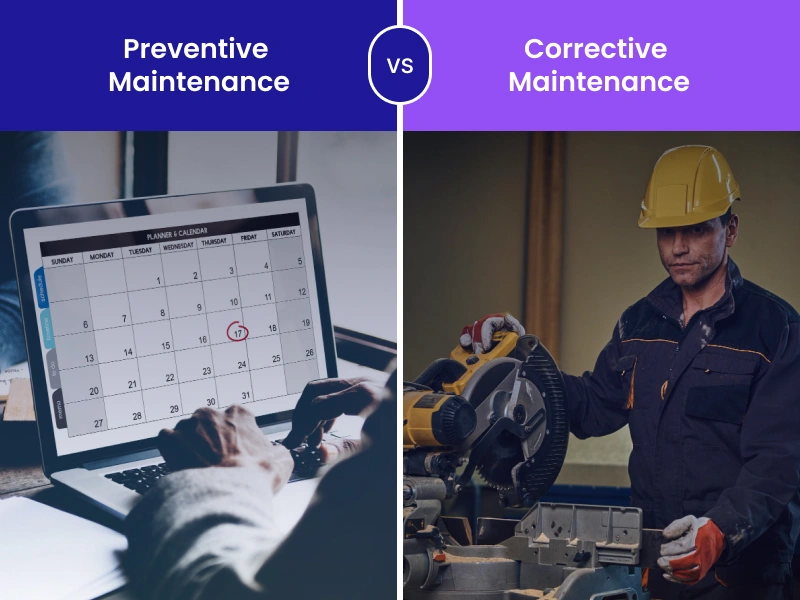
When I look at how maintenance decisions shape operations, the contrast between preventive and corrective approaches stands out right away. Both have their place, but choosing the wrong one can quietly drive up costs and downtime and vice versa.
In this blog, I break down how each approach works, where it fits, and what trade-offs come into play. I also walk through practical comparisons, performance metrics, and selection factors that teams rely on in real-world scenarios.
What Is Preventive Maintenance?
Preventive maintenance is a planned approach where equipment, machines, or systems are checked, serviced, and repaired at regular intervals to avoid unexpected breakdowns. Instead of waiting for something to fail, tasks like inspections, cleaning, lubrication, and part replacements are carried out based on time, usage, or condition.
What Are the Benefits of Preventive Maintenance?
Preventive maintenance brings a structured way to manage assets, helping teams stay ahead of failures while keeping operations steady and predictable. Here are notable preventive maintenance benefits:
- Reduced equipment failure risk
Regular inspections and timely servicing catch wear and minor issues early, preventing small faults from turning into major failures that disrupt operations and require costly repairs.
- Lower unexpected downtime
Scheduled checks and part replacements reduce sudden breakdowns, allowing systems to run without interruptions and helping teams avoid unplanned halts that affect productivity and service delivery.
- Extended asset lifespan
Consistent care through cleaning, lubrication, and part changes reduces strain on components, thereby extending the lifespan of equipment. The equipment can function efficiently for longer periods before requiring replacement or major overhaul.
- Planned maintenance scheduling
Maintenance tasks are organized in advance based on usage or time intervals, allowing better resource allocation, minimal disruption to workflows, and improved coordination across operational teams.
- Higher operational reliability
Well-maintained equipment performs consistently under expected conditions, reducing performance fluctuations and giving teams confidence in daily operations without worrying about sudden system failures.
What are the Cons of Preventive Maintenance?
Preventive maintenance also brings certain trade-offs that businesses need to account for while planning long-term asset management strategies. These are:
- Higher upfront maintenance costs
Regular servicing, inspections, and part replacements increase ongoing expenses, even when equipment is functioning properly and may not require immediate attention.
- Risk of unnecessary maintenance
Scheduled tasks may lead to replacing parts or performing work that is not yet needed, resulting in wasted resources and increased operational costs.
- Requires detailed planning and tracking
Maintenance schedules demand accurate data, consistent monitoring, and proper coordination, which can add administrative workload and require dedicated systems or personnel.
What Are the Types of Preventive Maintenance?
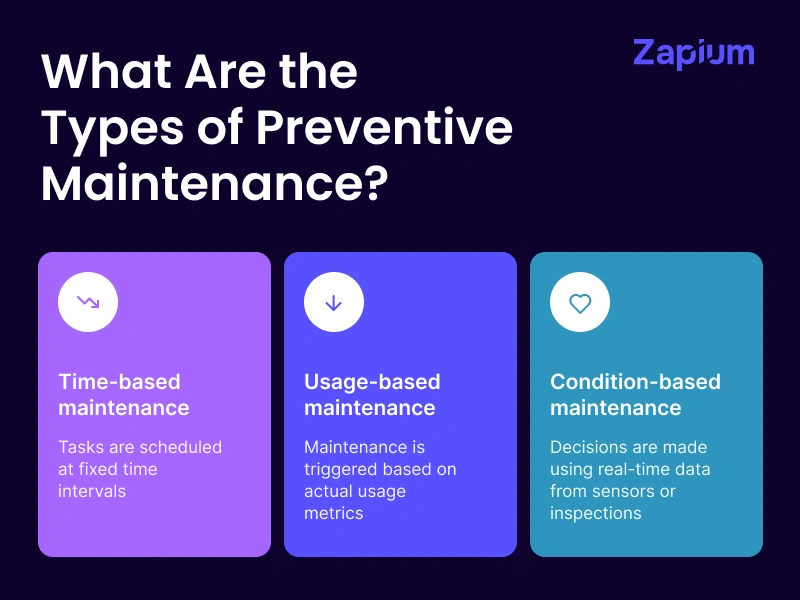
Following are the different ways preventive maintenance is carried out depending on how equipment is monitored and how maintenance schedules are defined:
- Time-based maintenance
Tasks are scheduled at fixed time intervals such as daily, monthly, or annually, regardless of equipment usage, making it simple to plan and execute consistently.
- Usage-based maintenance
Maintenance is triggered based on actual usage metrics like operating hours, cycles, or mileage, allowing servicing to align closely with how intensively equipment is used.
- Condition-based maintenance
Decisions are made using real-time data from sensors or inspections, where maintenance is performed only when signs of wear, performance drop, or faults are detected.
What Are Common Examples of Preventive Maintenance?
Following are the examples of preventive maintenance that help keep equipment in stable working condition and reduce the chances of unexpected issues:
- Routine lubrication of machinery
Moving parts are lubricated at regular intervals to reduce friction, prevent overheating, and limit wear, helping machines operate efficiently without premature component damage.
- Scheduled HVAC inspections
Heating and cooling systems are checked periodically to verify airflow, electrical components, and overall performance, helping maintain comfort levels and avoid sudden system breakdowns.
- Filter replacement in equipment
Filters in machines and systems are replaced at set intervals to maintain proper airflow or fluid flow, preventing contamination and protecting internal components from damage.
- Instrument and sensor calibration
Devices are calibrated regularly to maintain accurate readings, helping systems operate based on reliable data and reducing the risk of errors in monitoring or control processes.
What Is Corrective Maintenance?
Corrective maintenance is the approach where repairs are carried out after a fault, failure, or performance issue is identified in equipment or systems. The focus stays on diagnosing the problem, fixing or replacing faulty components, and restoring normal operation as quickly as possible. It can be planned when issues are detected early or unplanned when breakdowns occur suddenly, and it plays a key role in minimizing disruption while keeping assets functional.
What Are the Benefits of Corrective Maintenance?
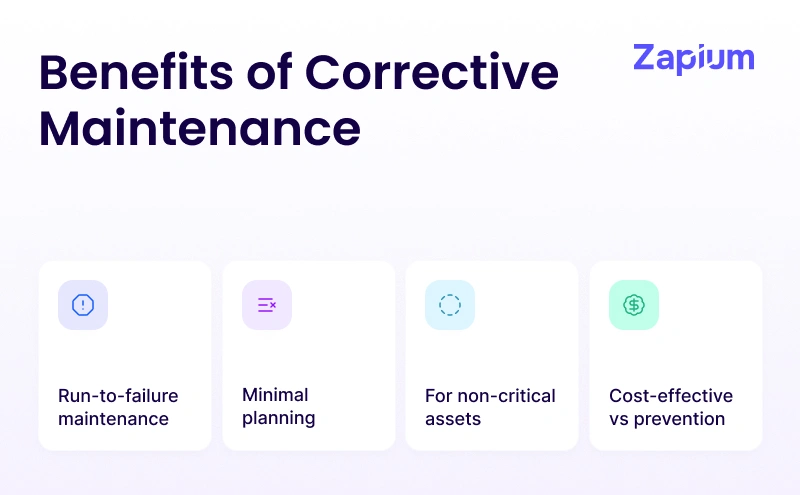
Corrective maintenance fits situations where acting after a failure makes more practical and financial sense than scheduling regular servicing, offering the following benefits:
- Maintenance performed only after failure
Work is carried out only when equipment fails or shows clear issues, helping avoid routine servicing tasks and focusing efforts directly on fixing actual problems.
- Lower planning effort
No fixed schedules or detailed tracking systems are required, reducing administrative workload and making it easier for teams to manage maintenance without extensive coordination.
- Suitable for non-critical assets
Works well for equipment that does not impact core operations, where occasional breakdowns do not cause major disruption or significant losses to the business.
- Useful where preventive cost exceeds failure risk
In cases where maintenance costs are higher than potential repair or replacement costs, fixing issues after failure can be a more cost-effective approach.
What are the Cons of Corrective Maintenance?
Corrective maintenance comes with certain limitations, especially when equipment reliability and operational continuity are critical. Some of these limitations are:
- Unplanned downtime
Breakdowns occur without warning, leading to sudden interruptions that can halt operations, delay output, and affect service delivery timelines.
- Higher repair costs
Failures can cause additional damage to connected components, increasing repair expenses and sometimes requiring complete replacement instead of minor fixes.
- Reduced asset lifespan
Continuous operation without regular servicing leads to accelerated wear, causing equipment to degrade faster and require earlier replacement.
- Operational disruptions
Unexpected failures can impact workflows, workforce productivity, and overall efficiency, especially when backup systems or contingency plans are not in place.
- Safety risks
Equipment failure can create unsafe conditions for operators, increasing the likelihood of accidents or hazards in environments where machinery plays a critical role.
What Are the Types of Corrective Maintenance?
Corrective maintenance doesn’t always wait for things to completely fall apart. It can step in at different stages depending on when a problem gets noticed and can be categorized into these two types:
- Unplanned corrective maintenance
This is performed after breakdown. Action is taken only after equipment fails completely, requiring immediate repair or replacement to restore operations and handle unexpected disruptions.
- Planned corrective maintenance
Here issues are identified before total failure, and so teams can schedule repairs in advance and fix problems at a convenient time without major interruptions.
What Are Examples of Corrective Maintenance in Operations?
Here are some common corrective maintenance examples that show how action is taken after a fault or failure is identified in operations:
- Repairing a failed motor
A motor that stops working is inspected to identify the fault, followed by repairing or replacing damaged components to restore normal machine operation.
- Replacing a broken pump seal
A damaged seal is removed and replaced after leakage or performance issues are noticed, helping bring the pump back to proper working condition.
- Fixing a malfunctioning control panel
Electrical or system faults in a control panel are diagnosed and corrected to regain control over connected equipment and maintain operational stability.
- Repairing equipment after breakdown
Equipment is repaired only after it fails completely, focusing on restoring functionality quickly so operations can resume with minimal further delay.
What Is the Difference Between Preventive Maintenance and Corrective Maintenance?
Following is a table that discusses preventive maintenance vs corrective maintenance difference across multiple parameters:
| Parameter | Preventive Maintenance | Corrective Maintenance |
|---|---|---|
Planning | Scheduled in advance based on time, usage, or condition | Carried out after a failure or when an issue is detected |
Equipment Downtime | Planned downtime with minimal disruption to operations | Unexpected downtime that can interrupt workflows |
Maintenance Cost | Predictable costs spread over time | Variable costs that may increase due to sudden failures |
Asset Life | Extends equipment lifespan through regular care | May shorten asset life due to continued wear before repair |
How Do Preventive and Corrective Maintenance Compare With Other Maintenance Strategies?
Below, I compare preventive maintenance with other approaches and clarify where it fits and how decisions are shaped in real-world operations.
Preventive Maintenance and Predictive Maintenance
Preventive maintenance follows a fixed schedule based on time or usage, while predictive maintenance relies on real-time data collected through sensors, analytics, and performance monitoring tools.
On the other hand, predictive models use trends like vibration, temperature, or pressure changes to forecast failures, whereas preventive plans move ahead with predefined intervals without depending on continuous equipment data.
Preventive Maintenance and Condition-Based Maintenance
Preventive maintenance runs on fixed intervals regardless of actual equipment condition, while condition-based maintenance depends on periodic checks or real-time monitoring to decide when action is needed.
Condition-based methods trigger maintenance only when indicators cross defined thresholds, reducing unnecessary servicing, whereas preventive schedules may lead to maintenance even when equipment is functioning normally.
Preventive Maintenance and Reactive Maintenance
Preventive maintenance focuses on avoiding failures through planned servicing, while reactive maintenance takes action only after a breakdown or performance issue occurs.
Reactive approaches prioritize immediate repairs and restoration, whereas preventive strategies aim to reduce failure frequency, improve reliability, and maintain consistent operational performance over time.
How Do Organizations Measure Preventive vs Corrective Maintenance Performance?
Measuring corrective and preventive maintenance performance comes down to tracking how well assets run, how frequently failures occur, and how efficiently teams respond to issues. I have seen how high-performance teams rely on maintenance KPIs to evaluate how maintenance efforts impact cost, uptime, and overall asset performance. Following are critical questions here:
What Is Planned vs Unplanned Maintenance Ratio?
This ratio compares scheduled maintenance activities with unexpected repairs, acting as a strong indicator of maintenance maturity and how effectively failures are being prevented.
A higher share of planned work signals better control over assets, while frequent unplanned tasks point to gaps in maintenance strategy and higher operational risk.
How Do Maintenance Teams Track Preventive Maintenance Effectiveness?
To understand how well equipment performs over time and how efficiently issues are handled, following maintenance KPIs must be tracked effectively:
- Mean Time Between Failures (MTBF)
Measures the average time equipment operates before a failure occurs, helping teams evaluate reliability and identify whether preventive actions are reducing breakdown frequency.
- Mean Time To Repair (MTTR)
Tracks the average time required to fix equipment after failure, indicating how quickly maintenance teams can restore operations and minimize disruption.
- Maintenance cost per asset
Calculates the total maintenance spending for each asset, helping assess cost control and determine whether preventive efforts are financially justified.
- Downtime frequency
Monitors how often equipment becomes unavailable, giving a clear view of operational interruptions and how effectively preventive maintenance reduces unplanned stoppages.
How Should Organizations Choose Between Preventive and Corrective Maintenance Strategies?
When it comes to preventive vs corrective maintenance strategy choice, it depends on how critical assets are to operations, the risks tied to failure, and the cost implications of downtime. Following questions become important here:
What Factors Influence Maintenance Strategy Selection?
Following are the key factors that shape how organizations decide between preventive and corrective maintenance, based on operational priorities and risk tolerance:
- Asset criticality
Equipment that directly impacts core operations requires a proactive approach, as failures can disrupt workflows and affect overall business performance.
- Cost of downtime
When downtime leads to revenue loss or delays, preventive maintenance becomes more practical to avoid unexpected interruptions and maintain continuity.
- Safety requirements
Assets operating in high-risk environments demand regular checks and servicing to reduce hazards and maintain safe working conditions.
- Equipment age and reliability
Older or less reliable equipment may need frequent maintenance, while newer and stable assets can sometimes be managed with less intensive strategies.
When Is Preventive Maintenance the Right Approach?
Preventive maintenance works best for critical assets, systems with high downtime costs, and environments where safety and compliance are priorities, making failure prevention essential. It suits equipment with predictable wear patterns, where scheduled servicing can reduce breakdowns and support consistent operational performance.
When Is Corrective Maintenance Acceptable?
Corrective maintenance is suitable for non-critical assets where failures have limited impact and repair costs are manageable compared to ongoing maintenance expenses. It fits situations where equipment has low usage, low replacement cost, or where failures do not significantly disrupt operations or safety.
To Wrap Up
Every maintenance program performs differently depending on how well preventive and corrective efforts are balanced. I see corrective vs preventive maintenance not as competing choices, but as a mix that supports reliable operations when applied with the right intent. Selecting the right type of maintenance depends on asset criticality, risk, and cost considerations.
Strong maintenance management ties everything together through clear planning, performance tracking, and consistent execution. With the support of a well-structured management system, teams can reduce failures, control costs, and keep operations running without unnecessary disruption.