

Preventive Maintenance vs Reactive Maintenance: Differences, Benefits, and Strategy Selection
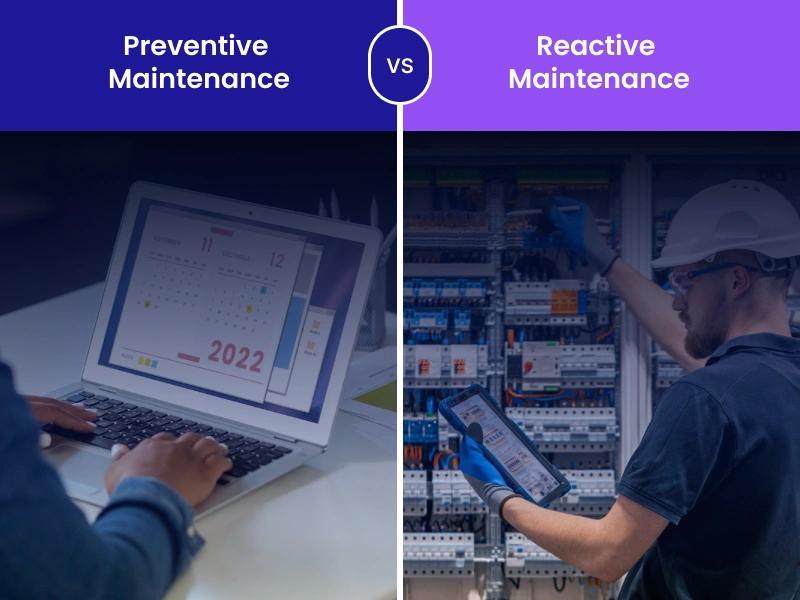
When it comes to maintenance, there are two approaches, preventive and reactive, and most organizations rely on a mix of both depending on how their operations are structured. Before arriving at any conclusion, you need to understand how each works in practical settings rather than just theoretical terms.
In the sections ahead, I discuss the reactive maintenance vs preventive maintenance comparison in detail, breaking down differences, benefits, limitations, and real use cases associated with preventive and reactive maintenance. So, by the end of this insightful article, you will get a clearer view of how each approach performs and how organizations should decide where to apply them.
What Is Preventive Maintenance?
Preventive maintenance is a planned approach to regularly inspecting, servicing, and maintaining equipment, systems, or assets to keep them running efficiently and avoid unexpected breakdowns. It includes routine tasks like cleaning, lubrication, adjustments, and part replacements carried out at scheduled intervals based on time or usage.
What Are the Benefits of Preventive Maintenance?
The data most relevant to preventive vs reactive: U.S. Department of Energy — O&M Best Practices Guide documents that a well-implemented preventive maintenance program can reduce maintenance costs by 12–18% and extend equipment life by 20–25%.
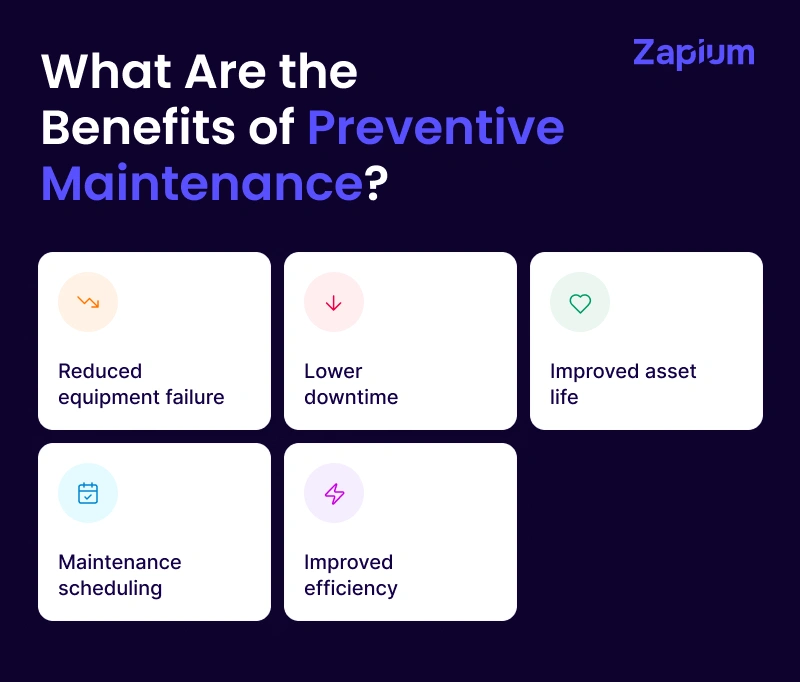
Keeping operations steady without unexpected disruptions comes down to how well equipment is maintained over time. A proactive maintenance approach offers several practical advantages for businesses aiming for consistency and cost control.
- Reduced equipment failure
Regular inspections and timely servicing help identify minor issues before they escalate into major faults, significantly lowering the chances of sudden breakdowns and keeping critical systems functioning reliably.
- Lower downtime
Planned maintenance activities reduce unplanned outages by addressing potential problems in advance, allowing businesses to avoid costly interruptions and maintain smoother workflows across operations.
- Improved asset life
Consistent care, including cleaning, lubrication, and part replacements, slows down wear and tear, helping equipment perform better over a longer period and delaying the need for expensive replacements.
- Predictable maintenance scheduling
Scheduled servicing and faster work order allocation allows organizations to plan maintenance activities in advance, making resource allocation easier and minimizing disruptions to daily operations through better coordination and timing.
- Improved operational efficiency
Well-maintained equipment operates at optimal performance levels, reducing energy consumption, minimizing errors, and supporting faster, more reliable output across different stages of the workflow.
What are the Cons of Preventive Maintenance?
Even with its structured approach and long-term advantages, preventive maintenance management also brings certain limitations that businesses need to account for when planning preventive maintenance strategies.
- Higher upfront costs
Regular inspections, servicing, and part replacements require consistent investment in labor, tools, and materials, which can increase initial maintenance expenses compared to a reactive approach in the short term.
- Potential for unnecessary maintenance
Scheduled servicing may lead to performing maintenance tasks on equipment that is still functioning well, resulting in wasted resources, time, and effort without immediate tangible benefits.
- High labor requirements
Frequent maintenance activities demand skilled personnel and dedicated time, which can place additional pressure on workforce availability and may require hiring or training specialized staff.
- Operational interruptions during maintenance
Even planned maintenance can temporarily halt equipment usage, creating short-term disruptions in workflows and requiring careful coordination to minimize the impact on overall productivity.
- Complex planning and scheduling
Managing maintenance schedules across multiple assets can become complicated, especially in large operations, requiring proper tracking systems and coordination to avoid overlaps, delays, or missed tasks.
What Are the Types of Preventive Maintenance?
Maintenance strategies vary based on how equipment is used, monitored, and managed over time. A preventive maintenance program comprises several types which are:
- Time-based maintenance
Maintenance tasks are carried out at fixed intervals such as daily, monthly, or yearly, regardless of equipment condition, making it suitable for assets with predictable wear patterns and consistent usage cycles.
- Usage-based maintenance
Servicing is scheduled based on actual usage metrics like operating hours, cycles, or output levels, helping align maintenance efforts with how intensively equipment is used rather than relying on calendar schedules.
- Condition-based maintenance
Equipment is monitored using inspections or sensors, and maintenance is performed only when specific indicators such as vibration, temperature, or performance deviations signal potential issues or declining condition.
- Predictive maintenance
Advanced technologies like data analytics and IoT sensors are used to analyze real-time performance data, allowing businesses to anticipate failures and schedule maintenance just before problems are likely to occur.
- Risk-based maintenance
Maintenance priorities are determined by evaluating the criticality and risk associated with each asset, focusing more attention on equipment that could cause significant operational or safety issues if it fails.
What Are Common Examples of Preventive Maintenance?
Day-to-day operations rely on consistent upkeep to avoid disruptions, and preventive maintenance shows up in routine tasks carried out across different types of equipment and systems.
- Routine HVAC servicing
Air filters are cleaned or replaced, ducts inspected, and system components checked at regular intervals to maintain airflow quality, prevent system strain, and keep heating and cooling units operating efficiently.
- Vehicle maintenance checks
Engine oil changes, brake inspections, tire rotations, and fluid top-ups are performed periodically to keep vehicles running smoothly, reduce breakdown risks, and maintain safety on the road.
- Industrial machine lubrication
Moving parts in machinery are lubricated and aligned on a scheduled basis to reduce friction, prevent overheating, and avoid premature wear that could lead to costly equipment failure.
What Is Reactive Maintenance?
Reactive maintenance is a strategy where repairs and servicing take place only after equipment or systems fail. Instead of planning maintenance in advance, action is taken once a breakdown occurs, making it a response-driven approach. It is used for non-critical assets or in situations where the cost of routine maintenance outweighs the impact of occasional failures.
What Are the Benefits of Reactive Maintenance?
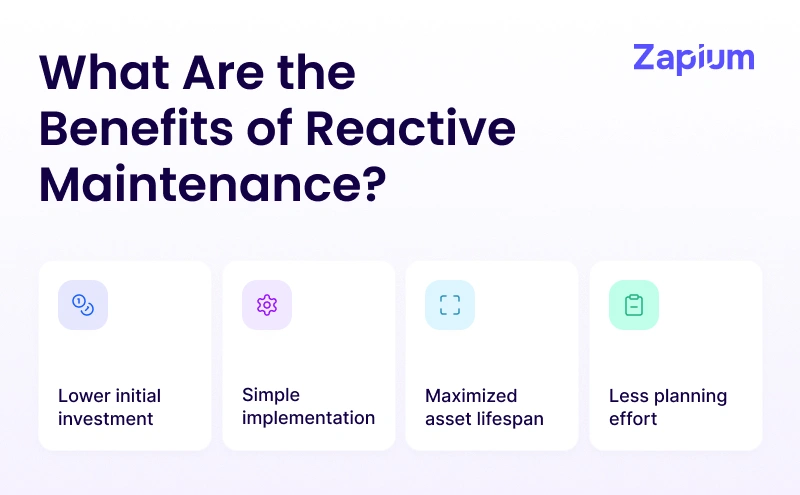
After understanding reactive maintenance meaning, let’s understand its advantages, which are as explained:
- Lower initial investment
No routine servicing schedules or continuous monitoring systems are required, allowing organizations to save on upfront maintenance costs, tools, and dedicated personnel during the early stages of operations.
- Simple implementation
No complex planning or tracking systems are needed, making it easier to manage, especially for smaller operations where maintenance processes need to remain straightforward and less time-consuming.
- Full utilization of asset lifespan
Equipment is used until it can no longer function, allowing businesses to extract maximum value from assets without spending on periodic servicing that may not always be necessary.
- Reduced planning efforts
Maintenance teams do not need to create detailed schedules or forecasts, allowing them to focus only on resolving issues as they arise without ongoing administrative overhead.
What are the Cons of Reactive Maintenance?
Despite its simplicity, relying only on breakdown responses can create several operational challenges which are:
- Unpredictable equipment failures
Breakdowns can occur at any time without warning, making it difficult to anticipate disruptions and leading to sudden interruptions in production or service delivery.
- Higher long-term costs
Emergency repairs, urgent part replacements, and potential damage escalation lead to higher expenses over time compared to more structured maintenance strategies.
- Extended downtime
Waiting for failures to occur can result in longer repair times, especially if spare parts or technicians are not immediately available, affecting overall productivity.
- Safety risks
Unexpected equipment failures can create hazardous situations for workers, particularly in environments where machinery plays a critical role in daily operations.
What Are the Types of Reactive Maintenance?
Even within a response-based approach, different variations exist depending on how failures are handled. These are:
- Run-to-failure maintenance
Equipment is allowed to operate until it completely stops working, after which repairs or replacements are carried out, commonly used for low-cost or non-essential assets.
- Emergency maintenance
Immediate action is taken to fix critical equipment failures that disrupt operations, requiring urgent resources and rapid response to restore functionality.
- Corrective maintenance
Repairs are performed to fix identified faults after a failure occurs, sometimes including adjustments or improvements to prevent the same issue from happening again.
What Are Examples of Reactive Maintenance in Operations?
Response-based maintenance appears in everyday operational scenarios in most asset-heavy industries. Some examples that demonstrate the use of reactive maintenance are:
- Production line equipment repair
A machine on a manufacturing line stops functioning unexpectedly, requiring technicians to diagnose and fix the issue before production can resume.
- IT system failure resolution
A server crashes during operation, prompting immediate troubleshooting and restoration efforts to bring systems back online and minimize service disruption.
- Facility equipment breakdown
An elevator or generator stops working without prior warning, leading to urgent repair work to restore normal facility operations and avoid inconvenience.
What Is the Difference Between Preventive Maintenance and Reactive Maintenance?
The following table explains the difference between preventive and reactive maintenance covering how each approach impacts cost, planning, and overall performance.
| Basis of Comparison | Preventive Maintenance | Reactive Maintenance |
|---|---|---|
Approach | Follows a planned and proactive method where maintenance activities are scheduled in advance based on time, usage, or condition. | Operates on a response-driven method where action is taken only after equipment or systems stop functioning. |
Timing of Action | Tasks are performed before any failure occurs, focusing on early detection and regular servicing. | Repairs and servicing begin only after a breakdown has already happened. |
Cost Structure | Maintenance involves consistent and predictable spending on maintenance activities over time, resulting in cost savings. | Lower upfront spending but can lead to higher and irregular costs due to emergency repairs. |
Downtime | Reduces unexpected interruptions by addressing issues early through planned interventions. | Maintenance often lead to sudden and unplanned downtime that can disrupt operations. |
Planning Requirement | Requires structured scheduling, monitoring, and resource allocation for maintenance tasks. | Minimal planning required, as maintenance is carried out only when needed. |
Impact on Asset Life | Regular servicing helps maintain performance and supports longer asset usage. | Frequent breakdowns can accelerate wear and may reduce overall asset longevity. |
Resource Utilization | Uses resources in a controlled and organized manner through scheduled activities. | Resources are used on demand, under pressure during unexpected failures. |
Suitability | Works well for critical systems where reliability and continuity are essential. | More suitable for non-critical assets where occasional failure has limited impact. |
How Do Preventive and Reactive Maintenance Compare With Other Maintenance Strategies?
Below, I walk through how preventive and reactive maintenance compare with other maintenance strategies, to help you understand where they differ, where they overlap, and how each one fits into broader maintenance practices. Let’s start with the predictive maintenance vs preventive maintenance discussion.
Preventive Maintenance and Predictive Maintenance
Preventive maintenance follows a fixed schedule based on time or usage, making it easier to plan but sometimes leading to unnecessary servicing. Predictive maintenance, on the other hand, relies on real-time data, sensors, and performance analytics to determine the exact moment when maintenance is required.
While preventive methods focus on consistency and routine care, predictive approaches aim for precision by acting only when early signs of failure appear. As a result, predictive maintenance can reduce unnecessary interventions and optimize resource usage, though it requires advanced technology and higher initial investment compared to the relatively straightforward nature of preventive maintenance.
Preventive Maintenance and Corrective Maintenance
Preventive maintenance is carried out before any fault occurs, aiming to keep equipment in stable working condition through regular servicing. Corrective maintenance comes into play after a fault is detected, focusing on fixing issues to restore normal operation.
While preventive efforts concentrate on avoiding disruptions through planned actions, corrective maintenance deals with resolving known problems, sometimes including improvements to prevent recurrence. Preventive maintenance offers more control over scheduling and resource allocation, whereas corrective maintenance can introduce variability in workload and costs, depending on when and how frequently issues arise.
How Do Organizations Measure Preventive vs Reactive Maintenance Performance?
If maintenance managers want to evaluate how maintenance approaches perform, they must look at measurable indicators that reflect planning, response patterns, and overall equipment reliability. Below, I break down how to assess proactive vs reactive maintenance performance.
What Is Planned vs Unplanned Maintenance Ratio?
Planned vs unplanned maintenance ratio measures the proportion of scheduled maintenance activities compared to unexpected repairs. A higher share of planned work indicates stronger control over maintenance operations, while a larger portion of unplanned work points to frequent breakdowns and reactive responses.
Organizations use this ratio to understand how effectively maintenance efforts are being managed and to identify whether improvements are needed in planning, monitoring, or execution.
How Do Maintenance Teams Track Preventive Maintenance Efficiency?
Maintenance teams evaluate preventive maintenance efficiency by monitoring key performance indicators such as task completion rates, equipment reliability trends, frequency of breakdowns, and maintenance costs over time.
A consistent drop in unexpected failures and stable operational performance signals effective preventive practices. Teams also review how closely maintenance schedules are followed and whether servicing activities contribute to smoother operations without causing unnecessary workload or delays.
How Should Organizations Choose Between Preventive and Reactive Maintenance Strategies?
Maintenance strategy decisions depend on operational priorities, asset criticality, and cost considerations, making it important to evaluate when a planned approach works better than a response-driven one.
What Factors Influence Maintenance Strategy Selection?
Following are the practical considerations that shape how organizations decide between preventive and reactive maintenance, based on how assets are used and the risks associated with failure:
- Asset criticality
Equipment that directly impacts production, safety, or service delivery requires a structured maintenance approach, while less critical assets may tolerate occasional breakdowns without major consequences.
- Cost implications
Balancing routine maintenance expenses against potential repair and downtime costs helps
determine whether a reactive or proactive approach is more financially viable.
- Usage patterns
Assets that operate continuously or under heavy loads typically demand regular servicing, whereas infrequently used equipment may not justify scheduled maintenance efforts.
- Failure impact
The extent to which a breakdown disrupts operations, causes delays, or affects customers plays a key role in choosing the appropriate asset maintenance method.
- Resource availability
Access to skilled technicians, tools, and spare parts influences whether an organization can support ongoing maintenance schedules or rely on on-demand repairs.
- Regulatory and safety requirements
Industries with strict compliance standards require routine inspections and servicing, limiting the feasibility of purely reactive maintenance strategies.
When Is Preventive Maintenance the Right Approach?
Preventive maintenance works best in environments where equipment reliability is essential to daily operations and failures can lead to significant disruptions, safety concerns, or financial losses.
It is particularly suitable for assets that experience consistent usage and predictable wear patterns, allowing organizations to plan servicing activities in advance and maintain stable performance. Businesses that prioritize long-term cost control, operational consistency, and reduced downtime rely on this approach to keep systems functioning without unexpected interruptions.
When Is Reactive Maintenance Acceptable?
Reactive maintenance becomes a practical option when dealing with low-cost, non-critical equipment where breakdowns have minimal impact on operations. It is also suitable for assets that are rarely used or inexpensive to repair or replace, making routine servicing unnecessary.
In such cases, responding only when a failure occurs can help reduce ongoing maintenance efforts and administrative overhead, especially in smaller setups or situations where resources for continuous monitoring and scheduling are limited. Organizations can successfully transition to proactive maintenance by taking the right steps and implementing the right resources.