
10 Strategic Facility Maintenance Goals for Optimal Results
Facility maintenance goals help organizations reduce downtime, improve equipment reliability, control operating costs, and maintain safe building operations. Without clear objectives, maintenance teams work reactively, increasing repair expenses, delaying schedules, and creating operational inefficiencies.
Strong facilities management goals give maintenance managers, supervisors, and technicians a measurable framework for preventive maintenance, asset management, compliance tracking, workforce coordination, and facility maintenance planning. They also help organizations improve facility performance priorities and support operational stability.
The most effective maintenance department goals combine measurable targets with practical execution strategies. For example, facility management objectives may focus on reducing emergency work orders, increasing preventive maintenance completion rates, lowering energy consumption, improving equipment uptime, or strengthening workplace safety standards.
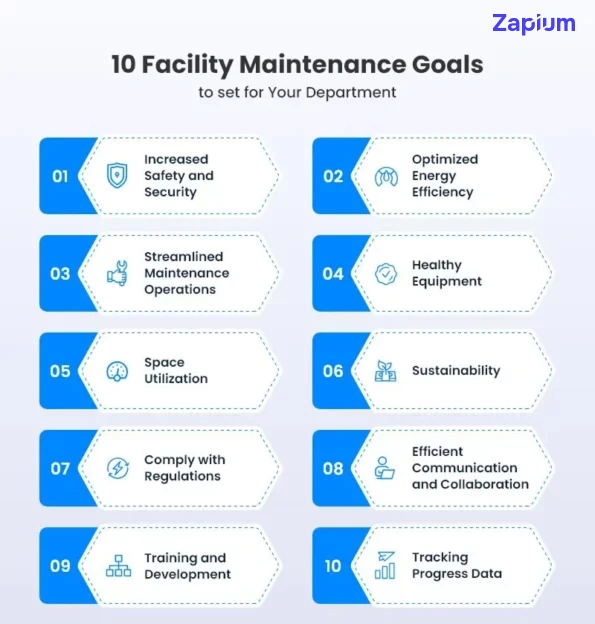
The following goals help improve facility performance, maintenance efficiency, and long-term operational planning:
- Improve Facility Safety and Security Maintenance Goals
- Optimize Energy Efficiency and Reduce Facility Operating Costs
- Streamline Maintenance Operations and Preventive Maintenance Workflows
- Maintain Equipment Health and Reduce Asset Downtime
- Improve Space Utilization and Workplace Efficiency
- Promote Sustainability Through Long-Term Facility Maintenance Planning
- Strengthen Regulatory Compliance and Risk Management
- Improve Communication and Collaboration Across Facility Teams
- Develop Maintenance Staff Skills Through Training and Performance Goals
- Use Facility Data and KPIs to Improve Maintenance Decision-Making
1. Improve Facility Safety and Security Maintenance Goals
Safety and security failures can disrupt operations, damage assets, increase liability, and put employees at risk. That is why improving workplace safety remains a top priority for maintenance departments, as it directly influences regulatory compliance, insurance costs, and the overall reliability of daily facility operations. A well-defined safety strategy helps facility teams reduce incidents, maintain compliance, and create secure environments for employees, vendors, and visitors.
Facility managers can strengthen safety goals by scheduling regular inspections, maintaining emergency systems, testing fire protection equipment, monitoring electrical systems, and standardizing preventive maintenance procedures. Teams should also prioritize hazard reporting, technician safety training, surveillance monitoring, and access control systems to reduce operational risks and improve security performance.
For example, a maintenance department goal may focus on reducing workplace safety incidents by 25% within 12 months through preventive inspections, faster work order response times, and routine compliance audits. This type of SMART goal helps organizations reduce emergency maintenance issues and maintain uninterrupted building operations.
2. Optimize Energy Efficiency and Reduce Facility Operating Costs
Energy costs are among the largest and most controllable expenses in facility operations, yet many organizations continue to overspend due to aging equipment, inconsistent maintenance, and a lack of real-time visibility into energy consumption. Facility teams can address this by maintaining HVAC systems, upgrading lighting infrastructure, monitoring utility consumption, and scheduling preventive maintenance for energy-intensive equipment, helping organizations lower energy waste, improve equipment performance, and build more cost-efficient operations over time.
Facility managers should conduct regular energy audits, automate lighting controls, calibrate equipment, and implement smart monitoring systems to identify inefficient energy usage patterns. Maintenance departments can also support an energy-efficient facility by improving insulation, reducing idle equipment runtime, and replacing outdated systems with energy-efficient alternatives.
A practical example would be targeting a 20% reduction in annual energy consumption within 12 months through HVAC optimization, LED lighting upgrades, and real-time energy tracking. This type of SMART goal helps reduce utility expenses, improve sustainability performance, and support long-term facility planning.
3. Streamline Maintenance Operations and Preventive Maintenance Workflows
Many maintenance departments lose significant time and resources to unplanned repairs, manual processes, and inconsistent scheduling, all of which compound over time and strain both budgets and teams. Standardizing preventive maintenance schedules, digitizing work orders, automating maintenance tracking, and reducing reactive maintenance activities help organizations improve technician productivity, reduce equipment downtime, and maintain consistent performance across facilities.
Facility managers can establish preventive maintenance workflows for critical assets, centralize maintenance requests through facility maintenance software, and prioritize recurring inspections to keep operations running smoothly. Tracking asset history, automating maintenance reminders, and improving work order response times through digital systems further reduces paperwork and eliminates bottlenecks that slow maintenance teams down.
A maintenance department goal, for example, focused on reducing reactive work orders by 30% within one year through preventive scheduling and automated tracking, is a strong example of a SMART goal in practice. Achieving this helps improve operational efficiency, extend asset lifespan, and support long-term facility maintenance planning.
4. Maintain Equipment Health and Reduce Asset Downtime
Unexpected equipment failures are disruptive and costly challenges maintenance departments face, often triggering emergency repairs, production delays, and unplanned budget overruns that could have been avoided with consistent preventive care. Performing routine inspections, scheduling preventive maintenance, monitoring equipment performance, and addressing repair issues before failures occur helps organizations improve equipment reliability, reduce emergency breakdowns, and maintain uninterrupted facility operations.
Critical assets such as HVAC systems, generators, elevators, and electrical equipment should each have dedicated preventive maintenance schedules that account for usage patterns, manufacturer guidelines, and historical performance data. Facility managers should track asset condition, automate inspection reminders, and apply structured equipment maintenance strategies to help maintenance teams identify recurring issues before they escalate into costly operational disruptions.
For example, targeting a 40% reduction in unplanned equipment downtime within 12 months through preventive servicing, condition monitoring, and faster maintenance response times is a measurable and achievable goal for most maintenance departments. Progress toward this SMART maintenance goal directly extends asset lifespan, improves maintenance efficiency, and lowers long-term repair costs across facilities.
5. Improve Space Utilization and Workplace Efficiency
Underused spaces, cluttered layouts, and poorly placed assets quietly erode workplace productivity and inflate facility operating costs over time. Facility teams can address this by optimizing workplace layouts, reducing underused areas, reorganizing asset placement, and creating flexible work environments that support daily operations, thereby reducing operational congestion and making better use of available space.
Evaluating occupancy patterns, monitoring workspace usage, and redesigning layouts based on operational requirements and employee workflows gives facility managers a clearer picture of where space is being wasted and where improvements will have the most impact. Consolidating storage areas, improving equipment placement, and integrating space planning into facility maintenance planning strategies further support smoother operations across departments.
A focused goal, such as increasing workspace utilization by 25% within one year through floor layout redesigns, reduced storage zones, and shared workspaces for hybrid teams, offers a practical and measurable target for facilities teams. Achieving this improves productivity, eliminates wasted space, and builds a stronger foundation for long-term operational efficiency.
6. Promote Sustainability Through Long-Term Facility Maintenance Planning
Many facilities generate more waste and consume more energy than necessary due to aging infrastructure, inconsistent maintenance practices, and the absence of a structured sustainability strategy. Reducing energy waste, improving resource efficiency, extending asset lifespan, and implementing preventive maintenance strategies help organizations lower operating costs, reduce environmental impact, and build more resilient facility operations over time.
Prioritizing energy-efficient equipment, waste-reduction programs, water-conservation measures, and sustainable asset-management practices lays the groundwork for meaningful long-term change. Maintenance departments can build on this foundation by adopting sustainable facility management strategies, improving preventive maintenance schedules, reducing unnecessary equipment replacement, and tracking sustainability KPIs tied to energy usage and resource consumption.
Setting a SMART goal, such as reducing facility waste by 30% and lowering energy consumption by 20% within two years through preventive maintenance, equipment upgrades, and sustainability-focused planning, provides maintenance teams with a clear, measurable direction. Working toward this target strengthens environmental performance, reduces long-term operational costs, and aligns facility management practices with broader organizational sustainability objectives.
7. Strengthen Regulatory Compliance and Risk Management
OSHA penalties can reach up to $16,550 per violation, and the National Safety Council estimates workplace injuries and illnesses cost U.S. employers over $167 billion annually, much of it tied to preventable compliance gaps. Conducting routine inspections, maintaining accurate records, and scheduling preventive maintenance for critical systems helps organizations reduce legal risks, avoid penalties, and maintain safe building operations.
Staying current with building regulations, OSHA requirements, fire safety standards, and equipment inspection schedules ensures maintenance teams are never caught off guard during audits. Documenting maintenance activities, automating compliance reminders, and integrating compliance tracking into daily workflows further strengthen risk management and reduce the likelihood of overlooked obligations.
A target such as achieving 100% compliance for fire safety inspections, equipment certifications, and preventive maintenance documentation within 12 months gives departments a concrete benchmark to work toward, reducing operational risks and supporting uninterrupted facility operations over the long term.
8. Improve Communication and Collaboration Across Facility Teams
Poor communication between maintenance staff, operations teams, and vendors is one of the most common causes of delayed repairs, duplicated work, and missed inspections that quietly undermine facility performance. Centralizing maintenance requests, standardizing reporting processes, using digital work order systems, and improving cross-departmental coordination help organizations reduce response delays, close communication gaps, and improve overall maintenance efficiency.
Establishing clear communication channels between maintenance staff, operations teams, vendors, and facility leadership improves task visibility and accountability across the board. Shared maintenance dashboards, mobile maintenance applications, automated notifications, and centralized documentation systems keep teams aligned on inspections, repairs, and preventive maintenance without manual follow-ups.
Reducing maintenance response delays by 25% within 12 months through digital work-order tracking and standardized communication procedures provides facility teams with a strong, measurable starting point. Reaching this target builds a culture of accountability where technicians, managers, and operations teams stay informed, aligned, and equipped to resolve issues before they escalate.
9. Develop Maintenance Staff Skills Through Training and Performance Goals
Undertrained technicians, unclear performance expectations, and inconsistent procedures are among the leading drivers of recurring maintenance errors, slower response times, and avoidable equipment failures that cost facilities significantly over time. Providing technical training, setting measurable performance goals, improving safety knowledge, and developing problem-solving skills helps organizations improve work quality, reduce operational errors, and build a more reliable maintenance workforce.
Regular employee training in preventive maintenance procedures, equipment diagnostics, safety protocols, compliance standards, and digital maintenance systems equips technicians with the knowledge needed to perform consistently across varying facility demands. Tracking response times, preventive maintenance completion rates, inspection accuracy, and repair efficiency alongside this training strengthens workforce accountability and supports long-term performance development.
For maintenance departments where skill gaps continue to affect output, targeting a 20% increase in preventive maintenance completion rates within one year provides a clear benchmark. Reaching it becomes far more achievable when technicians are trained in AI-based CMMS, safety protocols, and industry best practices, building a workforce confident and capable of handling challenges before they escalate.
10. Use Facility Data and KPIs to Improve Maintenance Decision-Making
Many maintenance departments make critical decisions based on habit rather than performance data, leading to misallocated resources, recurring equipment failures, and missed cost-saving opportunities. In an environment where energy efficiency, smooth operations, and occupant satisfaction are constant demands, using data effectively has become one of the most important strategic priorities for modern facility teams.
Clear key performance indicators (KPIs) act as a guiding compass, keeping teams focused and surfacing issues before they escalate. Tracking metrics such as preventive maintenance completion rates, equipment downtime, unplanned repair costs, and work order response times, supported by automated analytics dashboards and facility maintenance software, gives managers the visibility needed to make confident, data-backed planning decisions.
For departments still operating reactively, targeting a 35% reduction in emergency maintenance requests within one year through recurring failure analysis and refined preventive scheduling is a concrete, measurable starting point. Tracking progress against this goal builds accountability, optimizes resource allocation, and establishes data-driven decision-making as a core part of daily facility operations.
How Zapium Helps Achieve These Facility Maintenance Goals?
Zapium helps facility teams improve maintenance efficiency, reduce downtime, and manage operations from a centralized platform. With built-in support for work order management, preventive maintenance scheduling, asset tracking, inspection management, compliance monitoring, and maintenance reporting, Zapium provides organizations with the tools they need to achieve their facility maintenance goals more effectively.
Facility managers can use Zapium to automate maintenance scheduling, monitor KPIs, improve technician coordination, and support long-term planning through real-time operational visibility. By streamlining maintenance processes and reducing manual administrative work, Zapium helps organizations maintain safer, more efficient, and better-performing facilities.