

For most of the last century, a manufacturer’s job ended when the equipment left the loading dock. Service was a separate line item, usually billed when something broke. That created an awkward incentive: the more often a machine failed, the more the service provider earned.
Outcome-based service delivery reverses that. The customer pays for a result, such as a guaranteed level of uptime or a building that stays at the right temperature. The provider earns more when equipment runs well and less when it doesn’t.
This guide covers how the model works and what a service or maintenance organization needs in place before it can sell outcomes instead of hours.
What is outcome-based service delivery?
In an outcome-based model, the contract is written around a measurable result, not the labor and parts that go into it. The difference is easiest to see side by side:
- A traditional contract says: we’ll send a technician within four hours and bill for the time.
- An outcome-based contract says: this chiller will be available for 98% of operating hours, or we issue a service credit.
Harvard marketing professor Theodore Levitt liked to make this point with a drill. People who buy a quarter-inch drill, he told his students, don’t actually want the drill. “They want a quarter-inch hole.” Outcome-based service puts that idea directly into the contract.
Here’s how it compares with the models most service teams use today:
| Break-fix | Scheduled maintenance contract | Outcome-based | |
|---|---|---|---|
| Customer pays for | Each repair | A set number of visits | A result, such as uptime or response time |
| Who carries the risk of failure | Customer | Mostly the customer | Provider |
| How the provider earns more | More breakdowns | More contracts | Fewer breakdowns |
| Data needed | Very little | Visit records | Asset history, condition data and SLA tracking |
Where the idea came from
Researchers call this shift servitization. Sandra Vandermerwe and Juan Rada coined the term in a 1988 paper in the European Management Journal, describing how companies were adding services to the products they sold. In 2023, Vandermerwe revisited the concept with David Erixon in Servitization of business updated: Now, new, next, which traces how technology has changed it since the 1970s.
Most outcome-based offerings fit one of these types of product-service system:
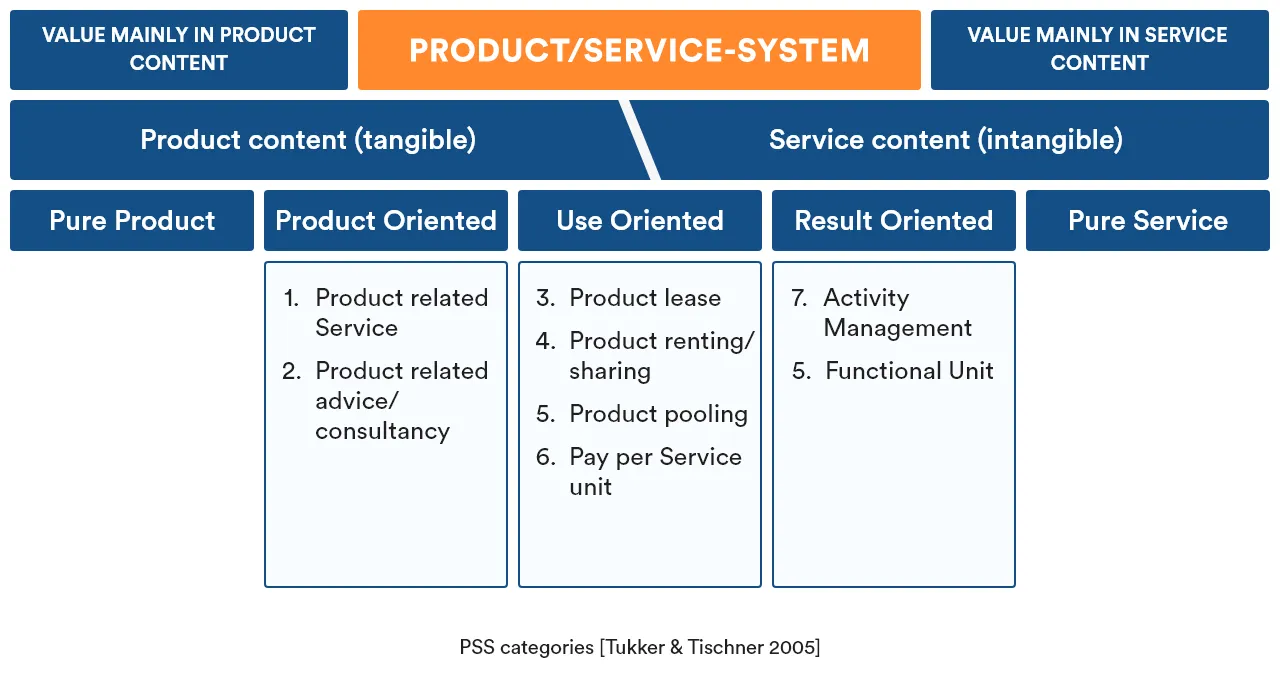
- Product-oriented: the customer owns the equipment, and the provider sells services around it, like maintenance contracts and extended warranties.
- Use-oriented: the provider keeps ownership, and the customer leases the equipment or pays per use.
- Result-oriented: the customer buys a result, and the provider decides how to deliver it.
Most maintenance contracts today are product-oriented. The biggest gains in margin and customer loyalty tend to sit further down that list.
Three companies that proved the model
Xerox: charging per copy
When Xerox introduced the 914 in 1959, it was the first automatic plain-paper copier, and it was expensive to build. Instead of selling the machine, Xerox leased it and charged for each copy made.
Customers didn’t have to commit a large capital budget to a new technology. Xerox earned more as usage grew. The company’s revenue went from $32 million in 1959 to more than $500 million by 1966.
Rolls-Royce: Power by the Hour
In 1962, Rolls-Royce introduced “Power by the Hour” for the Viper engine on the HS 125 business jet. It offered a complete engine and accessory replacement service for a fixed cost per flying hour. Operators only paid for engines that performed well, so a failed engine cost Rolls-Royce money, not the customer.
The program grew into CorporateCare for business jets and TotalCare for airlines. Miles Cowdry, then president of services at Rolls-Royce, described the change in the relationship this way: “our interest has become aligned with the customer.” That alignment is what makes the model work, and it shows up again in buildings.
Honeywell: outcome-based service for connected buildings
In 2017, Honeywell Building Solutions launched a service it called Outcome Based Service, aimed at commercial buildings. It works differently from a traditional maintenance contract:
- Continuous monitoring. Service engineers use analytics and building sensors to watch equipment around the clock, instead of waiting for the next scheduled visit.
- Dynamic tasking. Instead of working through a fixed inspection checklist, technicians are sent where the data shows a problem, so effort goes to the jobs that affect building performance most.
The reasoning is easy to follow. Honeywell noted that a building’s energy use can drift by up to 7% a year when nobody watches it closely. Its early pilots showed lower energy spend and fewer reactive service calls.
For maintenance teams, this is the most practical of the three examples. The customer isn’t paying for a checklist to be completed. They’re paying for a building that runs efficiently and stays comfortable, and the provider uses data to decide what work gets done.
What outcome-based service looks like in maintenance and field service
You don’t need to build jet engines to sell outcomes. Service providers and in-house maintenance teams already use versions of the model:
- Uptime guarantees on critical assets, such as chillers, elevators or commercial kitchen equipment, backed by service credits when availability drops.
- Response and resolution SLAs across a portfolio of sites, with part of the fee tied to hitting them.
- Fixed cost per site or per square foot, where the provider carries the risk of repair costs.
- Comfort or energy guarantees on HVAC, where the provider commits to temperature ranges or consumption targets.
The buyers are usually multi-site operators like retail chains, senior living groups and property portfolios. They want predictable maintenance costs and one provider accountable for results. For facility services companies, outcome-based contracts are also a way out of low-bid price wars, because they compete on performance instead of hourly rates.
What you need before you sell an outcome
Guaranteeing a result without the right data is gambling with your margin. These are the six things to put in place first.

Reference: Blekinge Institute of Technology, Karlskrona, Sweden 2017
1. A baseline for every asset
You can’t promise uptime on equipment you know nothing about. Before pricing a contract, you need each asset’s age, service history and failure record. Asset management keeps that history attached to the equipment, so you can see which units are likely to cost you money.
2. Early warning on equipment condition
Under an outcome contract, every unplanned failure comes out of your margin. Sensors that track temperature, vibration or runtime flag problems while there’s still time to act. Zap IoT connects that condition data to maintenance work, so an alert becomes a work order instead of an email nobody reads.
3. Preventive maintenance that actually gets done
A PM schedule on paper doesn’t protect uptime. Completed visits do. Preventive maintenance scheduling creates recurring work automatically and shows which visits are overdue before they turn into failures.
4. Field execution you can measure
Outcome contracts are won or lost in the field. You need to know when a job was logged, when a technician arrived and whether the problem was fixed on the first visit. Field service management software tracks each job against its SLA from dispatch to closeout.
5. Clear accountability when other vendors are involved
Most multi-site contracts involve subcontractors for specialist work like elevators, fire systems or roofing. If one of them misses a response time, your outcome still fails. Write down who owns which result, pass the relevant SLAs down into subcontractor agreements, and track their jobs in the same system as your own.
6. Reporting both sides trust
Disputes about whether an outcome was met can sour a contract fast. Give the customer access to the same uptime and SLA data you use. A CMMS or FSM with shared reporting turns the monthly review into a look at the numbers instead of an argument about them.
How to price the risk
Most providers don’t jump straight to a fully result-based contract. A safer path:
- Start hybrid. Charge a fixed base fee, then add a bonus or penalty tied to the outcome, so a bad month doesn’t wipe out the contract’s profit.
- Pilot on a small set of assets with good history before extending the model across a portfolio.
- Cap penalties and define exclusions in writing, such as customer misuse, power failures and equipment past its expected life.
- Review the numbers every quarter and reprice at renewal based on what the assets actually cost you.
Where to start
Pick one customer and one asset class where you already have reliable data. Commercial HVAC and refrigeration are common starting points, because downtime is expensive and easy to measure. Run an outcome-based pilot for a year, and compare the margin with your traditional contracts.
Zapium brings asset history, condition monitoring, preventive maintenance and field service onto one platform, so you can see whether an outcome is being met while there’s still time to fix it. Schedule a demo to see how it works with your contracts.
Some FAQ in this topic
What is an outcome-based service delivery model?
A model where the customer pays for a measurable result, such as uptime or response time, instead of for labor hours, parts or scheduled visits.
How is outcome-based service different from a maintenance contract?
A standard maintenance contract pays for visits, and the customer carries most of the risk of failure. In an outcome-based contract, the provider carries that risk and earns more when equipment runs reliably.
What data do you need to offer outcome-based contracts?
At minimum, asset service history, preventive maintenance completion rates and SLA tracking for every job. Condition monitoring makes the risk much easier to manage.