
ISO 55001 Asset Management: Standard, Principles, Implementation, and Certification Guide
Organizations across industries rely on physical assets, from equipment, facilities, infrastructure, and machinery so as to keep operations running. Managing those assets effectively has become far more complex in recent years. Rising maintenance costs, aging infrastructure, and growing regulatory scrutiny have pushed companies to adopt structured asset management approaches rather than relying on informal maintenance practices.
ISO 55001 is an international standard designed to address those challenges. It provides a framework for managing assets throughout their lifecycle while aligning asset strategies with broader business goals. In this guide, I’ll walk through what ISO 55001 is, why it matters, how it works, and what organizations should know before pursuing certification.
ISO 55001 Asset Management Certification at a Glance
| Item | Details |
|---|---|
Certification |
ISO 55001 Asset Management Certification |
Issuing Body |
Accredited certification bodies (based on the ISO 55001 Asset Management Standard) |
Standard Organization |
International Organization for Standardization (ISO) |
Certification Type |
Organizational certification for asset management systems |
Audit Duration |
Usually 2–5 days depending on organization size |
Certification Cost |
Typically $3,000 – $20,000+ depending on scope and audit body |
Validity |
3 years (with annual surveillance audits) |
What Is ISO 55001 Asset Management?
ISO 55001 asset management is a structured framework defined by the ISO 55001 standard that helps organizations manage physical assets systematically throughout their lifecycle. It establishes requirements for creating an Asset Management System (AMS) that aligns asset planning, operation, maintenance, and replacement decisions with organizational goals, risk management, and long-term value creation.
Why Is ISO 55001 Important?
A key benchmark for iso 55001 asset management: Industry Best Practices Metrics shows that top-performing maintenance teams sustain a planned maintenance rate of 85–90%, leaving fewer than 15% of hours consumed by reactive response — against an industry average of just 55–65% planned.
ISO 55001 provides a structured approach that helps organizations manage assets strategically rather than treating maintenance as an isolated activity. Some major reasons why ISO 55001 is important include:
- Improved asset reliability and performance
Structured asset management processes help organizations monitor asset condition, schedule maintenance effectively, and reduce unexpected failures that can disrupt operations.
- Better risk management
ISO 55001 encourages organizations to identify risks associated with asset failures and incorporate those risks into operational planning and decision making.
- More effective investment planning
Lifecycle cost analysis and asset performance data support smarter decisions regarding asset upgrades, replacements, and capital investments.
- Stronger governance and accountability
The standard establishes clear responsibilities, policies, and performance monitoring systems that improve transparency in how assets are managed across the organization.
What Is the ISO 55000 Asset Management Family?
ISO 55001 is part of a broader set of standards designed to guide organizations in managing assets systematically. Known as the ISO 55000 asset management family, these standards work together to provide concepts, requirements, and practical guidance for building effective asset management systems. Here is how each standard contributes to the framework:
- ISO 55000: Overview, terminology, and asset management principles
ISO 55000 introduces the core concepts of asset management. It explains the purpose of asset management, defines key terminology, and outlines the principles that guide organizations in managing assets effectively.
- ISO 55001: Asset management system requirements
ISO 55001 specifies the formal requirements for establishing, implementing, maintaining, and improving an Asset Management System (AMS). Organizations seeking certification must demonstrate compliance with these requirements.
- ISO 55002: Guidance for implementation
ISO 55002 provides practical guidance on how organizations can apply the requirements defined in ISO 55001. It offers explanations and recommendations that help translate the standard into operational asset management practices.
How Does ISO 55001 Differ from Traditional Maintenance Standards?
Traditional maintenance standards mainly focus on keeping equipment operational through inspections, repairs, and preventive maintenance schedules. ISO 55001 takes a broader approach by addressing how organizations manage assets strategically across their entire lifecycle. Instead of concentrating only on maintenance activities, the standard connects asset decisions with business goals, risk management, and long-term value creation.
- Strategic asset governance vs maintenance management
Traditional maintenance standards emphasize operational tasks such as servicing equipment and fixing failures. ISO 55001 focuses on governance, meaning organizations establish policies, leadership involvement, and structured decision-making processes that guide how assets are managed across the oqrganization.
- Lifecycle asset value vs short-term maintenance activities
Maintenance programs usually concentrate on short-term equipment performance. ISO 55001 evaluates assets throughout their lifecycle, from planning and acquisition to operation and replacement, so that organizations can maximize long-term value and strengthen operational resilience while making better investment decisions.
What Are the Core Objectives of ISO 55001?
ISO 55001 aims to help organizations manage their assets in a structured and strategic manner. The standard focuses on improving how assets support business operations, reduce risks, and contribute to long-term organizational performance. By establishing clear objectives, ISO 55001 guides companies in making informed decisions about asset planning, operation, and investment.
- Alignment of asset management objectives with organizational strategy
Asset management goals should support broader business objectives. ISO 55001 encourages organizations to align asset decisions with corporate strategy so that equipment, infrastructure, and facilities contribute directly to operational performance and broader organizational objectives.
- Lifecycle management of physical assets
The standard promotes managing assets throughout their entire lifecycle, including planning, acquisition, operation, maintenance, and replacement. Such an approach helps organizations maximize asset value while controlling long-term costs.
- Risk-based decision making
Asset failures can create operational disruptions, safety hazards, and financial losses. ISO 55001 encourages organizations to assess asset-related risks and incorporate those risks into decision-making processes.
- Cost optimization and value generation
Organizations evaluate both the costs and benefits associated with asset management decisions. Instead of focusing only on reducing maintenance costs, the standard supports strategies that deliver greater long-term value from assets.
- Data-driven monitoring of asset performance
Performance monitoring plays a key role in asset management. Organizations collect and analyze asset data to track reliability, maintenance effectiveness, and operational efficiency.
- Governance and accountability across asset portfolios
ISO 55001 establishes clear roles, responsibilities, and oversight mechanisms. Such governance structures help organizations maintain transparency and accountability in managing large and complex asset portfolios.
What Principles Guide ISO 55001 Asset Management?
ISO 55001 asset management is guided by several key principles that shape how organizations manage assets and make operational decisions. These principles help companies focus on long-term value, accountability, and structured asset governance across the organization.
- Value realization from assets
Assets should deliver measurable value to the organization. ISO 55001 encourages
organizations to manage assets in ways that support operational performance, productivity, and long-term financial returns.
- Leadership and top management commitment
Strong leadership involvement is essential for effective asset management. Senior management establishes policies, sets strategic direction, and allocates resources required to manage assets effectively.
- Structured risk management
Assets can create operational and financial risks if not managed properly. ISO 55001 promotes identifying, assessing, and controlling asset-related risks through structured risk management practices.
- Continuous improvement culture
Asset management systems must evolve as operational needs change. Organizations regularly evaluate asset performance and update their processes to improve efficiency and reliability.
- Stakeholder engagement
Asset decisions affect multiple stakeholders, including regulators, investors, employees, and customers. ISO 55001 encourages organizations to consider stakeholder expectations when planning and managing assets.
- Integration with other management systems
Asset management overlaps with quality, environmental, and safety management systems. ISO 55001 supports integrating asset management processes with other organizational management frameworks.
How Does ISO 55001 Integrate with Other Management Systems?
ISO 55001 is designed to align with other ISO management system standards through a common high-level structure. Because many organizations already operate systems for quality, environmental management, or occupational safety, the standard allows asset management processes to integrate with these frameworks.
Shared elements such as policy development, risk management, performance monitoring, and continual improvement help organizations coordinate asset governance with broader operational management systems. Such integration reduces duplication of effort and supports more consistent decision-making across departments.
What Is the Structure of the ISO 55001 Standard?
ISO 55001 follows a structured framework that outlines how organizations should design, implement, and improve their asset management system (AMS). The standard is organized into several key sections, each addressing a specific aspect of asset governance and operational management.
What Is Included in the Context of the Organization Clause?
Organizations must evaluate internal and external factors that influence asset performance and management. The clause also requires identifying stakeholder expectations- such as regulators, customers, and investors – and defining the scope of the asset management system (AMS), including which assets and operations fall under its coverage.
What Leadership Requirements Does ISO 55001 Include?
Leadership responsibilities include establishing an asset management policy that reflects organizational priorities. Senior management must also define clear roles, responsibilities, and authorities for asset management activities while demonstrating commitment by allocating adequate resources and supporting the system’s implementation.
What Planning Requirements Exist in ISO 55001?
The planning section focuses on establishing asset management objectives aligned with business strategy. Organizations must address risks and opportunities related to asset performance, develop Strategic Asset Management Plans (SAMP), and incorporate lifecycle cost planning to guide long-term asset investment and management decisions.
What Support Functions Are Required in ISO 55001?
Support functions provide the resources required to operate the asset management system effectively. These include developing workforce competence through training, establishing communication strategies across departments, maintaining documentation control, and using asset information systems to store and manage asset data.
What Operational Requirements Does ISO 55001 Include?
Operational requirements address the practical execution of asset management activities. Organizations must implement operational planning and asset control processes, manage changes that may affect asset performance, oversee outsourcing and contractor management, and maintain emergency preparedness for potential asset-related incidents.
How Does ISO 55001 Evaluate Performance?
Organizations must monitor asset performance using key performance indicators (KPIs) and other metrics. Internal audits assess whether the asset management system operates as intended, while management reviews evaluate overall system effectiveness and compliance monitoring verifies adherence to regulatory and organizational requirements.
How Does ISO 55001 Promote Continuous Improvement?
The final section focuses on strengthening the asset management system over time. Organizations must implement corrective and preventive actions when issues arise, maintain continuous improvement processes, and integrate lessons learned from operational experiences to improve future asset management practices.
How Does ISO 55001 Support Asset Lifecycle Management?
ISO 55001 supports asset lifecycle management by encouraging organizations to manage assets from initial planning and acquisition through operation, maintenance, and eventual replacement or disposal. The standard promotes evaluating lifecycle costs, operational performance, and associated risks when making asset-related decisions.
By monitoring asset condition and performance over time, organizations can plan maintenance activities, upgrades, and replacements more effectively. Such a lifecycle-based approach helps organizations maximize asset value, reduce unexpected failures, and ensure more informed long-term investment decisions.
What Are the Business Benefits of ISO 55001 Certification?
Organizations that achieve ISO 55001 certification experience operational and financial improvements because the standard promotes structured asset governance and lifecycle management. By implementing a formal Asset Management System, companies gain better visibility into asset performance, costs, and risks, which supports more informed decision-making across the organization.
Improved asset reliability and uptime
ISO 55001 encourages systematic monitoring, maintenance planning, and performance evaluation of assets. These practices help reduce equipment failures and improve overall reliability, allowing assets to operate consistently with fewer disruptions.
Reduced operational risk and unexpected downtime
The standard promotes risk-based decision making and proactive asset management strategies. Identifying potential failures early allows organizations to address issues before they escalate into costly operational interruptions.
Better capital investment planning
Lifecycle cost analysis and asset performance data provide insights that help organizations make informed investment decisions. Companies can plan asset upgrades, replacements, and infrastructure investments more strategically.
Stronger regulatory compliance
ISO 55001 establishes structured policies, documentation, and monitoring processes. These mechanisms help organizations demonstrate responsible asset governance and maintain compliance with regulatory requirements.
Improved collaboration across departments
Asset management activities involve engineering, maintenance, finance, and operations teams. ISO 55001 encourages coordinated processes and shared responsibilities, improving collaboration and decision making across departments.
Increased investor and stakeholder confidence
Certification signals that the organization manages its assets using internationally recognized standards. Such transparency and accountability can strengthen trust among investors, regulators, and other stakeholders while providing additional assurance regarding asset governance practices.
How Does ISO 55001 Compare with Other Management System Standards?
Organizations that rely on multiple management frameworks evaluate how different ISO standards align with their operational priorities. Asset-intensive industries, in particular, look closely at how asset management integrates with quality, environmental, and occupational safety systems. Below, I highlight how ISO 55001 compares with other commonly implemented ISO management system standards.
How Does ISO 55001 Compare with ISO 9001?
| Dimension | ISO 55001 | ISO 9001 |
|---|---|---|
Primary Focus | Concentrates on systematic asset management, covering planning, acquisition, operation, maintenance, and disposal of assets. | Focuses on maintaining consistent product and service quality through structured quality management processes. |
Key Objective | Maximizes value from physical assets while balancing cost, performance, and risk across the asset lifecycle. | Improves customer satisfaction by maintaining reliable processes and meeting product or service quality requirements. |
Scope of Application | Used heavily in asset-intensive sectors such as manufacturing, utilities, transportation, and infrastructure management. | Widely adopted across industries that prioritize standardized quality management systems and customer-focused operations. |
Performance Measurement | Measures asset performance through reliability, lifecycle cost management, and risk-based decision-making. | Evaluates performance through quality metrics, process efficiency, and customer satisfaction indicators. |
Strategic Role | Aligns asset strategies with broader organizational goals and financial planning. | Aligns operational processes with quality policies and continuous improvement objectives. |
How Does ISO 55001 Compare with ISO 14001?
| Dimension | ISO 55001 | ISO 14001 |
|---|---|---|
Primary Focus | Concentrates on structured management of physical assets and infrastructure. | Focuses on managing environmental impact and promoting sustainable operational practices. |
Key Objective | Improves asset reliability, cost control, and lifecycle value across an organization’s asset portfolio. | Reduces environmental impact through waste reduction, pollution control, and responsible resource usage. |
Scope of Implementation | Primarily adopted by organizations managing large asset bases such as utilities, energy, transportation, and heavy industry. | Implemented across organizations seeking structured environmental management and regulatory compliance. |
Risk Management | Addresses risks related to asset failure, performance degradation, and operational disruptions. | Addresses environmental risks such as emissions, waste disposal, resource consumption, and ecological impact. |
Organizational Impact | Supports long-term infrastructure planning and asset investment decisions. | Supports environmental responsibility, sustainability goals, and regulatory adherence. |
How Does ISO 55001 Compare with ISO 45001?
| Dimension | ISO 55001 | ISO 45001 |
|---|---|---|
Primary Focus | Deals with effective management of organizational assets throughout their lifecycle. | Focuses on occupational health and safety management within the workplace. |
Key Objective | Maximizes asset value while managing risks, performance expectations, and lifecycle costs. | Prevents workplace injuries and health risks by improving safety policies, procedures, and monitoring systems. |
Operational Emphasis | Concentrates on asset reliability, maintenance planning, and infrastructure performance. | Concentrates on identifying hazards, assessing workplace risks, and implementing safety controls. |
Performance Indicators | Asset utilization rates, maintenance efficiency, lifecycle cost optimization, and reliability metrics. | Workplace incident rates, safety compliance metrics, hazard reduction, and employee safety participation. |
Organizational Role | Supports asset-centric decision-making and infrastructure sustainability. | Strengthens workplace safety culture and regulatory compliance for employee protection. |
How Can Organizations Implement ISO 55001?
ISO 55001 sets the governance framework; quantified performance targets give it teeth. McKinsey research on analytics-driven maintenance programs found that organisations meeting the standard’s intent — systematic, data-informed asset care — cut unplanned downtime by up to 50%, a benchmark consistent with ISO 55001’s life-cycle optimisation objectives.
Organizations planning to align their asset management practices with ISO 55001 Asset Management Standard follow a structured set of actions. The following steps outline what organizations need to do during implementation.
Conduct an ISO 55001 Gap Analysis
Review current asset management practices and compare them with ISO 55001 requirements. Identify missing processes, weak documentation, or unclear responsibilities. Use the findings to outline improvement priorities and create an implementation roadmap.
Define an Asset Management Policy and Objectives
Establish a formal asset management policy approved by leadership. Set clear objectives related to asset reliability, lifecycle cost control, and risk management so that asset strategies align with broader business and operational goals.
Develop an Asset Management Framework
Create a structured framework that defines asset lifecycle processes, governance structures, and departmental responsibilities. Align engineering, maintenance, operations, and finance teams so asset planning and decision-making follow consistent procedures.
Establish Asset Performance Metrics
Define measurable indicators like OEE that track asset reliability, availability, maintenance efficiency, and lifecycle cost performance. Use operational data and maintenance records to monitor asset performance and support informed investment or maintenance decisions.
Implement Documentation and Control Processes
Prepare structured documentation such as asset registers, maintenance plans, risk assessments, and lifecycle strategies. Maintain document control procedures to manage updates, maintain record accuracy, and support traceability during audits.
Internal Audits and Management Reviews Working
Conduct internal audits to evaluate compliance with asset management policies and ISO 55001 requirements. Present audit findings to leadership during management reviews to assess performance and determine corrective actions or improvement priorities.
Prepare for Certification
Once processes operate consistently, schedule an external audit with an accredited certification body. Provide documentation, operational evidence, and audit records to demonstrate that the asset management system meets ISO 55001 requirements.
What Is the ISO 55001 Certification Process?
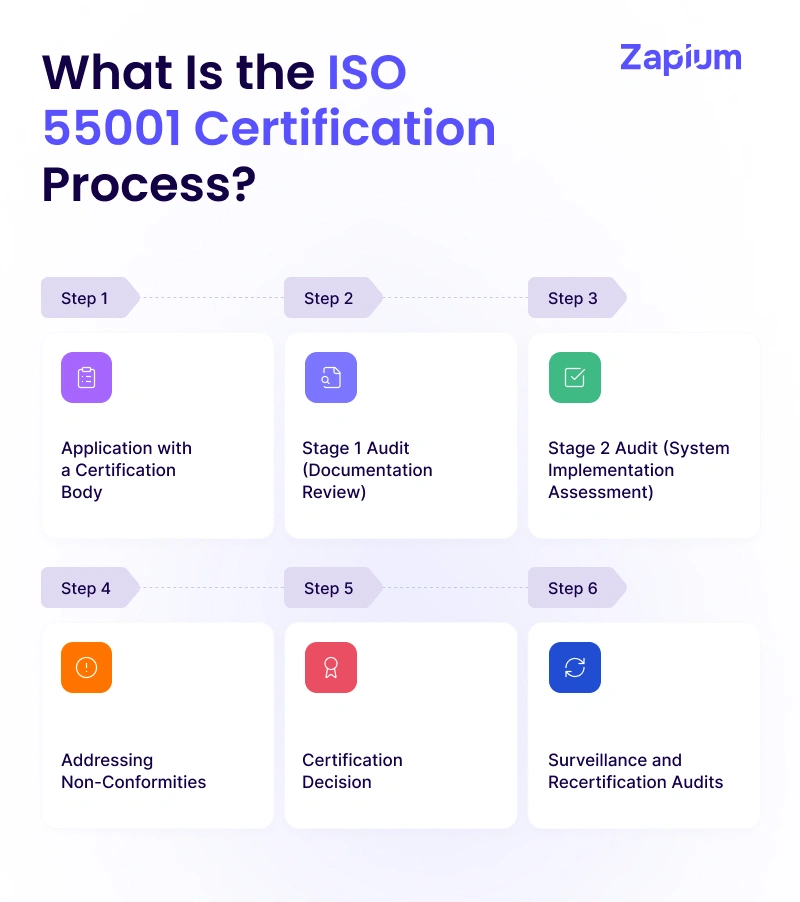
Organizations seeking certification under ISO 55001 Asset Management Standard must follow a structured evaluation process conducted by an accredited certification body. The process typically includes several stages designed to verify whether the asset management system meets the requirements of the standard.
- Application with a Certification Body
Organizations begin by selecting an accredited certification body and submitting an application for ISO 55001 certification. The certification body reviews the organization’s scope, asset management activities, and readiness for the audit process.
- Stage 1 Audit (Documentation Review)
Auditors review the organization’s asset management documentation, policies, asset registers, and procedures. The purpose of this stage is to confirm that the asset management system aligns with ISO 55001 requirements before the full audit.
- Stage 2 Audit (System Implementation Assessment)
Auditors evaluate how the asset management system operates in practice. Interviews with staff, process evaluations, and operational evidence help determine whether asset management activities follow documented procedures.
- Addressing Non-Conformities
Any gaps or non-conformities identified during the audit must be corrected by the organization. Corrective actions and supporting evidence are submitted to the certification body for verification.
- Certification Decision
After confirming that all requirements are satisfied, the certification body issues ISO 55001 certification. The organization can then formally demonstrate compliance with internationally recognized asset management practices.
- Surveillance and Recertification Audits
Certification remains valid for a limited period, typically three years. Periodic surveillance audits are conducted during this period to verify ongoing compliance, followed by a recertification audit at the end of the cycle.
What Challenges Do Organizations Face When Implementing ISO 55001?
Following are the common challenges organizations may face while implementing ISO 55001 Asset Management Standard:
Lack of leadership buy-in
Successful implementation requires active support from senior management. Weak leadership commitment leads to limited resource allocation, unclear strategic direction, and reduced coordination between departments responsible for asset planning and maintenance.
Poor asset data quality
Incomplete asset registers, outdated maintenance records, or inconsistent asset classification can create major obstacles. Reliable asset data forms the foundation for lifecycle planning, performance monitoring, and risk assessment under ISO 55001.
Resistance to organizational change
Employees may hesitate to adopt new asset management processes, documentation practices, or performance monitoring systems. Change resistance slows implementation, particularly when departments are accustomed to informal or decentralized asset management practices.
Limited lifecycle costing expertise
ISO 55001 requires organizations to evaluate assets based on total lifecycle costs rather than short-term maintenance expenses. Many teams lack experience in lifecycle costing methods, asset depreciation analysis, and long-term capital planning.
Integration issues with ERP or CMMS platforms
Asset management systems frequently depend on integration with enterprise platforms such as ERP or computerized maintenance management systems. Technical compatibility issues or poorly configured systems can disrupt data flow and reporting accuracy.
How Does Digital Transformation Support ISO 55001?
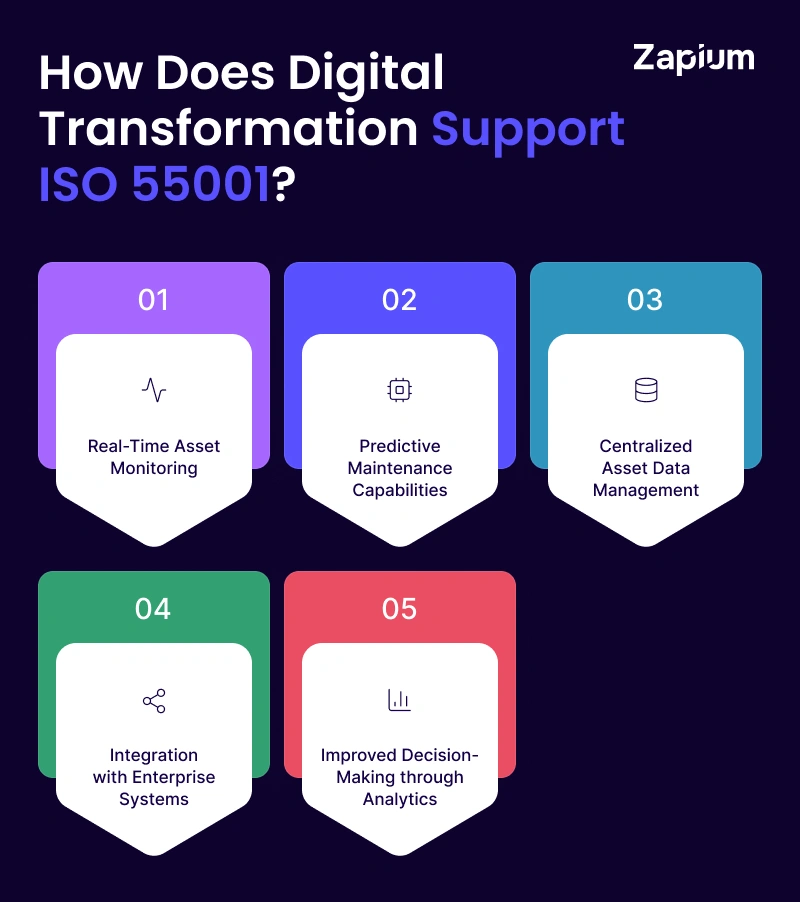
Digital technologies like CMMS and asset management software play a major role in strengthening asset management systems aligned with ISO 55001 Asset Management Standard. Major ways digital transformation supports ISO 55001 include:
- Real-Time Asset Monitoring
Sensors and connected devices provide real-time data on asset condition, performance, and usage, helping organizations detect faults early and improve maintenance planning.
- Centralized Asset Data Management
Digital asset management platforms consolidate asset registers, maintenance records, and lifecycle data in a centralized system, improving data accuracy and accessibility for operational teams.
- Integration with Enterprise Systems
Integration with enterprise platforms such as ERP and computerized maintenance management systems helps streamline asset tracking, work order management, and reporting processes.
- Predictive Maintenance Capabilities
Data analytics and machine learning models analyze equipment behavior patterns to predict potential failures, allowing maintenance teams to schedule interventions before breakdowns occur.
- Improved Decision-Making through Analytics
Advanced analytics tools evaluate asset performance trends, lifecycle costs, and risk factors, helping organizations make informed investment and replacement decisions.
Which Industries Benefit Most from ISO 55001?
Every asset-intensive sector gains significant operational value from implementing ISO 55001 Asset Management Standard. Organizations that depend on large physical asset networks use the standard to improve reliability, lifecycle planning, and risk management. Key industries that benefit the most include:
Manufacturing plants
Manufacturing facilities operate with extensive production equipment, machinery, and supporting infrastructure. ISO 55001 helps maintain equipment reliability, reduce unplanned downtime, and improve maintenance planning across production assets.
Oil and gas facilities
Exploration, drilling, refining, and pipeline operations rely on complex and high-value assets. Structured asset management helps control operational risks, maintain equipment performance, and support long-term infrastructure investment decisions.
Power generation and utilities
Power plants, transmission networks, and utility infrastructure require consistent monitoring and lifecycle planning. ISO 55001 supports asset reliability, grid stability, and better management of large-scale utility assets.
Transportation networks
Railways, airports, ports, and road infrastructure depend on numerous physical assets such as tracks, vehicles, signaling systems, and terminals. Asset management systems help maintain operational safety and infrastructure performance.
Public infrastructure agencies
Government organizations responsible for highways, bridges, water systems, and urban infrastructure use ISO 55001 to manage long-term asset value while balancing maintenance costs and public service requirements.
Facility management organizations
Facility management providers oversee building systems such as HVAC, electrical networks, security systems, and structural assets. ISO 55001 supports structured maintenance planning and efficient management of building infrastructure.
What KPIs Should Be Tracked in an ISO 55001 Asset Management System?
When implementing ISO 55001 Asset Management Standard, you need to track specific performance indicators to evaluate asset reliability, financial efficiency, and risk exposure across the asset lifecycle. Typically these KPIs are:
- Asset Uptime Percentage: Measures the proportion of time assets remain operational, helping organizations evaluate equipment reliability and identify assets that frequently experience operational interruptions.
- Lifecycle Cost per Asset: Tracks the total cost of owning and operating an asset throughout its lifecycle, supporting better decisions regarding maintenance, upgrades, or asset replacement.
- Maintenance Cost as Percentage of Asset Value: Indicates how much is spent on maintaining assets relative to their value, helping organizations evaluate maintenance efficiency and cost control.
- Asset Risk Index: Assesses the likelihood and potential impact of asset failure, enabling organizations to prioritize maintenance actions and risk mitigation strategies.
- Return on Assets (ROA): Evaluates how effectively organizational assets generate financial returns or operational value, helping management assess asset utilization efficiency.
- Capital Expenditure Effectiveness: Measures how effectively capital investments in new or upgraded assets contribute to performance improvements, operational reliability, or cost reduction.
Is ISO 55001 Certification Worth It for Your Organization?
If you are a business that relies on critical infrastructure and high-value equipment gain measurable advantages from adopting ISO 55001 Asset Management Standard. The certification introduces a structured approach to managing assets across their lifecycle, helping organizations improve reliability, control maintenance costs, and support informed capital investment decisions. Clear governance, performance monitoring, and risk-based planning also contribute to stronger operational stability.
I have seen how for asset-intensive sectors, the framework supports long-term asset value and better coordination between engineering, maintenance, and financial planning teams. While evaluating certification, consider asset scale, operational complexity, and strategic priorities before moving forward.
Frequently Asked Questions (FAQs)
What Is the Difference Between ISO 55000 and ISO 55001?
ISO 55000 explains the concepts, terminology, and principles of asset management, providing an overview of how asset management systems function. ISO 55001, on the other hand, defines the formal requirements for establishing and operating an Asset Management System (AMS) and is the standard used for certification.
Who Should Implement ISO 55001?
ISO 55001 is most suitable for organizations that depend heavily on physical assets to operate. Asset-intensive industries such as manufacturing, utilities, oil and gas, transportation, infrastructure management, and facility management commonly adopt the standard to improve reliability, lifecycle planning, and asset performance.
How Long Does It Take to Implement ISO 55001?
Implementation timelines vary depending on the organization’s asset complexity and current management practices. Many organizations take 6 to 18 months to implement the framework, including gap analysis, process development, documentation preparation, and internal audits before certification.
Is ISO 55001 Certification Mandatory?
ISO 55001 certification is not mandatory for most organizations. It is a voluntary standard adopted by companies that want to demonstrate structured asset management practices, improve asset governance, and build confidence with regulators, investors, and stakeholders.
Can ISO 55001 Be Integrated with Existing Management Systems?
Yes. ISO 55001 follows the ISO High-Level Structure (HLS) used by many other ISO standards. Organizations that already operate systems aligned with quality, environmental, or occupational safety standards can integrate asset management processes into existing governance, risk management, and performance monitoring frameworks.
How Often Is ISO 55001 Certification Renewed?
ISO 55001 certification typically remains valid for three years. During this period, certification bodies conduct annual surveillance audits to verify ongoing compliance. At the end of the cycle, organizations must undergo a recertification audit to maintain their certification.