


Keeping industrial equipment running at peak performance requires more than routine checks. It requires insight into how machines behave in real time. I have seen how monitoring key signals like vibration, temperature, pressure, and electrical currents can reveal problems long before they cause breakdowns.
Understanding these signals is only the first step. Knowing which predictive maintenance methods to use and how to interpret the data is equally important.
In this discussion, I walk you through the 9 types of predictive maintenance techniques, explaining how each collects and analyzes data and how to choose the right method for specific equipment and operating conditions.
Why Does Predictive Maintenance Matter for Equipment Performance
Predictive maintenance directly impacts equipment performance by using AI-driven algorithms that work on real-time data and identify issues before they turn into failures, thereby helping you,
- Reduce equipment downtime: Early detection of faults allows corrective action before breakdowns occur, minimizing unexpected stoppages and production losses.
- Lower maintenance costs: Targeted interventions replace only what is necessary, reducing labor, parts, and emergency repair expenses.
- Improve operational efficiency: Machines running under optimal conditions maintain consistent output and performance, avoiding inefficiencies caused by undetected wear or misalignment.
- Extend asset lifespan: Continuous monitoring helps prevent severe damage, keeping equipment within safe operating limits and prolonging its usable life.
What Are the Different Types of Predictive Maintenance Techniques
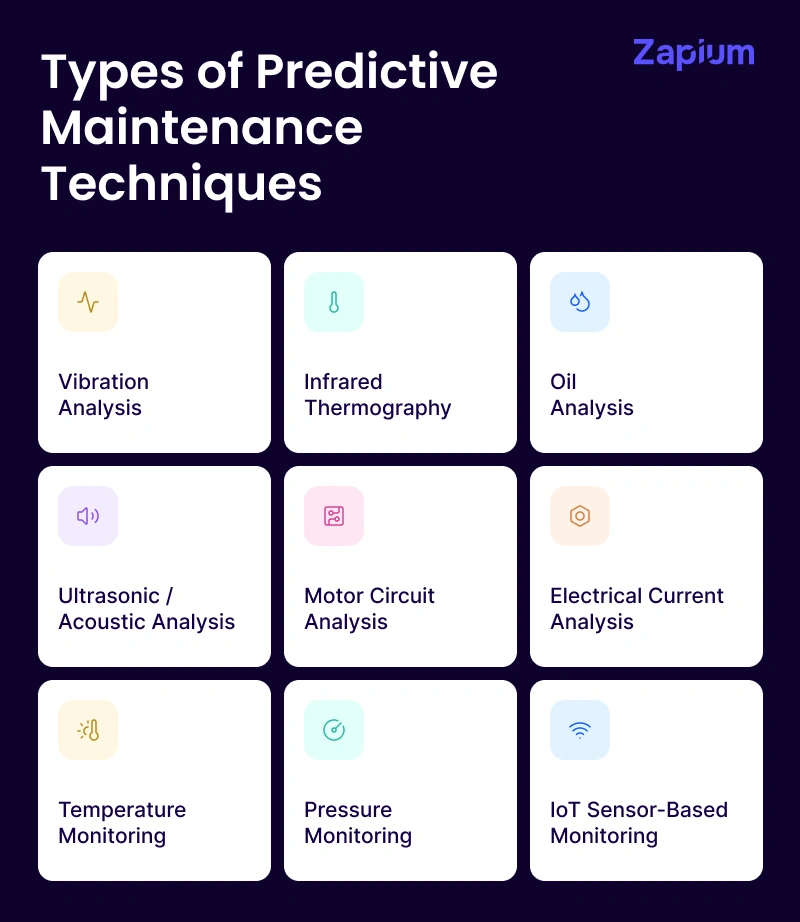
Different predictive maintenance techniques focus on specific physical or electrical parameters, using dedicated instruments and analysis methods to interpret data. Covering some key predictive maintenance examples, I explain these approaches to predictive maintenance below.
1. Vibration Analysis
Rotating equipment generates vibration signatures tied to its mechanical condition. Accelerometers mounted on bearings or housings capture velocity, acceleration, and displacement data across multiple axes. Signal processing techniques such as Fast Fourier Transform (FFT) convert time-domain signals into frequency spectra, helping isolate characteristic fault frequencies like imbalance, misalignment, or bearing defects. Envelope detection and spectral kurtosis are also applied to identify early-stage anomalies.
Data acquisition systems sample at high frequencies to capture transient events. Analysts correlate frequency peaks with known mechanical fault patterns using baseline references. Trending vibration amplitude and frequency shifts over time enables precise tracking of machine condition. Integration with predictive maintenance software allows automated fault classification based on predefined frequency bands and thresholds.
2. Infrared Thermography
One of the key predictive maintenance types, infrared thermography captures thermal radiation emitted by surfaces using infrared cameras. Each component emits radiation proportional to its temperature, which is converted into a thermal image. Variations in temperature distribution reveal abnormal heat patterns caused by electrical resistance, friction, or insulation breakdown. Calibration factors such as emissivity, ambient temperature, and reflected radiation must be accounted for accurate readings.
Thermal images are analyzed for hotspots, gradients, and deviations from baseline profiles. Advanced systems apply image processing algorithms to quantify temperature differentials across components. Periodic scans or continuous monitoring setups generate thermal trends. Data integration with maintenance systems allows correlation with load conditions, enabling precise identification of thermal anomalies under varying operational states.
3. Oil Analysis
This predictive maintenance method evaluates lubricant condition and contamination levels within machinery. Samples are tested for viscosity, particle count, wear metals, and chemical composition. Techniques such as spectroscopy identify metallic particles like iron, copper, and aluminum, indicating component wear. Ferrography provides detailed insights into particle size and morphology, helping distinguish wear types.
Chemical analysis detects oxidation, acidity (TAN), and additive depletion. Contaminants like water, fuel, or dirt are measured using methods such as Karl Fischer titration and particle counters. Trending these parameters over time provides a detailed profile of lubrication health. Data is integrated into maintenance platforms to correlate lubricant degradation with operating conditions and mechanical wear patterns.
4. Ultrasonic / Acoustic Analysis
Ultrasonic analysis detects high-frequency sound waves generated by mechanical and electrical phenomena. Sensors capture frequencies typically above 20 kHz, beyond human hearing. Friction, turbulence, and electrical discharge produce distinct ultrasonic signatures. Heterodyning converts these signals into audible ranges for analysis while preserving frequency characteristics.
Signal patterns are analyzed for amplitude changes and frequency modulation. Time waveform analysis helps identify intermittent events like arcing or leakage. Directional sensors enable pinpointing of sound sources in complex systems. Data is logged and trended to track changes in acoustic intensity, allowing identification of evolving fault conditions based on deviations from baseline acoustic profiles.
5. Motor Circuit Analysis
Motor circuit analysis evaluates electrical integrity of motors without requiring operation. Test instruments inject low-voltage signals to measure parameters such as resistance, impedance, inductance, and phase balance. These measurements help identify issues like winding faults, insulation degradation, and rotor bar defects.
Advanced techniques include surge testing to detect turn-to-turn insulation weaknesses. Data is compared across phases to identify asymmetry or imbalance. Static and dynamic tests provide a comprehensive view of motor conditions. Results are stored and trended over time, enabling detection of gradual electrical deterioration through deviations in circuit characteristics.
6. Electrical Current Analysis
Electrical current analysis monitors current waveforms drawn by equipment during operation. Sensors such as current transformers capture real-time current signals, which are analyzed using frequency-domain techniques. Variations in current patterns reflect mechanical and electrical anomalies, including rotor defects and load inconsistencies.
Motor Current Signature Analysis (MCSA) identifies fault frequencies associated with specific issues. Harmonic analysis isolates distortions in current waveforms caused by faults. Data acquisition systems continuously record current signals, enabling time-based trending. Analytical models correlate waveform changes with operational parameters, providing a detailed electrical behavior profile of the equipment.
7. Temperature Monitoring
Temperature monitoring uses sensors like thermocouples, RTDs, and infrared devices to measure heat levels in components. Trends and rate-of-change analysis help identify thermal anomalies before they escalate, making it one of the essential condition monitoring techniques for bearings, windings, and fluid systems.
Data is analyzed for deviations from established thermal baselines. Rate-of-change analysis identifies abnormal heating trends, while threshold-based alerts highlight critical conditions. Integration with control systems allows synchronization with load and environmental data. Long-term temperature trends provide insights into thermal behavior and help identify gradual changes in operating conditions.
8. Pressure Monitoring
Pressure monitoring evaluates fluid and gas systems by measuring pressure levels at various points. Sensors such as piezoelectric or strain gauge transducers capture real-time pressure data. Variations in pressure profiles indicate issues like blockages, leaks, or pump inefficiencies.
Data is analyzed using time-series and statistical methods to identify fluctuations and anomalies. Differential pressure measurements help assess system performance across filters and valves. Continuous monitoring systems log pressure trends, enabling correlation with flow rates and operational conditions. Advanced analytics detect subtle deviations from normal pressure patterns, indicating evolving system irregularities.
9. IoT Sensor-Based Monitoring
Now, we arrive at another one of the key predictive maintenance strategies, which is IoT predictive maintenance. It integrates multiple sensor types into a connected ecosystem. Cloud platforms process the aggregated data using machine learning models to detect patterns, predict equipment failures, and optimize maintenance schedules. This approach forms the backbone of modern predictive maintenance systems.
Cloud-based systems aggregate and store large datasets for analysis. Machine learning models process multi-parameter data to identify patterns and anomalies. Time-series databases support high-frequency data ingestion, while dashboards visualize real-time and historical trends. Integration with industrial systems allows synchronized monitoring across assets, enabling a unified view of operational data streams.
How Does Predictive Maintenance Work in Industrial Systems
Understanding how predictive maintenance works requires tracking real-time signals, transmitting them to acquisition systems, and analyzing patterns against historical data.
Data around important parameters like vibration, temperature, pressure, and electrical signals is collected in real-time data from equipment using sensors. This data is transmitted to acquisition systems where it undergoes filtering and normalization to remove noise and standardize inputs. It is then stored in centralized platforms, typically in time-series databases designed to handle continuous data streams.
Analytical models process this data to identify patterns and deviations from baseline conditions. Techniques such as signal processing, statistical analysis, and machine learning detect anomalies by comparing current readings with historical data.
The system tracks trends, frequency variations, and parameter correlations, flagging conditions that match known fault signatures or exceed defined thresholds. Based on this principle there exist multiple predictive maintenance applications in industrial systems.
What Are the Benefits of Predictive Maintenance Techniques
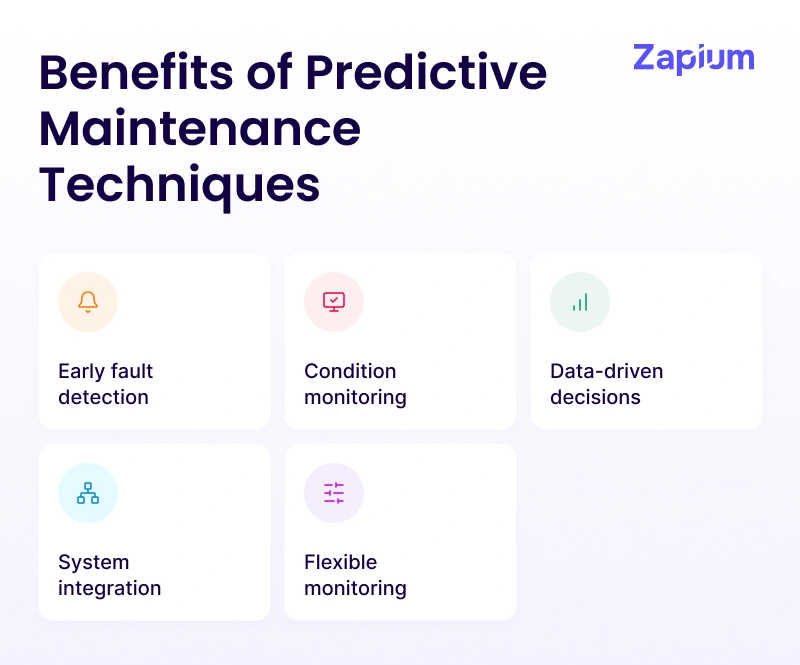
Following are the key predictive maintenance benefits, showing how the technique helps sustain equipment performance:
- Early fault detection: Techniques like vibration or current analysis identify problems at their inception, even before symptoms appear.
- Comprehensive condition monitoring: Combining thermal, pressure, and ultrasonic data provides a complete view of equipment health.
- Data-driven decision making: Historical trends and real-time measurements support accurate maintenance planning.
- Integration with digital systems: IoT-based techniques enable centralized dashboards and automated alerts for faster response.
- Flexible monitoring options: Techniques can be adapted for continuous, periodic, or targeted inspections based on asset criticality.
How Do Predictive Maintenance Techniques Compare with Each Other
Below is a side-by-side comparison of all the above predictive maintenance techniques that explain how each approach fits specific equipment conditions and monitoring requirements:
| Technique | Primary Parameter Monitored | Equipment Type | Data Type | Detection Focus | Measurement Method |
|---|---|---|---|---|---|
Vibration Analysis | Vibration (velocity, frequency) | Rotating machinery | Dynamic signal data | Imbalance, misalignment, bearing faults | Accelerometers + FFT analysis |
Infrared Thermography | Surface temperature | Electrical & mechanical systems | Thermal imaging data | Heat patterns, insulation issues | Infrared cameras |
Oil Analysis | Lubricant condition | Gearboxes, engines | Chemical & particle data | Wear particles, contamination | Spectroscopy, particle counting |
Ultrasonic / Acoustic | High-frequency sound | Mechanical & electrical systems | Acoustic signal data | Friction, leaks, electrical discharge | Ultrasonic sensors |
Motor Circuit Analysis | Electrical circuit parameters | Electric motors | Static electrical data | Winding faults, insulation degradation | Resistance, impedance testing |
Electrical Current Analysis | Current waveform | Motors, electrical equipment | Time & frequency data | Rotor faults, load variations | Current transformers + MCSA |
Temperature Monitoring | Heat levels | Bearings, fluids, motors | Continuous sensor data | Overheating, thermal deviations | Thermocouples, RTDs |
Pressure Monitoring | Fluid/gas pressure | Hydraulic & pneumatic systems | Time-series data | Leaks, blockages, flow issues | Pressure transducers |
IoT Sensor-Based Monitoring | Multi-parameter (combined data) | Integrated industrial systems | Aggregated data streams | Pattern detection across parameters | Networked sensors + cloud platforms |
How to Choose the Right Predictive Maintenance Technique
For a maintenance team, picking the right predictive maintenance technique starts with understanding how your equipment behaves under normal and stressed conditions. They must know that each technique is important when building a predictive maintenance program. Different assets fail in different ways, so the choice depends on failure modes rather than preference.
For instance, rotating machines call for vibration analysis, electrical systems lean toward current or circuit analysis, and fluid-based systems require pressure or oil monitoring. Sensor placement, data resolution, and operating environment also play a role, since inaccurate or inconsistent data can distort the analysis.
Another key factor is how the data will be processed and interpreted. Some techniques generate high-frequency signals that need advanced processing, while others rely on simpler threshold-based monitoring.
Integration with predictive maintenance tools, data storage capability, and analysis tools should align with the complexity of the technique. Matching the method with available infrastructure and technical expertise helps maintain consistency in data collection and interpretation over time.
To Wrap Up
When organizations use predictive maintenance, they can schedule maintenance tasks based on real-time insights, boosting overall equipment reliability. Rightly embracing these approaches empowers maintenance teams to step in at the right time and save several dollars.
However, the success of these techniques depends on your technological infrastructure. Adopting predictive maintenance technologies allows organizations to streamline maintenance management and prioritize critical equipment issues. By integrating these systems, teams can more effectively implement the above discussed strategies and effectively address the most pressing concerns.